

Post actualizado el día octubre 27, 2026 by DeiviSanzPlay
Most drivers throw the triangle somewhere behind the car and call it a day. That’s how people get rear-ended. The real answer to at what distance should warning triangles be visible isn’t a single number you can memorize — it’s a rule that changes with the road, the light, and how fast the traffic is moving at that exact spot.
What the Law Actually Says About Warning Triangle Placement
In Spain, the DGT requires the triangle to be placed at least 50 meters behind the vehicle on conventional roads, and that distance must be enough for another driver to see it and react. On highways and expressways, if you can’t reach a safe spot, the rule flips: don’t walk along the shoulder, use the V-16 beacon instead (mandatory from January 2026 for vehicles registered in Spain).
The key phrase is «visible from a distance» — not «placed at a fixed distance.» A triangle 50 meters back on a straight, dry road at noon is fine. That same triangle 50 meters back on a blind curve at night is useless.
In the UK, the Highway Code is blunt: don’t place the triangle closer than 45 meters behind the vehicle, and never on a motorway. Germany, France and Italy all sit in a similar 30 to 50 meter range for standard roads. Nobody in Europe agrees on an exact figure because the figure isn’t the point — visibility is.
Why 50 Meters Is a Guideline, Not a Magic Number
Think about the math. A car doing 90 km/h covers 25 meters every second. If a driver needs 1.5 seconds just to notice something and decide, they’ve already eaten 37 meters before touching the brake. Add wet asphalt and you’re past 80 meters of stopping distance. A triangle 20 meters behind your car is invisible to that driver until it’s too late.
That’s why the emergency triangle visibility distance matters more than the placement distance. The triangle has to be seen before the driver needs to react, not while they’re already reacting.
If you can’t see your own triangle clearly from where you’re standing next to the car, no one approaching at speed will see it in time either.
On a curve or a hill, the effective visible distance shrinks dramatically. You might need to walk 100 meters back to find a spot where the triangle is actually visible to oncoming traffic. The rule isn’t «50 meters.» The rule is «far enough that it’s seen.»
Highways vs. Secondary Roads: The Distance Changes
On a two-lane secondary road, 50 meters is often plenty. Traffic is slower, sightlines are usually shorter, and other drivers expect surprises. On a highway, you should not be walking along the shoulder at all — that’s how people die. The official advice is to leave the triangle inside the car, turn on the hazard lights, and get behind the barrier.
If you absolutely must place it (breakdown on a hard shoulder with no alternative), the minimum distance for warning triangles on a highway should be 50 meters or more, and only if the shoulder is wide and traffic is light. Otherwise, don’t do it.
Another thing people get wrong: you should place two triangles in most cases, one behind and one in front, on two-way roads. On a one-way road, only behind. The front triangle exists so drivers coming the other way don’t plow into your car head-on.
How to Place the Triangle So It’s Actually Seen
Facing matters as much as distance. The reflective side must face oncoming traffic. If you’ve ever driven past a triangle that looked dull, it was probably facing the wrong way or covered in mud.
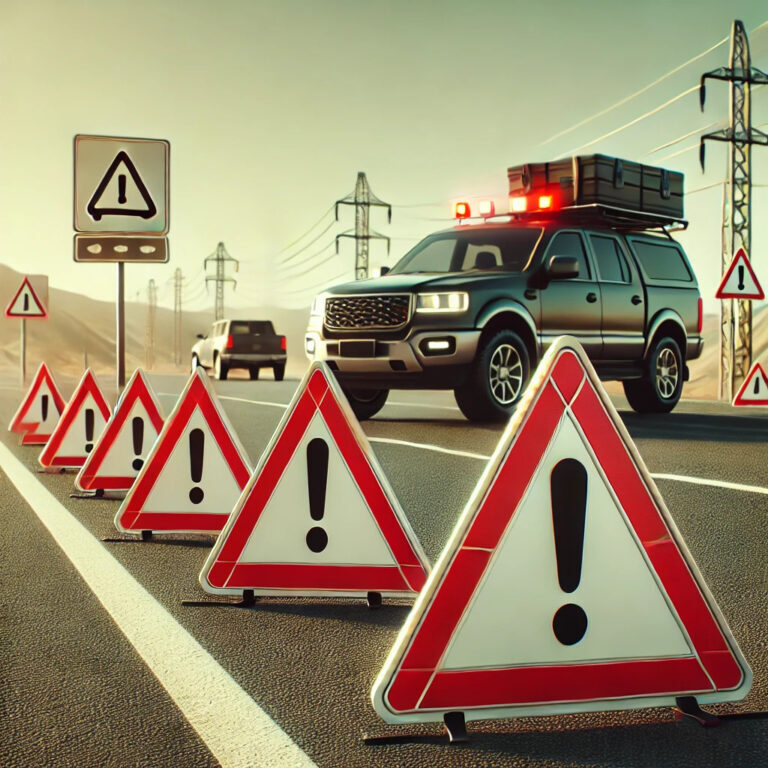
- Place the first triangle at least 50 meters behind the car on conventional roads.
- Place the second one in front, around the same distance, on two-way roads.
- On curves, walk further back until you can see the car clearly — that’s your real distance.
- Never place a triangle on a motorway if you can avoid it.
- Check the reflective surface every few months. Faded triangles are dead weight.
And wear the reflective vest before you get out of the car. Not after. Not while you’re looking for it in the trunk. Before.
Fines, Points, and the Real Cost of Getting It Wrong
In Spain, not using the warning triangle or the V-16 correctly can cost you up to 200 euros. In France, the fine is 135 euros. In the UK you won’t be fined directly, but if your poor placement contributes to an accident, you’re looking at liability and possibly a careless driving charge.
The bigger cost is obvious. A triangle placed 10 meters behind a car on a dark road is a decoration, not a warning. It gives the driver behind you about half a second of notice. That’s not enough to do anything except brace.
The legal distance for warning triangles exists because someone, somewhere, died learning that 50 meters is the point where a normal driver at normal speed has a fighting chance. Treat it as a floor, not a ceiling.
What About the V-16 Beacon Replacing Triangles?
Spain is phasing out physical triangles. From January 2026, all vehicles registered in Spain must carry a connected V-16 beacon instead. It sits on the roof, emits a 360-degree amber flash visible from over a kilometer, and doesn’t require you to walk anywhere near traffic.
Other countries are watching. The logic is simple: a triangle forces you to stand on the road. A beacon doesn’t. If your car was registered before 2026, you can still use triangles, but honestly, get the beacon. It’s the difference between warning people and becoming part of the accident.
Quick Answers People Actually Search For
How far behind the car should a warning triangle go?
At least 50 meters on conventional roads. Further on curves, hills, or anywhere visibility is limited. On motorways, don’t place it at all if you can avoid it.
Can I place the triangle in front of the car?
Only on two-way roads, and only as a second triangle. Never as your only one. The rear triangle is the one that saves you from being rear-ended.
Do I need one or two triangles?
Legally, you must carry two. In practice, use both on two-way roads. On one-way roads, one behind is enough.
Are triangles visible at night?
Yes, if the reflective surface is clean and intact. If it’s dirty or cracked, it’s barely visible. Replace it.
Can I use something else if I don’t have a triangle?
No. Hazard lights alone aren’t a substitute in most countries. If you’re stuck without a triangle, get behind the barrier and call for help.
The honest takeaway: the distance on the box is a starting point. Your eyes, the road, and the speed of traffic decide the real number. If you’re not sure, go further back. Nobody ever got hurt because a triangle was too visible.
