Post actualizado el día octubre 27, 2026 by DeiviSanzPlay
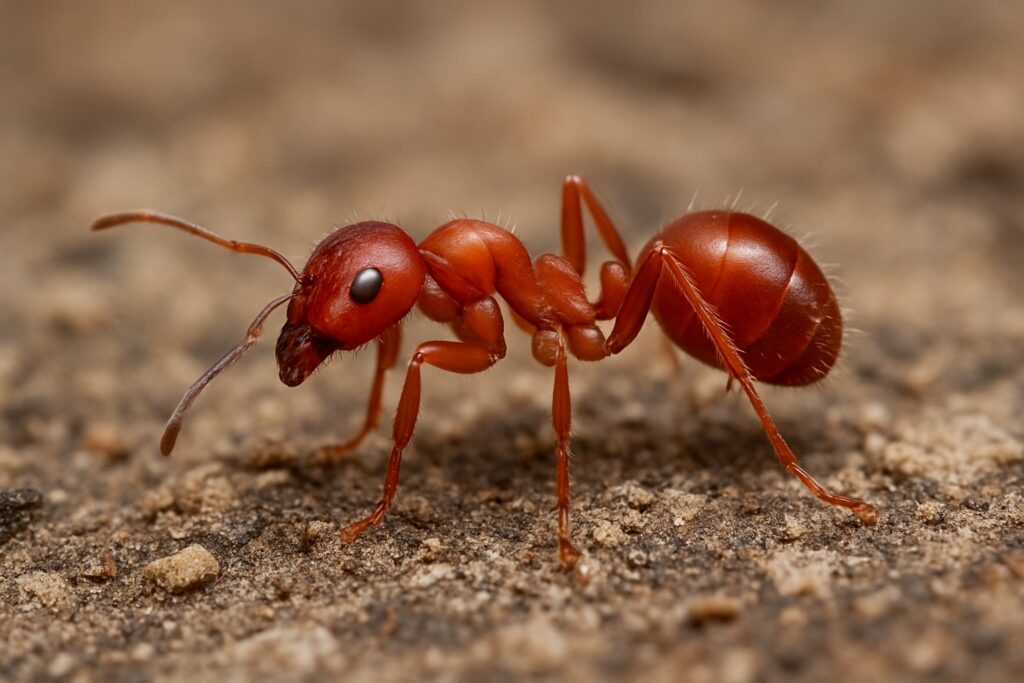
You see a line of tiny reddish ants crossing the sidewalk and you think, «whatever, they’re just ants.» Big mistake. The red fire ant (Solenopsis invicta) is one of the most aggressive invasive species on the planet, and in 2026 it’s already established across large parts of Spain, the southern US, Australia and parts of Asia. A single sting can land you in the ER. This isn’t a B-movie monster — it’s a real pest that bites, stings, and won’t let go.
I’m not exaggerating. The venom of fire ants is called solenopsin, an alkaloid that triggers a burning sensation so intense it feels like someone’s holding a lit match on your skin. Within 24 hours, a sterile pustule forms. If you’re allergic, you can go into anaphylactic shock. That’s when the afternoon in the garden turns into a hospital visit.
What Actually Makes Fire Ants Dangerous
Fire ants don’t just bite. They grab your skin with their mandibles and then sting repeatedly, rotating around the bite point. One ant can sting multiple times. And they don’t do it alone: when one is disturbed, the whole colony attacks. This is what scientists call social immunity, and it’s the reason a single misstep near a mound can leave you with dozens of stings in seconds.
The Spanish Ministry of Agriculture (MAPA) has been tracking the spread of Solenopsis invicta since it was first detected near Marbella and Estepona. The colonies build mounds that can reach 40 cm high and house up to 250,000 workers. That’s not a pest — that’s a small army.
Why Fire Ants Are So Hard to Kill
Here’s the part most pest control guides skip: fire ants reproduce through polygyne colonies, meaning multiple queens in one nest. Kill one queen and the others keep laying. A single colony can produce 3,000 to 5,000 eggs per day. That’s why DIY sprays barely make a dent.
The USDA’s APHIS program has documented that fire ants spread through budding — a queen takes a group of workers and walks to a new spot nearby. So when you poison one mound, you often trigger the colony to split and establish three more. It’s a nightmare.
Effective Control Methods That Actually Work
- Boiling water: kills about 60% of a mound if poured slowly into the center. Cheap, but risky if you get splashed.
- Bait granules: slow-acting toxins like hydramethylnon or fipronil. Workers carry it to the queen. Takes 2-4 weeks but kills the colony.
- Professional treatment: two-step approach — broadcast bait plus individual mound drench. This is what MAPA recommends for confirmed infestations.
- Prevention: seal cracks, don’t leave pet food outside, and check soil bags before bringing them home.
«Fire ants are not a nuisance pest. They are a public health issue, an agricultural threat, and an ecological disruptor all in one.» — USDA APHIS report
What to Do If You Get Stung
First: get away from the area fast. Brush the ants off — don’t slap them, that triggers more stings. Wash with soap and water, apply ice, and take an antihistamine. Don’t pop the pustules; that’s how you get a secondary infection. If you feel dizzy, short of breath, or your throat tightens, call emergency services immediately. That’s anaphylaxis and it kills.
I’ve seen people shrug off fire ant stings and end up with cellulitis two days later. The venom itself is bad, but the bacterial infection from scratching is worse. If the redness spreads or you get a fever, go to a doctor.
Zombie Ants: The Fungus That Hijacks Their Brain
You’ve probably heard of zombie ants. It sounds like a Halloween joke, but it’s real. The fungus Ophiocordyceps unilateralis infects carpenter ants, takes over their nervous system, and forces them to climb to a specific height on a plant, bite into a leaf vein, and die. Then the fungus sprouts a stalk from the ant’s head and releases spores onto the colony below.
What’s wild is that the ant colony knows. Workers detect infected nestmates and carry them far away to die alone. Biologist David Hughes at Penn State has documented this behavior in detail. The fungus doesn’t just kill one ant — it manipulates the entire colony’s behavior to ensure its own survival.
Does that happen in humans? No. Ophiocordyceps is species-specific. But it does make you think about how much we still don’t understand about parasites and behavior.
Collective Intelligence: How Ants Think as One
There’s no boss in an ant colony. No general giving orders. Yet they build bridges with their own bodies, farm fungus, herd aphids, and wage wars. This is swarm intelligence — simple rules followed by thousands of individuals producing complex behavior.
Researchers at Stanford and the University of Bristol have shown that ant colonies can solve optimization problems that would stump some algorithms. They find the shortest path to food, allocate workers to different tasks, and even «vote» on new nest sites by physically carrying each other to candidates.
It’s humbling. A brain the size of a poppy seed, multiplied by a million, outperforms a lot of human systems. Maybe that’s why fire ants are so hard to eradicate. You’re not fighting insects. You’re fighting a distributed intelligence that adapts faster than you can spray.
The Bottom Line for 2026
If you live in a fire ant zone — southern Spain, the Gulf Coast, California, Australia — you need to take this seriously. Check your garden, your kids’ play areas, and your pet’s food bowls. If you see mounds, don’t stomp them. Call a professional. And if you get stung and feel anything beyond local pain, get medical help. Fast.
These little ants aren’t just a nuisance. They’re a reminder that nature doesn’t care about your weekend plans. And sometimes the smallest things pack the hardest punch.