Post actualizado el día octubre 24, 2026 by DeiviSanzPlay
Hanging a picture isn’t about hammering a nail and praying it comes out straight. It’s a design decision that can ruin or elevate a room in a matter of seconds. And I’ll tell you straight: most people get it terribly wrong. They buy what matches the sofa, not what moves something inside them. Mistake.
Decorative pictures are much more than an ornament: they’re the visual thermometer of your home. They set the focal point, direct the eye, and say who you are without you opening your mouth. If you get it right, people walk in and stare at the wall. If you get it wrong, that picture becomes just another piece of furniture no one remembers.
What makes a picture truly stand out (and not go unnoticed)
The key isn’t the price or the artist’s signature. It’s the relationship between the work, the wall, and the light. A decorative picture shines when its palette converses with the room and when its scale respects the architecture of the space.
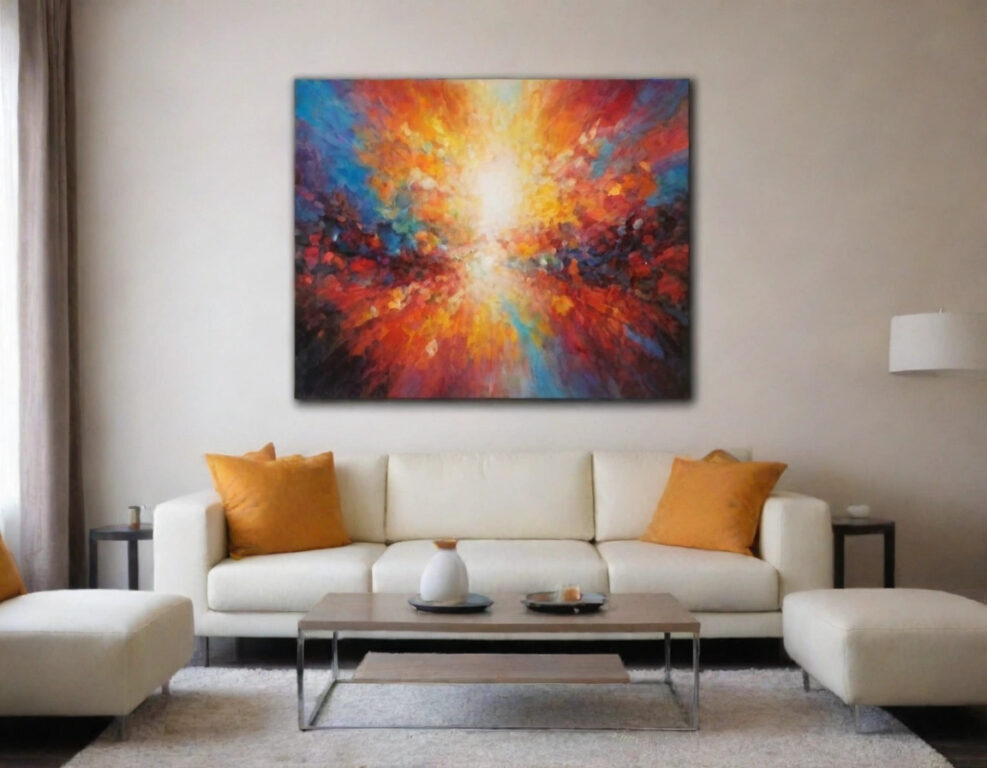
I’ve seen 40-euro canvases transform a bland living room and outrageously expensive oils end up looking like a badly placed patch. The difference: proportion and placement. A picture at 60-75% of the width of the furniture below it usually works. No more, no less.
Art doesn’t decorate: it organizes. If you don’t know what to look at first when you enter a room, the picture isn’t doing its job.
Another detail almost no one calculates: height. The center of the picture should be about 145-150 cm from the floor. That’s a person’s average sightline. If you hang it higher, it seems to float; lower, it seems about to fall.
Picture styles: from classic to abstract without falling into disaster
Choosing a style is choosing an emotional tone. Classic pictures—portraits, still lifes, realistic landscapes—bring weight, tradition, and a sense of permanence that works very well in offices and formal entryways.
Modern styles, on the other hand, play a different game. Impressionism captures light and movement; cubism breaks form; abstract minimalism reduces everything to color and geometry. And here’s my unfiltered opinion: in small, bright apartments, a well-chosen abstract almost always beats an overdone landscape.
Urban and conceptual art have made a strong entrance into domestic interiors. They’re not just for galleries. A graffiti-style canvas can be the perfect counterpoint in a Nordic living room. The important thing is that the picture’s style doesn’t compete with the rest of the decor: that it adds, not shouts.
How to choose the perfect picture for your space: a no-nonsense guide
Before buying, ask yourself three questions. What atmosphere do you want to create, how much space do you have, and what colors dominate the room. With those answers, half the options eliminate themselves.
- Atmosphere: if you’re after calm, go for cool tones and clean compositions; if you want energy, dive into saturated colors and dynamic strokes.
- Size: measure the wall and the furniture. A picture that’s too small on a large wall gets lost; a giant one in a narrow hallway is overwhelming.
- Color: it doesn’t have to match 100%. A picture that repeats just one tone from the room already creates cohesion. Sometimes controlled contrast is better than total harmony.
- Personal style: if you’re torn between two, choose the one that makes you stop and look at it. That one is yours.
- Theme: a picture with a personal story—a trip, a city, a memory—stands the test of time better than an Instagram trend.
And experiment with the arrangement. A gallery of several small pictures can fill a wall better than just one. The rule: leave 5 to 8 cm between frames so they can breathe.
Large pictures for spacious areas: when size matters
In high-ceilinged living rooms or lobbies, a large picture isn’t a luxury: it’s a necessity. Without it, the wall swallows the space and everything feels temporary.
Large pictures dominate visually, amplify details, and create depth. A large-format work can simulate the wall opening onto another landscape. That said, don’t hang it alone: pair it with good lighting. An adjustable spotlight or warm side light completely changes how the picture is perceived.
In spacious areas, the typical mistake is hanging several small works spread out like stamps. Better a single large piece with presence or an intentional composition. Less is more when the wall is enormous.
Minimalism and abstract art: the pairing that never fails in 2026
Minimalism with abstract art pictures remains the safe bet for contemporary interiors. Simple shapes, reduced palettes, and plenty of white space. The result: effortless elegance and a sense of order that spreads to the whole room.
Abstract art doesn’t require understanding anything. It requires feeling. That’s why it works so well in bedrooms, home offices, and transitional areas. It doesn’t distract, but it’s there. And when you look at it twice, you discover something new.
If you’re going to hang an abstract, take care with the lighting: diffused light prevents reflections and enhances textures. And don’t put it facing a window with direct sun, because in two years the pigments will fade.
Mistakes I see every day when decorating with pictures (and how to avoid them)
One: hanging everything at the same height without thinking about the furniture. Two: filling the wall with identical frames holding tiny photos. Three: choosing by trend rather than connection. Four: ignoring cables and power outlets, which end up peeking out from behind the frame.
Before drilling, make a paper template with the picture’s measurements and stick it to the wall with tape. Live with it for a couple of days. If it doesn’t bother you, go ahead. This trick prevents 90% of regrets.
And if you’re not sure about the style, start with a small piece in a low-commitment corner. Decorative pictures are cumulative: once you get one right, the rest of the wall asks for more.
Where to buy decorative pictures with good judgment
Today you have everything from museum-quality printed prints to original canvases by emerging artists. Online stores let you filter by size, style, and palette, something that’s harder in a physical store.
My advice: if the budget is tight, invest in the frame. A good frame with a mat transforms a cheap print into a piece that looks expensive. And if the budget allows, buy original work. You support artists and you have something unique.
In the end, decorating with pictures is an exercise in honesty. The wall doesn’t lie. If you choose what you truly like, the space notices. And so does anyone who visits.