Post actualizado el día octubre 26, 2026 by DeiviSanzPlay
If you’ve ever watched a crocodile lying still on a riverbank and thought, «that thing sleeps more than my cat,» you’re onto something. But the real answer to how many hours does a crocodile sleep a day is way weirder than a simple number. These reptiles don’t clock out for eight solid hours like we do. An adult croc racks up between 8 and 12 hours of rest in a 24-hour cycle, but it’s chopped into fragments, scattered across day and night, and always with one foot (or rather, one brain half) on the gas pedal.
I’ve dug into studies on crocodilian sleep, including research from the Max Planck Institute and the University of Tokyo on unihemispheric sleep, and the picture is clear: crocodiles are the ultimate light sleepers. They never fully surrender. That’s not laziness, it’s survival engineering.
Crocodile sleep cycle: fragmented, light, and always half-awake
Unlike mammals, crocs don’t have a single long REM-heavy block. Their crocodile sleep cycle is broken into short bouts of rest alternating with alert pauses. A croc might doze for 20 minutes, pop its eyes open, scan the water, then drift off again.
This pattern explains why they can react in milliseconds if something touches the water surface. If you’ve ever tried to sneak up on a basking crocodile, you know: it’s gone before you take a second step. That’s not magic, that’s a sleep architecture built for ambush predators living in predator-rich waters.
Here’s a nuance most articles miss: juvenile crocs sleep more than adults. Young ones rest up to 14 hours in captivity when safe, while big territorial males often cut down to 6-8 hours during mating season. So the «8 to 12 hours» figure is an average, not a rule.
Do crocodiles sleep in the water? Yes, and that changes everything
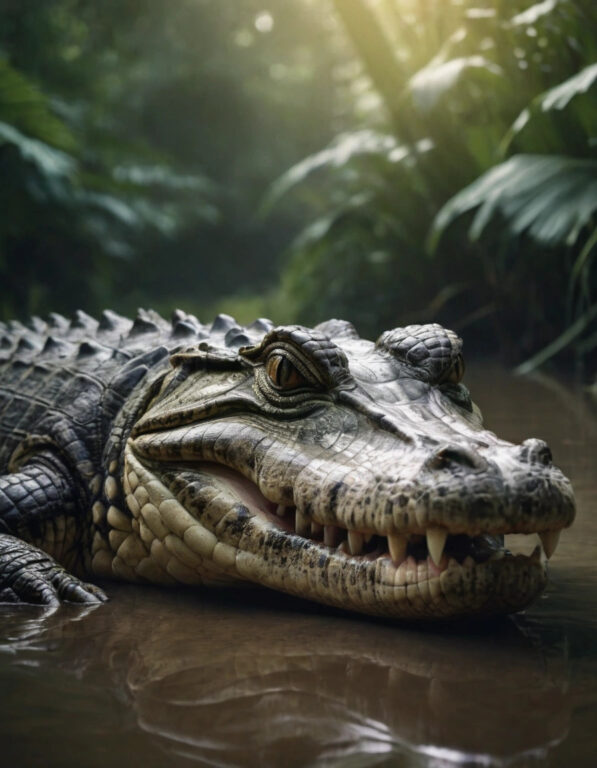
This is the part that blows people’s minds. Crocodiles don’t need dry land to rest. They can float motionless at the surface with just nostrils and eyes above water, a posture called «logging.» Their heart rate drops, their metabolism slows, and they stay there for hours.
So do crocodiles sleep in the water? Absolutely. They’ll rest partially submerged near shorelines, in mangroves, or even in open water if they feel secure. The water gives them buoyancy, temperature control, and a 360-degree threat detector: any ripple betrays a nearby animal.
On land, they prefer shaded banks, sandbars, or floating vegetation mats. But here’s the thing, they rarely choose a spot without an escape route to water. A crocodile that feels cornered on dry land is a crocodile that fights. And you don’t want to be the reason it feels cornered.
One eye open: the real superpower behind crocodile sleep
You’ve probably heard that crocs sleep with one eye open. It’s true, and it’s not a metaphor. Research published in the Journal of Experimental Biology confirmed that crocodiles can keep one brain hemisphere active while the other rests. This is called unihemispheric slow-wave sleep.
They even position the open eye toward whatever they consider a threat. In experiments, crocs kept the eye facing a human observer open while the other eye stayed shut. That’s not random, that’s targeted vigilance.
Only a handful of animals pull this off: dolphins, some birds, and crocodilians. It’s a rare evolutionary trick that lets them rest without ever being truly off-duty.
Circadian rhythm: why temperature dictates when they crash
Crocodiles are ectotherms. Their body temperature, digestion, and energy levels depend on the environment. That’s why their circadian rhythm is less about internal clocks and more about the sun.
On a cool morning, you’ll see them basking with mouths open, soaking up heat. As the day heats up, they retreat to water or shade to avoid overheating. In hot regions, they’re often more active at dusk and night, when temperatures drop and prey is easier to ambush.
So the answer to «when do crocodiles sleep» depends on where they live. A croc in Costa Rica might nap midday in the shade. A croc in the Northern Territory of Australia might hunt at night and rest in the morning. Flexibility is the name of the game.
How crocodile sleep compares to mammals (and why it matters)
Mammals cycle through deep slow-wave sleep and REM. Crocs have slow-wave sleep, but their REM-like states are shorter and less frequent. They also wake up faster. A human takes seconds to fully rouse from deep sleep. A crocodile can go from resting to lunging in under 100 milliseconds.
That difference is the whole point. Mammals trade alertness for deep recovery. Crocodiles trade deep recovery for constant readiness. Neither is «better,» they’re just tuned to different survival pressures.
There’s also a myth worth killing: crocodiles do not sleep standing up with their mouths open for hours like statues. That’s basking, not sleeping. They’re regulating temperature, not dreaming.
Quick facts about crocodile sleep you can drop in conversation
- Total daily rest: 8 to 12 hours on average, fragmented.
- Sleep in water: Yes, often floating with only eyes and nostrils exposed.
- One-eye-open sleep: Confirmed by science, linked to unihemispheric sleep.
- Juveniles vs adults: Young crocs sleep more, dominant males less during breeding season.
- No true hibernation: They slow down in cold months but don’t hibernate like bears.
If you ever get the chance to watch a crocodile in the wild, pay attention to its eyes. You’ll see the flicker, one eye tracking you while the rest of the body looks completely comatose. That’s millions of years of evolution compressed into a single glance.