Post actualizado el día octubre 17, 2026 by DeiviSanzPlay
Forget the postcard version of the solar system. Yes, Saturn has rings and Mars is red, but the real weirdness starts once you leave the neighborhood. In 2026 we’ve confirmed over 5,800 exoplanets, and the planets of the universe are far stranger than anything sci-fi dared to imagine a decade ago.
I’m not going to pretend every discovery is a potential home for humanity. Most of them are hellscapes. But that’s exactly why they matter: they show us how planets actually form, and how lucky we are that Earth sits where it does.
Exoplanets where it literally rains glass
HD 189733b is the poster child for hostile worlds. It’s a gas giant orbiting so close to its star that its atmosphere hits around 1,000°C. Winds tear through it at roughly 8,700 km/h, and silicate particles condense into glass droplets that fly sideways.
That’s not a metaphor cooked up for clicks. NASA’s Hubble and Spitzer data back it up. When people ask about the planets of the universe that sound fake, this one is always my first answer.
Then you’ve got 55 Cancri e, often called the «diamond planet.» It’s a super-Earth roughly twice our size, rich in carbon, with pressures so extreme that carbon could crystallize into diamond layers. Is it a literal gemstone floating in space? Not exactly. But it’s probably the closest thing we’ve found.
Gas giants: the atmospheric monsters of the cosmos
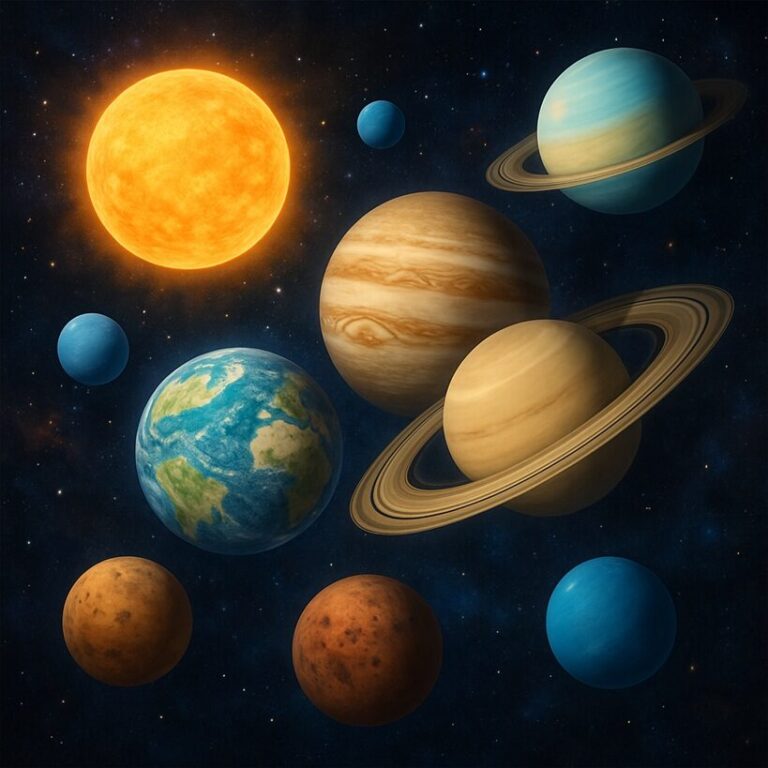
Jupiter is the blueprint. Its Great Red Spot has been churning for at least 190 years (some estimates push it to 350), and it’s wide enough to swallow Earth whole. That storm is a reminder that gas giants aren’t just big planets — they’re weather systems with gravity that dictates the fate of everything nearby.
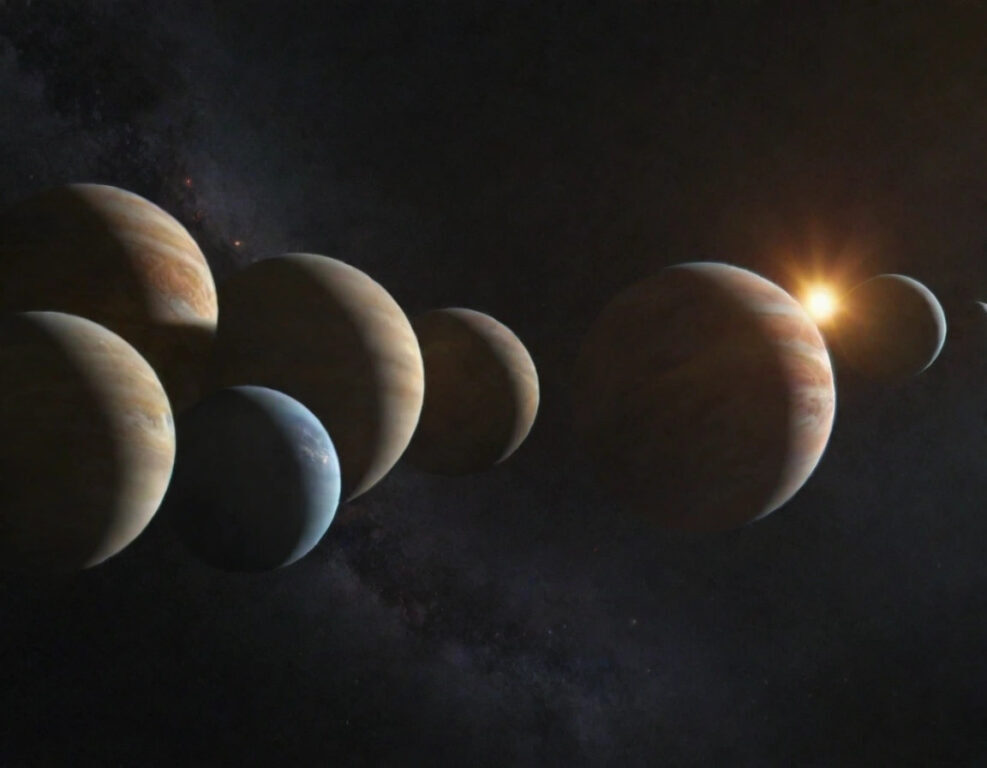
Outside our system, hot Jupiters are a different beast. They orbit their stars in days, not years, and their atmospheres get stripped away by stellar radiation. Some are so puffy they’d float in water if you had a bathtub big enough.
Neptune, by contrast, is the quiet-looking one with the electric blue methane haze. Winds there hit 2,100 km/h — the fastest in the solar system. Looks calm in photos. Isn’t.
Rogue planets: the loners drifting in total darkness
Here’s the part that messes with your head: there are planets that don’t orbit any star at all. They’re called rogue planets, and astronomers estimate there could be billions of them just in the Milky Way.
Some got kicked out of their original systems by gravitational chaos. Others may have formed alone, like failed stars. Either way, they wander through interstellar space at near-freezing temperatures, with no sunrise, no seasons, no sky.
Roman Microlensing surveys, launching later this decade, are expected to find thousands more. The planets of the universe don’t need a sun to exist. They just need mass and time.
Super-Earths and the habitable zone trap
Kepler-186f was a big deal when it was confirmed: roughly Earth-sized, sitting in its star’s habitable zone. That’s where liquid water could exist. Notice the word «could.»
The habitable zone isn’t a guarantee. Venus sits in our Sun’s habitable zone and it’s a 460°C pressure cooker. So when headlines scream «Earth 2.0,» I roll my eyes. We don’t know if these planets have atmospheres, magnetic fields, or plate tectonics — the stuff that actually keeps a world livable.
TRAPPIST-1 is the best current laboratory. Seven rocky planets, three in the habitable zone, all packed tight around a red dwarf. JWST is already sniffing their atmospheres. If any of them has water vapor, we’ll know within a few years.
Why this matters more than another telescope selfie
Every new planet class we find — lava worlds, ice giants, puffy Jupiters, rogue drifters — sharpens our models of how solar systems form. That knowledge feeds back into climate science, planetary geology, and the search for biosignatures.
And yes, it also humbles us. Earth isn’t the template. It’s one data point. The planets of the universe come in shapes and behaviors we didn’t anticipate, and pretending we’ve got it figured out is the least scientific attitude possible.
The next decade of surveys — PLATO, Roman, the Extremely Large Telescope — will likely double the exoplanet catalog. Somewhere in that data there’s probably a world with liquid water, a stable atmosphere, and a sky someone could actually stand under. We just haven’t found it yet.