Post actualizado el día octubre 27, 2026 by DeiviSanzPlay
So there’s this thing that keeps popping up every couple of years: some supposedly leaked version of the Coca-Cola recipe. And in 2026, people are still asking about it. The most famous leak came from the radio show This American Life back in 2011. They claimed to have found a handwritten copy of the original formula, published in an Atlanta newspaper in 1979. Coca-Cola never confirmed it, obviously. But insiders say it’s close. Close enough to be interesting.
What the 1979 Leak Actually Says About the Coca-Cola Formula
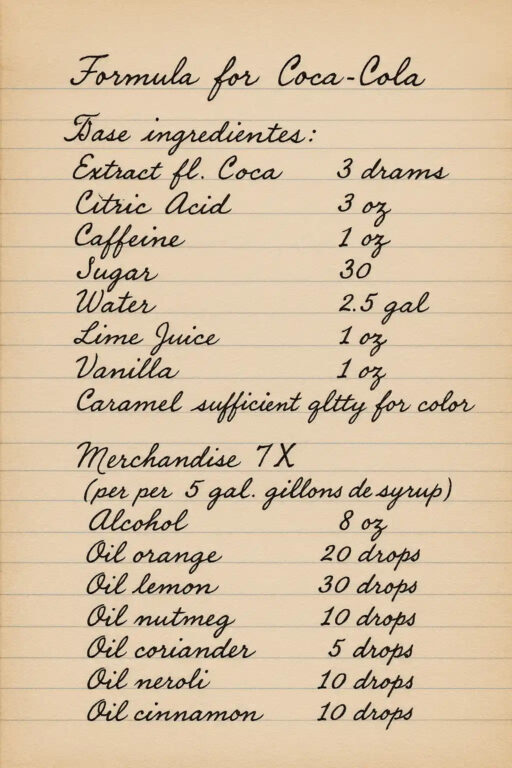
Let’s cut the fluff. Here’s the base recipe as published in that old Atlanta paper. It’s messy, imprecise, and very much a product of its time.
- Fluid extract of coca: 3 drams (1 dram is roughly 3.9 grams)
- Citric acid: 3 ounces
- Caffeine: 1 ounce
- Sugar: 30 (no unit given, but almost certainly pounds)
- Water: 2.5 gallons
- Lime juice: 1 ounce
- Vanilla: 1 ounce
- Caramel: enough to get that dark color
Notice something? There’s no exact measurement for sugar. No temperature. No timing. That’s not a real production formula — it’s a sketch. And that’s exactly why Coca-Cola’s legal team probably laughed it off.
The Secret Sauce: Merchandise 7X
Here’s where the Coca-Cola formula gets its soul. The famous «Merchandise 7X» is the aromatic base. According to the leak, for every 5 gallons of syrup, you’d mix these oils into alcohol:
- Alcohol: 8 ounces
- Orange oil: 20 drops
- Lemon oil: 30 drops
- Nutmeg oil: 10 drops
- Coriander oil: 5 drops
- Neroli oil (orange blossom): 10 drops
- Cinnamon oil: 10 drops
You let that emulsify. That’s your secret weapon. And honestly? If you’ve ever smelled those oils together, you’d recognize it instantly. It’s citrus-forward with a warm spice underneath. That’s the Coca-Cola formula’s fingerprint.
Why the Cocaine Thing Is a Red Herring
Yes, the original coca extract contained cocaine. In tiny doses. But that was gone by the early 20th century. Today, Coca-Cola uses decocainized coca leaves processed by a DEA-authorized company in the U.S. So no, your Coke isn’t laced with anything. That’s a myth that needs to die.
What matters more is that the coca leaf extract still provides a subtle bitterness. It’s not just about the cocaine. It’s about the flavor profile. And that’s something most copycat recipes miss.
Can You Actually Make This at Home?
Technically, yes. Practically, no. Here’s why.
First, you can’t buy fluid extract of coca. Not legally, not easily. Second, those essential oils? Neroli oil alone costs a fortune. Third, the sugar quantity is a guess. You’re working blind.
But if you’re stubborn, you can approximate. Use a strong black tea for bitterness. Skip the coca. Use orange, lemon, cinnamon, and nutmeg oils in tiny amounts. Mix with a bit of alcohol. Add citric acid and caramel. You’ll get something that tastes like a cousin of Coke. Not the real thing. But close enough to impress your friends at a barbecue.
The Real Reason This Recipe Leaked
Let’s be honest: Coca-Cola has never confirmed this. And they never will. The company’s actual formula is stored in a vault in Atlanta. Only a handful of people know it. The 1979 version is probably a simplified version that someone wrote down from memory. Or a decoy. Or both.
But here’s the thing: it doesn’t matter. The Coca-Cola formula is a legend. People want to believe it’s knowable. That’s why this leak keeps circulating. It’s not about making Coke at home. It’s about feeling like you’re in on the secret.
What You Should Take Away
If you’re searching for the Coca-Cola recipe, you’ll find a dozen versions online. Most are garbage. The 1979 leak is the most credible one. But even that has holes. Use it as a starting point, not a gospel.
And if you try to make it, don’t expect perfection. Expect a fun experiment. Expect something that tastes like 1886. Or at least like a memory of it.
That’s the real value here. Not the exact formula. The chase.