Post actualizado el día octubre 25, 2026 by DeiviSanzPlay
The humpback whale is not just a big, beautiful animal. It is one of the strangest marine mammals in existence: it sings, leaps, migrates thousands of kilometers, and even changes its «dialect» depending on the area of the ocean where it lives. I’ll tell you straight, no frills.
If you have seen a video of a whale leaping entirely out of the water, it was almost certainly a humpback. That iconic image is just the tip of the iceberg. What this species does is far more interesting than the typical nature documentary.
What makes the humpback whale unique compared to other species
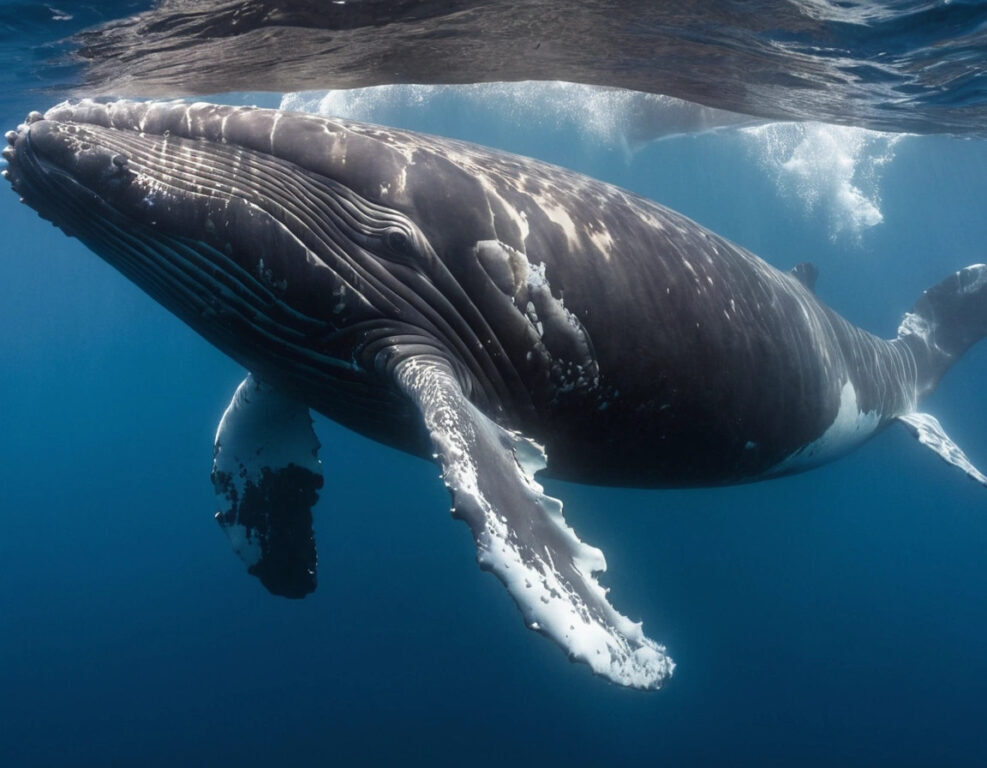
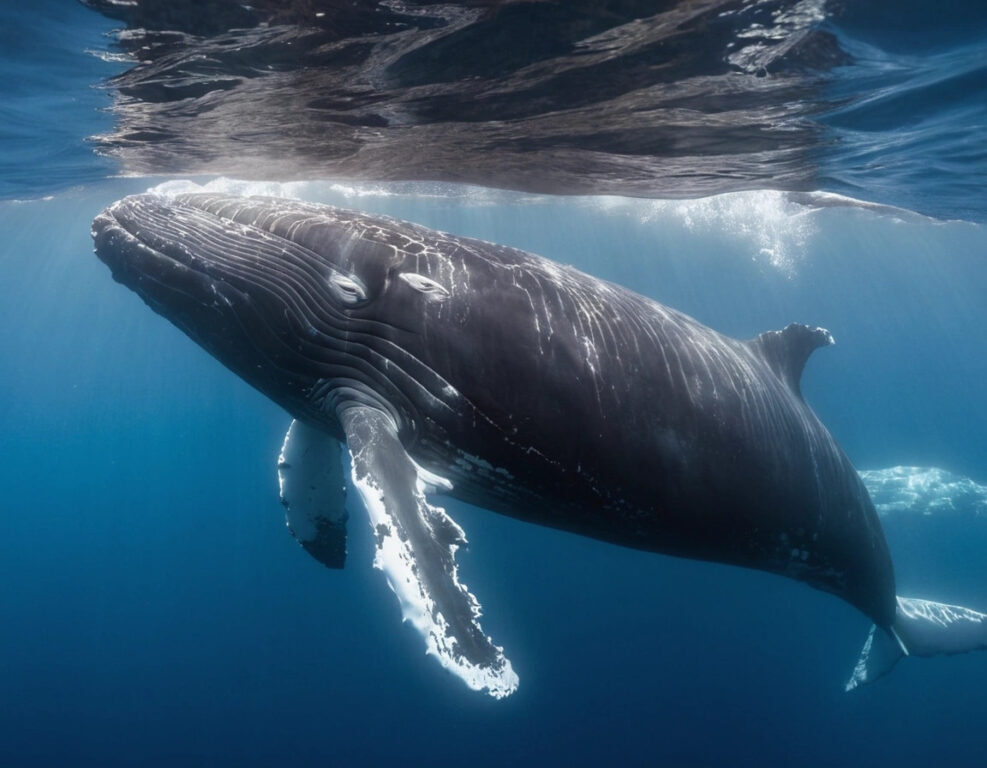
The characteristics of the humpback whale give it away at a glance: extremely long pectoral fins (up to a third of its body, the largest of any cetacean), a head with bumps called tubercles, and a tail with irregular edges that is unique to each individual, like a fingerprint.
It measures up to 16 meters and weighs around 30 tons. Nothing more. But what sets it apart from the rest is not its size, but its behavior. It is the only whale that combines acrobatic leaps, complex songs, and cooperative hunting with bubble nets.
Its scientific name is Megaptera novaeangliae, which means «great wing of New England.» And yes, that «great wing» refers to its pectoral fins. Whoever gave it that name was not exaggerating.
The humpback whale’s song: not just a pretty sound
Here’s where it gets interesting. Only males sing, and they do so during the breeding season. A complete song can last between 10 and 20 minutes, and it is repeated for hours. But what truly astonishes scientists is that all the males in the same region sing the same song, and that song changes over the years.
In other words, they have culture. It is not pure instinct. In 2022 it was documented that populations in the South Pacific learned new songs that arrived from Australia within two years. That is cultural transmission, not genetic.
The humpback whale’s song has not been fully deciphered, but it is believed to serve to attract females and to compete among males. What’s curious is that not all populations sing the same way: there are «dialects» that vary depending on the ocean.
Record migrations: up to 8,000 kilometers a year
Humpback whales make one of the longest migrations in the animal kingdom. They feed in cold waters, such as Antarctica, Alaska, or Norway, and breed in warm tropical waters, such as Hawaii, Mexico, or the Caribbean.
The documented record is more than 8,000 kilometers in a single direction. And they don’t do it in a straight line: they use spatial memory to remember routes and specific feeding areas. Some individuals return to exactly the same fjord year after year.
During migration they barely eat. They live off their fat reserves. When they arrive at the breeding grounds, many are practically fasting. It is a brutal toll they pay to reproduce in safe waters.
Bubble nets: team hunting as if they were sea wolves
The humpback whale does not hunt alone. In coordinated groups, several whales release bubbles forming a kind of cylindrical net around a school of fish. The fish concentrate in the center, and then the whales rise with their mouths wide open all at once.
This is called bubble-net feeding. It is a learned technique, not innate. In some populations it has been observed that each whale has a role: one makes the outer circle, another the inner one, another scares the fish. There is hierarchy and real cooperation.
They feed mainly on krill and small fish such as herring or mackerel. An adult can eat up to 1,500 kilos of food a day during the fattening season.
The ecological role that almost no one mentions
The ecological importance of the humpback whale goes far beyond being beautiful. By feeding at depth and defecating at the surface, it moves nutrients from the bottom up to the layer where there is sunlight. That fertilizes phytoplankton, which produces an enormous part of the oxygen we breathe.
When a humpback dies, its body falls to the bottom and becomes what is called a «whale fall.» A single carcass can feed an entire ecosystem for decades. It is an oasis of nutrients in abyssal zones where there is almost no food.
And it is no exaggeration: more than 400 different species have been documented living off the remains of a single whale. That is pure ecological impact.
Curiosities that change the way you see them
- Unique tail: the underside of the tail fin has a pattern of white and black spots that is unrepeatable. Scientists use them to identify individuals just like a fingerprint.
- Leaps of up to 3,000 kilos: an adult humpback can launch its entire body out of the water. It is not fully known why, but it is believed to be communication, play, or to get rid of parasites.
- Spyhopping: sometimes they poke only their head out of the water, which is called «spyhopping.» They are looking at what is happening on the surface.
- They don’t always migrate: some populations in the Red Sea or the Persian Gulf are residents all year round. Not all follow the classic pattern.
- Elephant memory: they remember routes and feeding areas for years, even after long periods without visiting them.
How many are left and why they are not out of danger
Commercial whaling decimated the species. It is estimated that before the 20th century there were about 125,000 individuals in the southern hemisphere. Today the global population is estimated at between 60,000 and 80,000, with critical subpopulations such as the one in the northwest Pacific, which does not reach 1,500 specimens.
Although many populations have recovered since the 1986 moratorium, the dangers for the humpback whale are still there: collisions with ships, fishing nets, acoustic pollution that interferes with their songs, and climate change, which affects the availability of krill.
In 2022, NOAA removed special protection for some humpback populations in the Pacific due to their recovery. But that does not mean they are safe. The Arabian subpopulation is still critically endangered and the northwest Pacific one is not recovering.
What we still don’t know
There are things science has not resolved. It is not known with certainty why they leap so much. It is not fully understood how they learn new songs. And it is not known exactly how long they live: it is estimated between 45 and 80 years, but there are records of individuals that exceed 90.
What is clear is that the humpback whale is much more than a spectacular animal. It is an ecosystem engineer, a cultural transmitter, and a thermometer of the ocean’s health. Protecting it is not an environmentalist whim: it is maintaining a gear that sustains marine life as we know it.