

- Protect local industries: By making foreign products more expensive, the purchase of domestic products is encouraged.
- Generate tax revenue: The government collects money that it can use for public works, education, etc.
- Regulate foreign trade: They control excessive imports or exports.
🌎 Real examples of tariffs
- Imported automobiles in Brazil pay high tariffs to promote the national automotive industry.
- Agricultural products in Europe are usually protected with tariffs to prevent the massive entry of cheaper food from other continents.
⚖️ Tariffs vs. Free trade
While tariffs seek to protect domestic markets, <a href="https://www.chusmeando.com/preguntas-y-respuestas/como-puedes-limpiar-tu-texana-en-casa-y-mantenerla-free-de-pelusa/” title=”Cómo puedes limpiar tu texana en casa y mantenerla libre de pelusa”>free trade seeks to eliminate these barriers to facilitate global exchange.
Treaties such as the USMCA, Mercosur, or the EU reduce or eliminate tariffs between member countries.
🧠 Conclusion:
In summary, tariffs are fiscal and economic tools that governments use to control foreign trade. They directly affect the prices of imported products and can influence our purchasing decisions without us even noticing.
Post actualizado el día September 27, 2026 by DeiviSanzPlay
Tariffs are taxes applied to products imported or exported between countries. If you have ever wondered what tariffs are, what they are for, and how they affect the economy or the price of products, in this article we explain it to you clearly, with easy-to-understand examples and without technical jargon.
I recommend you check out this interesting article: Pensions in Spain: a fundamental economic and social pillar.
🧾 What are tariffs?
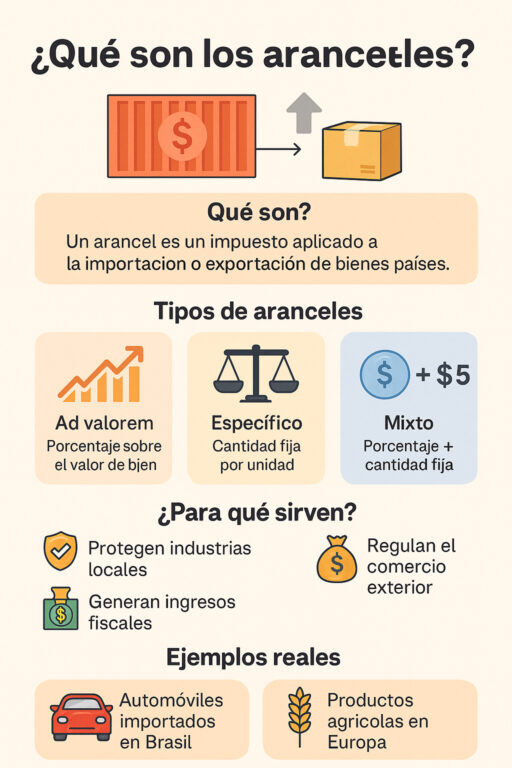
A tariff is a type of tax that a country charges on certain products when they enter (import) or leave (export) its territory.
Its main purpose is to regulate international trade, protect local production, and generate revenue for the State.
📦 Types of tariffs
- Ad valorem tariff: Calculated as a percentage of the product’s value.
Example: 10% on a $1,000 television = $100 tariff. - Specific tariff: A fixed amount is charged per unit.
Example: $5 per kilogram of imported rice. - Mixed tariff: Combines a percentage and a fixed amount.
Example: 5% + $3 per unit.
💡 What are tariffs for?
- Protect local industries: By making foreign products more expensive, the purchase of domestic products is encouraged.
- Generate tax revenue: The government collects money that it can use for public works, education, etc.
- Regulate foreign trade: They control excessive imports or exports.
🌎 Real examples of tariffs
- Imported automobiles in Brazil pay high tariffs to promote the national automotive industry.
- Agricultural products in Europe are usually protected with tariffs to prevent the massive entry of cheaper food from other continents.
⚖️ Tariffs vs. Free trade
While tariffs seek to protect domestic markets, <a href="https://www.chusmeando.com/preguntas-y-respuestas/como-puedes-limpiar-tu-texana-en-casa-y-mantenerla-free-de-pelusa/” title=”Cómo puedes limpiar tu texana en casa y mantenerla libre de pelusa”>free trade seeks to eliminate these barriers to facilitate global exchange.
Treaties such as the USMCA, Mercosur, or the EU reduce or eliminate tariffs between member countries.
🧠 Conclusion:
In summary, tariffs are fiscal and economic tools that governments use to control foreign trade. They directly affect the prices of imported products and can influence our purchasing decisions without us even noticing.