

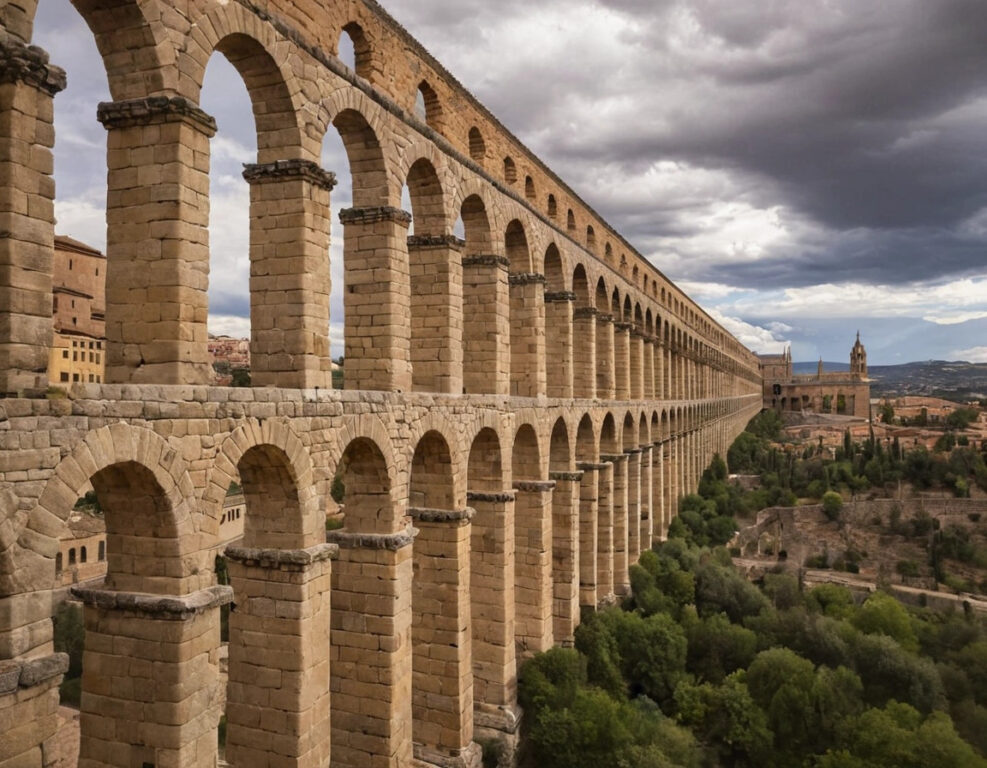
Post actualizado el día September 27, 2026 by DeiviSanzPlay
What is the Aqueduct of Segovia and what was its original purpose?
The Aqueduct of Segovia, built at some point in the 1st century AD, is one of the most outstanding examples of Roman civil engineering still preserved in Spain.
I recommend checking out this interesting article: Cómo un invernadero grande puede transformar tu enfoque hacia el cultivo si tienes espacio para su instalación.
This monumental work was designed to transport water from the Frío River, located about 15 kilometers from Segovia, to the city, crossing valleys and mountains.
The main purpose of the aqueduct was to provide fresh and clean water to the city of Segovia, vital for the daily sustenance of its inhabitants, as well as for sanitary and hygiene needs. Water was a crucial resource for urban development in the Roman Empire, and the aqueduct allowed Segovia to prosper, also facilitating the growth and expansion of the city.
How was the Aqueduct of Segovia built?
The construction of the Aqueduct of Segovia is a testament to the advancement in construction techniques and urban planning of the Romans. Using giant granite blocks without mortar, Roman engineers assembled this masterpiece with astonishing precision that has withstood the passage of time.
The design of the aqueduct features two rows of superimposed arches, with the lower level composed of larger arches to support the weight of the structure. This technique not only provided the structural strength necessary to hold the water channel at the top, but also maximized the efficiency of the water flow along its length of its route.
How did the Aqueduct of Segovia <a href="https://www.chusmeando.com/preguntas-y-respuestas/como-work-un-barco-a-vapor-desde-la-ciencia-detras-de-su-motor-hasta-el-impacto-global-de-esta-tecnologia/” title=”Cómo funcionaba un barco a vapor, desde la ciencia detrás de su motor hasta el impacto global de esta tecnología”>work to transport water?
The operation of the Aqueduct of Segovia was based on an ingenious yet simple principle: gravity. The aqueduct was meticulously inclined along its route, which allowed water to flow naturally from its source to the city. No pumps or equipment were needed; gravity did all the work.
The channel through which the water passed was lined with a type of waterproofing mortar to prevent leaks and ensure that the water reached its destination as efficiently as possible. Additionally, this design helped minimize the need for frequent maintenance and ensured the durability of the structure.
What has been the impact and legacy of the Aqueduct of Segovia?
The Aqueduct of Segovia is not only an architectural marvel, but also a cultural and technological legacy. It has influenced modern engineering, inspiring both in terms of design and functionality. Its construction demonstrated that it is possible to create durable and efficient structures without the need for advanced technologies, only with a deep understanding of natural principles and the proper use of available materials.
Today, the aqueduct not only provides invaluable historical context but has also been a pillar in the identity of Segovia, attracting tourists from all over the world and serving as a constant reminder of what human beings are capable of achieving with ingenuity and dedication.