
Post actualizado el día September 27, 2026 by DeiviSanzPlay
I have seen how a well-made paper plane flies, and it is not by chance. Almost all of us have done it at some point, but the ones that truly fly are another story. I got hooked when I saw one glide farther than I had ever imagined.
I am not going to give you those generic steps that you find anywhere. Paper, for example, is much more important than it seems. A standard 80-gram sheet is a good starting point, but if you try a thinner flyer sheet, sometimes it also works. Avoid thick cardboard, but that does not mean a slightly sturdier paper cannot surprise you if you adjust the weight.
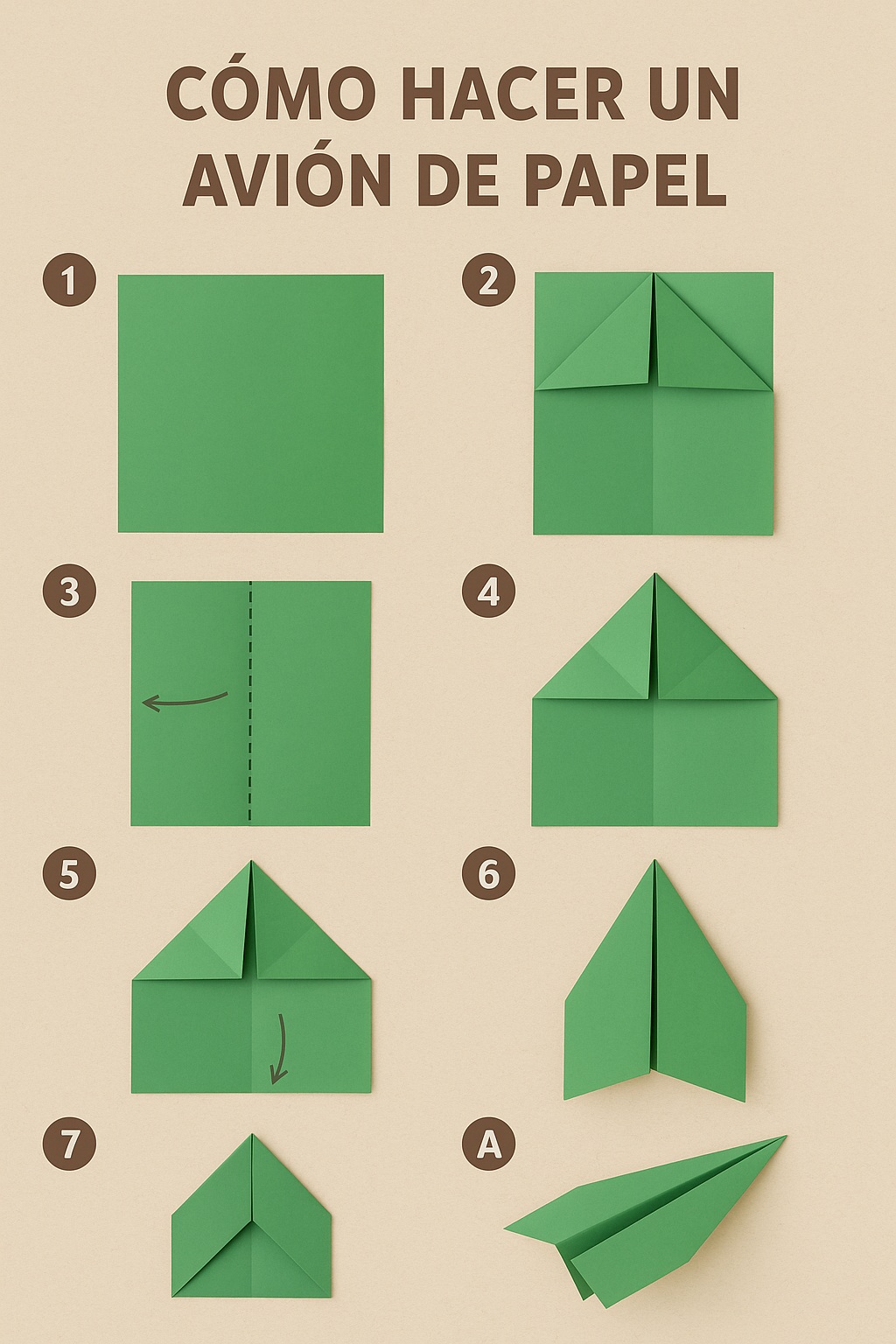
Precision in the folds is what separates a lopsided plane from one that cuts through the air. Folding and unfolding to crease better, even using a ruler for the edges, changes everything. And the most critical part: symmetry. If one wing ends up half a millimeter shorter or a fold is not identical, the plane will spin in a spiral down to the ground. You have to check it by turning it and looking at it from every angle.
The design that truly goes far
The classic sharp-nosed one is reliable, but it is not the only one. For pure distance, I have seen that designs with a slim body and wings that are not too wide tend to go faster and straighter. Sometimes, a small clip on the nose can save a plane that tends to lift up and slow down. It is a matter of trying: you attach it, you test it, and if it does not work, you take it off.
The final touch is in the elevators. Folding only the rear tip of the wings upward will make the plane descend. If you fold it slightly downward, it will gain altitude. And if you want it to turn, one up and one down, but with minimal adjustments, almost imperceptible.
Launching it is not just throwing
This is where many people ruin it. Force is not everything. For most, a firm but not violent throw, with the plane perfectly level or with a minimal upward tilt, is what works. If there is wind, playing with it is key: throwing against the wind can give a glider more lift, and with the wind, more speed.
The real trick is not settling for the first attempt. You make one, you throw it, you watch how it falls, you adjust an elevator, you try another launch angle. Sometimes a design simply does not work with that paper, and you have to start over with a clean sheet. That is the only way that, suddenly, one of them escapes from your hands and travels across the whole room, or crosses the yard in one go, as if it truly knew where it was going.