
Post actualizado el día September 27, 2026 by DeiviSanzPlay
Have you ever wondered what would happen if, from one moment to the next, the government military took control of everything? If the streets were patrolled by soldiers and the rules changed drastically overnight? That, my friend, is martial law, and although it sounds like a story taken from a science fiction movie, it is a reality that has happened in several countries and that, under certain circumstances, could be implemented in ours.
I recommend you check out this interesting article: What does the work life certificate include?.
Martial law is a state of exception where civilian power is relegated and the armed forces intervene directly in the administration and control of a territory. In short, it is when the army holds absolute authority and dictates new rules for the restoration of public order in situations of crisis.
Sounds intense, right? And it is. Under martial law, constitutional guarantees can be suspended, which means that rights such as freedom of expression, mobility, and privacy can be drastically restricted.
It is not something that happens for no reason. For a country to resort to martial law, extreme situations must arise, such as situations of national emergency, such as wars, invasions, or rebellions; catastrophic natural disasters that overwhelm the capacity of the civil government; crises of great social magnitude, such as riots or total chaos.
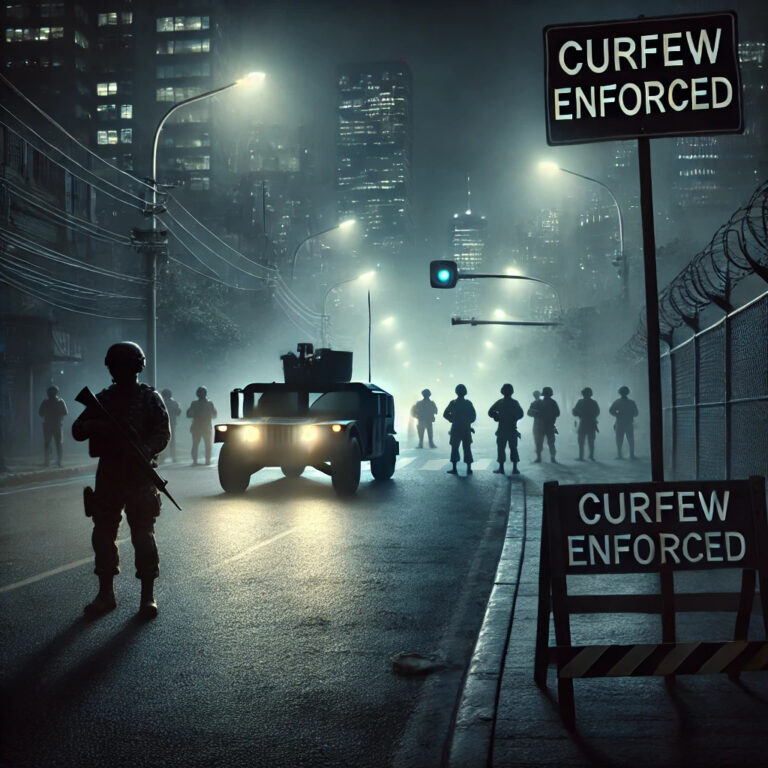
When martial law is activated, you could see in your city restrictions on freedom of movement, the imposition of curfews, and the suspension of constitutional rights. The justification is that, in moments of extreme crisis, order must be restored at all costs.
This is where things get tense. Imagine that one day you wake up and discover that you cannot leave your house after 8 p.m. because of the imposition of a curfew. All the news is controlled, and there are limitations on freedom of expression. The police are no longer the ones enforcing the laws, but rather the soldiers. You are prohibited from gathering in large groups or holding demonstrations. Certain civilian institutions stop operating because now everything is under military command.
The most unsettling thing is that, under martial law, military courts can replace civilian courts. In other words, if someone is arrested, they can be tried according to the application of military rules to civilians, which could mean harsher penalties and legal processes completely different from the usual ones.
Over the years, there have been multiple cases where martial law has been declared. Some of the best known include: the Philippines (1972-1981), when President Ferdinand Marcos imposed martial law alleging a communist threat. During that time, there was censorship, political persecution, and absolute state control. China (1989), during the Tiananmen Square protests, the military government took control and used military force to crush the demonstrations. United States (1863), during the Civil War, President Abraham Lincoln suspended some constitutional rights and there was intervention of the armed forces in certain states.
These cases show how martial law can become a dangerous tool if used for other purposes, such as perpetuating power or silencing the population.
It depends on who you ask. On the one hand, some will say that it is an extreme but necessary measure to restore public order in chaotic situations. On the other hand, many see it as a pretext for governments to abuse their power, cutting freedoms, and ruling with an iron fist.
While it is true that there are moments when a temporary suspension of civil institutions can be useful in extreme crises, it is also true that history has shown us how some leaders have used martial law to consolidate power and repress their citizens.
It is a question many people ask themselves. Although in theory, martial law would only be activated in scenarios of national emergency, the possibility is always latent. Can you imagine waking up one day and discovering that the world as you know it has completely changed? That decisions are no longer in the hands of politicians, but of generals and commanders.
The key is to stay informed and understand that martial law is not just a concept from dystopian movies, but a real tool that governments can use in extreme circumstances.
Now that you know what martial law entails, surely many questions come to mind. Is it something that could happen soon? How would it really affect us? The truth is that it is a measure that can drastically alter our lives. That is why staying informed and being critical of government decisions is more important than ever.
Martial law can bring security, but it can also bring abuse of power. And in a world where crises seem to be the order of the day, perhaps it is not so far-fetched to ask: are we prepared to face something like that?