Post actualizado el día octubre 25, 2026 by DeiviSanzPlay
If you’re thinking about bringing a giant poodle into your life, forget what you think you know. This isn’t the typical lapdog with a bow. It’s an animal that can exceed 60 cm in height and 30 kg in weight, bred to work in water and with an energy that will put you to the test. Here I’ll tell you what really matters, no frills.
What exactly is a giant poodle and why it’s not just a «large» poodle
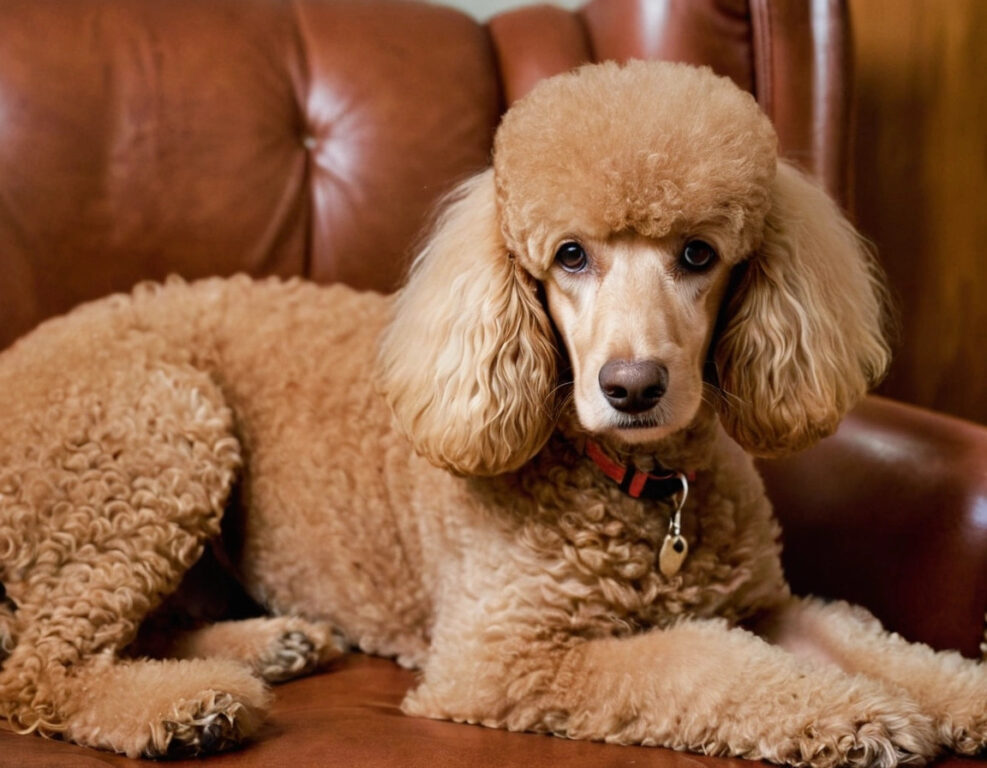
The giant poodle, or standard poodle, is the largest variety of the poodle breed. It’s not an inflated toy poodle or a dwarf on steroids: it’s a breed with its own standard, recognized by the FCI and the AKC. Its height at the withers ranges from 45 to 60 cm in males and somewhat less in females, with a weight that oscillates between 20 and 32 kg. That makes it a large-sized dog, not giant in the literal sense, but certainly imposing.
Its curly, woolly coat is no aesthetic whim. It’s designed to insulate it from the cold and protect it from water, which makes perfect sense when you discover its origin. We’re talking about a dog that was bred to dive into lakes and rivers to retrieve game, not to walk the runway.
A past as a water hunter that almost nobody knows about
Although the poodle is associated with France, its origin is in Germany. There it was known as Pudel, which comes from pudeln, to splash about. It was used as a water retriever: it retrieved waterfowl and worked alongside hunters in harsh conditions. That’s the reason for its dense, curly coat and its incredible swimming ability.
When it stopped being a working dog, it became a symbol of elegance in the French court. But underneath the fancy trim there’s still an athlete. If you treat it like an ornament, you’ll frustrate it.
Temperament: elite intelligence, but with nuances
The giant poodle is one of the smartest breeds that exists. It learns new commands in few repetitions and enjoys solving problems. That makes it an ideal dog for agility, obedience, tracking, or any discipline that involves working with its owner. But so much intelligence has a flip side: if you don’t give it mental stimulation, it gets bored and invents its own entertainment, which usually includes destroying something.
It’s affectionate, loyal, and protective of its family. With strangers it tends to be reserved, not aggressive. That makes it a good watchdog without the burden of aggression of other breeds. That said, it needs socialization from puppyhood so that this reserve doesn’t turn into shyness or reactivity.
Coat care: not a dog for lazy people
The giant poodle’s coat is beautiful, but it demands work. It must be brushed every two or three days to prevent knots, and taken to a dog groomer every 6-8 weeks if you want it to maintain a functional cut. You don’t need the show cut with pom-poms, but you do need regular maintenance.
A neglected coat isn’t just unattractive: it accumulates dirt, encourages skin infections, and can cause ear infections if the ear canal isn’t kept clean. Bathing should be with a shampoo specifically for curly hair, and always dry it well to prevent fungus.
Exercise: at least an hour a day, and the park alone won’t cut it
This dog needs to move. It’s not a miniature poodle that settles for a short walk. It needs at least an hour of physical activity a day, and if it can be more, even better. It loves to swim, so if you have access to a river, lake, or pool, you’ll make it happy.
Agility, canicross, or simply long walks with some obedience training mixed in also work well. The key is combining physical exercise with mental challenges. A tired giant poodle is a balanced giant poodle.
Feeding: quality protein and portion control
Due to its size and activity level, the giant poodle needs a diet rich in high-quality proteins and healthy fats. But be careful not to overdo it: it’s prone to overweight if fed more than it should be or if treats are overused. A large-breed kibble, adjusted to its age and exercise level, is usually the most practical option.
The vet should supervise the amount and type of food, especially in puppies and senior dogs. Excess weight aggravates joint problems like hip dysplasia, very common in large breeds.
Training: learns fast, gets bored fast
Training a giant poodle is rewarding because it responds very well. But don’t always repeat the same thing. It needs variety: a new trick today, a different route tomorrow, a scent game the day after. If you bore it, it disconnects and looks for its own distractions.
Positive reinforcement works much better than punishment. They’re dogs sensitive to tone of voice and their owner’s approval. With patience and consistency, you can teach it almost anything.
Health: what you should monitor closely
Hip dysplasia is the most common problem, followed by eye issues such as cataracts or progressive retinal atrophy. It can also suffer from gastric torsion, typical of large, deep-chested breeds. That’s why it’s advisable to divide food into several meals and avoid intense exercise right after eating.
Annual veterinary checkups are essential. The good news is that its life expectancy is notably long for its size: between 12 and 15 years. That means you’re adopting a long-term companion, not a whim for a few years.
Giant poodle vs. miniature and toy poodle: they’re not the same dog
Although they share a breed, the differences go beyond size. The giant poodle is calmer and more balanced than the toy or miniature, which tend to be more nervous and barky. The giant needs space and exercise; the toy can live in a small apartment with short walks.
If you’re looking for a dog for a family with children, the giant is a solid option if well socialized. It’s patient, playful, and protective. But don’t forget that its size can unintentionally frighten small children, so supervision is key.
Is it worth adopting a giant poodle in 2026?
If you’re willing to dedicate time, exercise, and care to it, it’s one of the best dogs you can have. Intelligent, loyal, healthy, and long-lived. But it’s not for everyone: it needs active owners, with patience and a willingness to work with it. If you’re looking for a decorative dog, this isn’t the one for you.
If the profile fits you, get ready for years of companionship, games, and the occasional challenge. Because a giant poodle isn’t just a big dog: it’s a companion with a capital C.