Post actualizado el día octubre 26, 2026 by DeiviSanzPlay
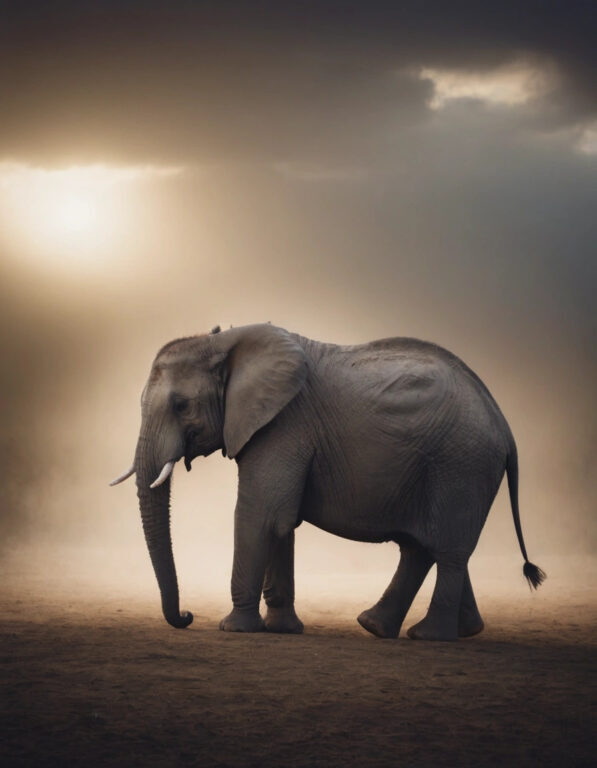
You think you know the elephant? That trunk alone packs over 40,000 muscles. Not 40. Not 400. Forty thousand. That’s more than the entire human body. If you’ve ever wondered how an elephant uses its trunk, the short answer is: for everything. It’s a nose, a hand, a straw, a trumpet, a shovel, and a social tool, all rolled into one fleshy appendage. And that’s just the start of the weird, brilliant biology of these animals.
The trunk is not just a nose—it’s a Swiss Army knife
Let’s kill the biggest myth right now: the elephant trunk isn’t a modified nose you can compare to a dog’s snout. It’s a fusion of the upper lip and the nose, elongated into a muscular hydrostat—same principle as your tongue, but scaled up to a 100-kilogram tool. Because it has no bones, it can bend, twist, curl, and even pinch with enough precision to pick up a single blade of grass.
Elephants use the trunk to eat, drink, breathe, smell, and communicate. They can suck up to 3 liters of water in one go, then blow it into their mouths. They can also use it as a snorkel when swimming—the trunk goes above the surface while the rest of the body stays submerged. That’s not a party trick; it’s survival in flooded rivers.
And the sense of smell? Off the charts. An elephant can detect water sources from miles away and even smell danger before it sees it. That’s why the elephant trunk function is so tightly linked to their intelligence—they’re constantly reading the world through it.
Those giant ears are air conditioners, not just for show
African elephants have ears shaped like the continent of Africa. Cute, but not the point. The point is thermoregulation. Elephants live in scorching climates, and their ears are packed with blood vessels. By flapping them, they create a breeze that cools the blood before it circulates back into the body. It’s a built-in radiator.
Asian elephants have smaller ears, which makes sense: they live in cooler, forested habitats. This is a textbook case of physical traits of the elephant adapting to environment. No fluff, just evolution doing its thing.
And here’s a detail most people miss: elephants can hear low-frequency rumbles through their feet. They pick up vibrations from the ground, which is how they communicate over kilometers without making a sound you or I could hear.
Social life: it’s a matriarchy, and it works
Elephant herds are led by the oldest female—the matriarch. She’s the one who remembers where the water holes are during drought, which paths are safe, and which lions are trouble. Males? They get kicked out when they hit puberty and either roam alone or form small bachelor groups. Not exactly a family sitcom, but it works.
The social behavior of the elephant is built on cooperation. They grieve their dead, they help injured herd members, and they even “greet” each other by touching trunks or entwining them like a handshake. If you’ve ever seen two elephants wrap trunks, that’s not a cute accident—it’s a deliberate social bond.
Elephants also have an exceptional memory. They remember individual humans, other elephants, and routes they haven’t taken in decades. That’s not sentimental nonsense; it’s a survival mechanism. In the wild, forgetting where water is means death.
African vs. Asian: two different beasts, same trunk genius
You can’t talk about elephant traits without drawing the line between African and Asian elephants. African elephants are bigger, have larger ears, and both sexes grow tusks. Asian elephants are smaller, only some males have tusks, and their heads have a double-dome shape.
But the trunk? Both species use it to dig for water, strip bark, and gather food from tall trees. The African elephant, in particular, is a landscape architect. It knocks down trees, creates paths, and digs water holes that other animals later use. That’s not random destruction—it’s ecosystem engineering.
Without elephants, savannas would turn into dense scrubland. They keep the grasslands open, which allows grazing animals to thrive. So when you ask what role the elephant plays in nature, the answer is: keystone species. Remove them, and the whole system collapses.
The brain behind the trunk
Elephants have the largest brain of any land animal—around 5 kilograms. But size isn’t everything; it’s the convolutions that matter. Their cortex is highly folded, similar to humans and dolphins. That’s why they can solve problems, use tools, and even recognize themselves in a mirror.
They can also mimic sounds. There’s a famous case of an elephant in Korea who learned to “speak” Korean words by putting his trunk in his mouth and modulating his breath. Weird? Yes. But it proves their vocal control is off the charts.
So next time you see an elephant at a zoo or on a safari, don’t just stare at the size. Watch the trunk. Watch how it moves, how it tests the air, how it touches the ground. That’s not an animal doing tricks—that’s a highly intelligent being navigating its world with a tool that puts our hands to shame.
And if you ever get the chance to see one up close, do it. You’ll never forget the way it looks at you. Not like prey. Not like a threat. More like it’s figuring you out. And it probably is.