

Post actualizado el día octubre 26, 2026 by DeiviSanzPlay
When you hear «sloth,» you probably picture a furry blob hanging upside down, barely moving. But calling them just lazy misses the point. Folivores, the scientific term for leaf-eaters, are a whole category of animals built around one of the toughest diets in the jungle: leaves. And sloths are the poster child for this strange, slow-motion survival strategy.
What exactly is a folivore? More than just a sloth
A folivore is any animal whose main food source is leaves. The word comes from Latin folium, meaning leaf. That’s it. It doesn’t describe behavior, size, or how cute you are. So while sloths are the most famous folivores, they’re not alone. Howler monkeys, koalas, gorillas, okapis, and even some rodents and insects are folivores. Each has its own twist on the same problem: leaves are everywhere, but they’re a nutritional nightmare.
Leaves are packed with cellulose, a tough fiber that most mammals can’t break down. They also contain toxic compounds that plants use to defend themselves. So folivores need special guts, special bacteria, and a lot of patience. Sloths have all three.
Why sloths take up to 30 days to digest a single meal
Here’s a number that blows people’s minds: a sloth can take up to 30 days to fully digest one meal of leaves. That’s not a typo. Their stomach has multiple chambers, like a cow’s, but way slower. A colony of symbiotic bacteria does the heavy lifting, fermenting the leaves little by little. The result? Very few calories extracted per bite.
That’s the reason sloths move so slowly. It’s not laziness. It’s economics. If your food gives you almost no energy, you can’t waste energy running around. Sloths have a metabolic rate roughly half of what you’d expect for their body size. They descend from the canopy maybe once a week to poop. Everything else is a masterclass in energy conservation.
Built for the trees: adaptations that make folivory work
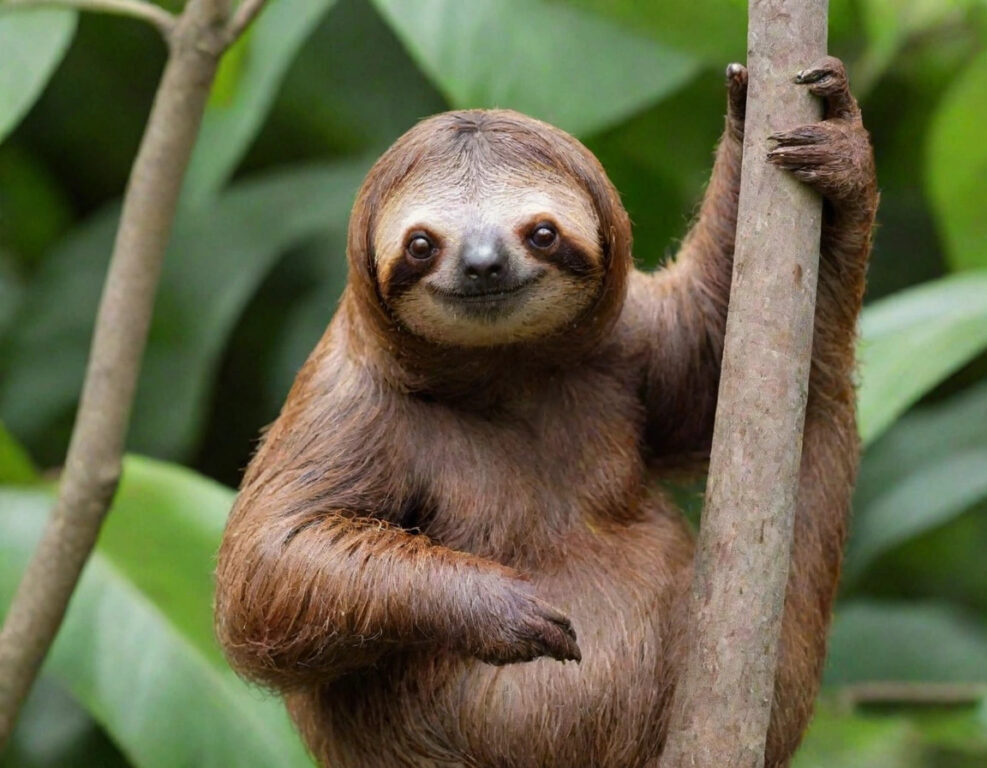
Sloths live in the tropical rainforests of Central and South America, and they almost never leave the trees. Their long, curved claws hook over branches like built-in carabiners. They can hang from a single limb for hours without muscle fatigue. Their fur grows from belly to back, so rainwater runs off. Even their neck vertebrae are extra flexible, letting them rotate their head 270 degrees to look around without moving their body.
But the real magic is internal. A sloth’s digestive system is a slow-cooker. The stomach can make up to a third of their body weight. They also have a low body temperature, which slows everything down even more. And they’ve got a trick: they lick their own fur to get extra nutrients from algae that grows there. That greenish tint isn’t dirt. It’s a snack.
Sloths vs. other folivores: koalas, monkeys, and the diet wars
Not all folivores are created equal. Koalas are picky eaters—they eat almost exclusively eucalyptus leaves, which are toxic to most animals. Sloths, on the other hand, eat a wider variety of leaves depending on the species. Three-toed sloths stick to a few tree species; two-toed sloths are more generalist. Howler monkeys are folivores too, but they supplement with fruit, which gives them more energy and lets them be louder and more social.
The key difference is metabolism. Sloths are the slowest of the slow. A howler monkey can leap between branches; a sloth would rather not. That’s not a flaw—it’s a niche. By being extremely efficient at processing low-quality food, sloths avoid competing with fruit-eaters. They thrive where others would starve.
How long do sloths live—and what’s killing them
In the wild, sloths can live 20 to 30 years. In captivity, some have reached 40. That’s a long time for a mammal that moves less than a mile a day. But their biggest threat isn’t old age. It’s us. Deforestation in the Amazon and Central America destroys their habitat. They also get hit by cars when they try to cross roads, and they’re poached for the illegal pet trade. Baby sloths are especially vulnerable.
Conservation efforts are patchy. Some sanctuaries rescue orphaned sloths and rehabilitate them. But the real fix is protecting rainforest. Sloths are a flagship species—if they disappear, it means the whole ecosystem is in trouble.
The ecological role of sloths: more than just slow movers
Sloths are ecosystem engineers in a quiet way. They eat leaves, which helps control vegetation growth. They poop in the same spot over and over, creating nutrient hotspots that fertilize trees. Their fur hosts algae, moths, and beetles. When they die, their bodies feed decomposers. Even their slow movement helps seed dispersal—seeds stuck to their fur get carried from tree to tree.
So next time you see a sloth, don’t call it lazy. Call it a specialist. A folivore that turned a terrible diet into a survival strategy. Leaves are low-energy, toxic, and hard to digest. Sloths made it work for millions of years. That’s not laziness. That’s genius.


