

Post actualizado el día octubre 26, 2026 by DeiviSanzPlay
Most people picture a hawk hunting over open fields, hovering like a kestrel. The goshawk bird of prey does the opposite. It hunts inside the woods, threading through branches at 40 mph, using the trees as cover instead of avoiding them. That alone makes it one of the most lethal raptors in the Northern Hemisphere, and one of the least understood.
The goshawk (Accipiter gentilis) is a short-winged, long-tailed hawk built for acceleration, not soaring. Birders call it the «phantom of the forest» because you usually hear it before you see it — or you just don’t see it at all.
What Exactly Is a Goshawk (Accipiter gentilis)?
The goshawk bird of prey is a medium-to-large accipiter, bigger and bulkier than a Cooper’s hawk or a sparrowhawk. Females are noticeably larger than males, a trait common in raptors called reversed sexual dimorphism. A big female can weigh over 1,100 grams and take prey as large as a hare or a grouse.
Its wings are short and rounded, its tail long and broad. That body plan is not a design flaw — it’s a trade-off. The goshawk gives up long-distance gliding speed for explosive bursts and sharp turns between trunks.
You’ll sometimes hear it called the «northern goshawk» to separate it from the crested goshawk of Asia or the grey goshawk of Australia. In Europe and North America, «goshawk» almost always means Accipiter gentilis.
Where Goshawks Live: Habitat and Distribution
The goshawk breeding range covers the temperate and boreal forests of Europe, across Russia and Asia, and through North America from Alaska down into the northern United States and Mexico’s mountain ranges.
Its habitat of choice is mature, dense woodland with a closed canopy and open understory — exactly the kind of forest where it can launch a surprise attack. It also nests in fragmented forests, forest edges, and sometimes even city parks in Europe, where it has adapted to hunt feral pigeons and corvids.
That urban shift tells you something important: this raptor is more adaptable than its «old-growth specialist» reputation suggests. In parts of Germany and the Netherlands, goshawk bird of prey pairs now breed in cities, using tall buildings and park trees as nesting platforms.
Behavior and Hunting Style: Low, Fast, and Brutal
Unlike buzzards or eagles that soar and scan, the goshawk hunts from a perch or a short patrol flight just above the canopy. When it spots prey, it drops into the trees and chases it on the wing.
The goshawk bird of prey relies on a burst of speed, a long tail for steering, and short wings that let it dodge branches without losing momentum. It doesn’t glide — it sprints.
Typical prey includes:
- Birds: pigeons, crows, jays, woodpeckers, grouse, ducks
- Mammals: squirrels, rabbits, hares, young foxes, even small deer fawns in rare cases
- Reptiles and insects: occasional, mostly by juveniles
Females take the big prey, males take smaller birds. That size split reduces competition inside a pair and lets both birds hunt the same territory without starving each other.
The «Scourge of Prey»: Catching Birds in Mid-Air
The goshawk’s signature move is catching birds in flight. It shadows a flock from below or behind, then closes the gap in a few wingbeats. The strike is a single grab with those long talons, often killing instantly.
What makes this so effective is anticipation. Goshawks don’t just chase — they cut corners. They learn escape routes, and they intercept prey before it can break into open sky. This is the «scourge of prey» behavior that falconers have exploited for centuries.
Falconers call the goshawk a «short-wing» hawk. It doesn’t wait for the slip — it makes the slip happen.
Physical Characteristics That Make It Deadly
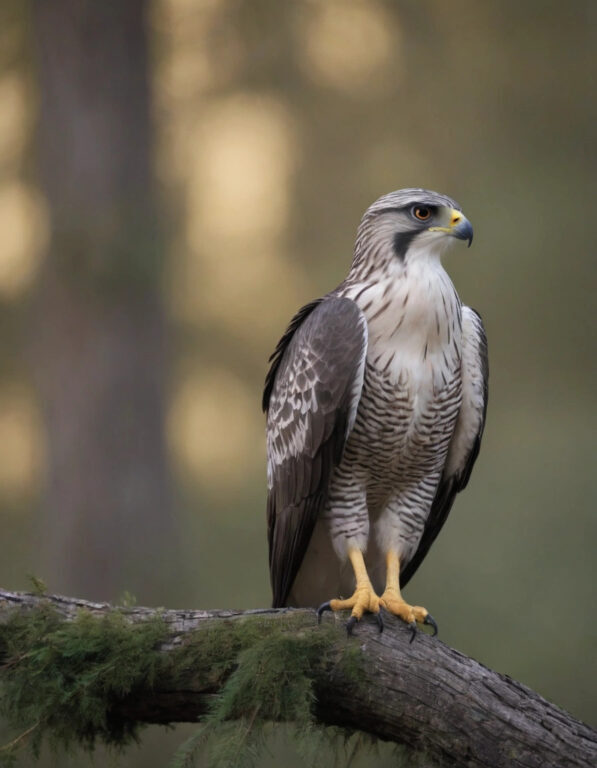
Adults have slate-grey upperparts, a dark crown, and pale underparts with fine grey barring on the chest. Juveniles are brown above and streaked below, with a distinctive pale eyebrow stripe that fades with age.
The eyes turn from pale yellow in young birds to deep orange or red in adults — a sign of maturity and a serious advantage in bright forest light. The legs are long and yellow, the talons long and needle-sharp, and the grip strength is enough to hold a struggling hare.
Its flight silhouette is unmistakable once you know it: broad, rounded wings, a long tail, and a heavy chest. In a glide, it looks almost like a buzzard — until it flips into a chase.
Reproduction and Life Cycle
Goshawk pairs usually mate for life or at least for several seasons. They build or rebuild a stick nest in a tall tree, often in the main fork of a mature beech, pine, or oak.
The female lays two to four eggs in spring, incubates for around 35 to 38 days, and stays on the nest while the male brings food. After hatching, both parents feed the chicks, and the young fledge at roughly 35 to 45 days.
Juveniles stay dependent for weeks after fledging, learning to hunt through practice and by stealing prey from their parents. Most don’t survive their first year — starvation, collisions, and predation by larger raptors are common.
Goshawk in Culture and Mythology
The goshawk bird of prey has been a symbol of power, strategy, and swift judgment across many cultures. In medieval Europe it was the hawk of the nobility — a bird for knights and kings, not for commoners. In Japanese falconry, the goshawk (ōtaka) was prized for its courage and was often used to hunt pheasants and hares.
In Norse and Germanic folklore, the goshawk appears as a messenger and a guardian. In modern birding, it carries a different reputation: the forest ghost, the bird you’re most likely to miss.
Conservation Status: Is the Goshawk Endangered?
Globally, the goshawk bird of prey is listed as Least Concern by the IUCN. But that global label hides real problems at the local level.
In the UK, the goshawk was driven to extinction in the 19th century and only re-established through escapes and releases. Populations there remain small and vulnerable. Across parts of Europe, illegal persecution by gamekeepers and pigeon fanciers is still a serious threat.
Deforestation, logging of mature forests, and disturbance at nest sites also cut into breeding success. Conservation efforts focus on protecting old-growth woodland, reducing persecution, and monitoring nesting pairs.
If you ever spot a goshawk in the wild, count yourself lucky. It’s not a bird that performs for an audience — it appears, strikes, and vanishes back into the canopy. That brief glimpse is exactly why it remains one of the most respected predators in the forest.
