Post actualizado el día octubre 26, 2026 by DeiviSanzPlay
You look at the job offer, see «€30,000 gross per year» and mentally start planning holidays. Then the first payslip arrives and that number is nowhere to be found. That gap between what you’re promised and what actually hits your bank account is the whole gross vs net salary debate, and honestly, most people only learn it the hard way.
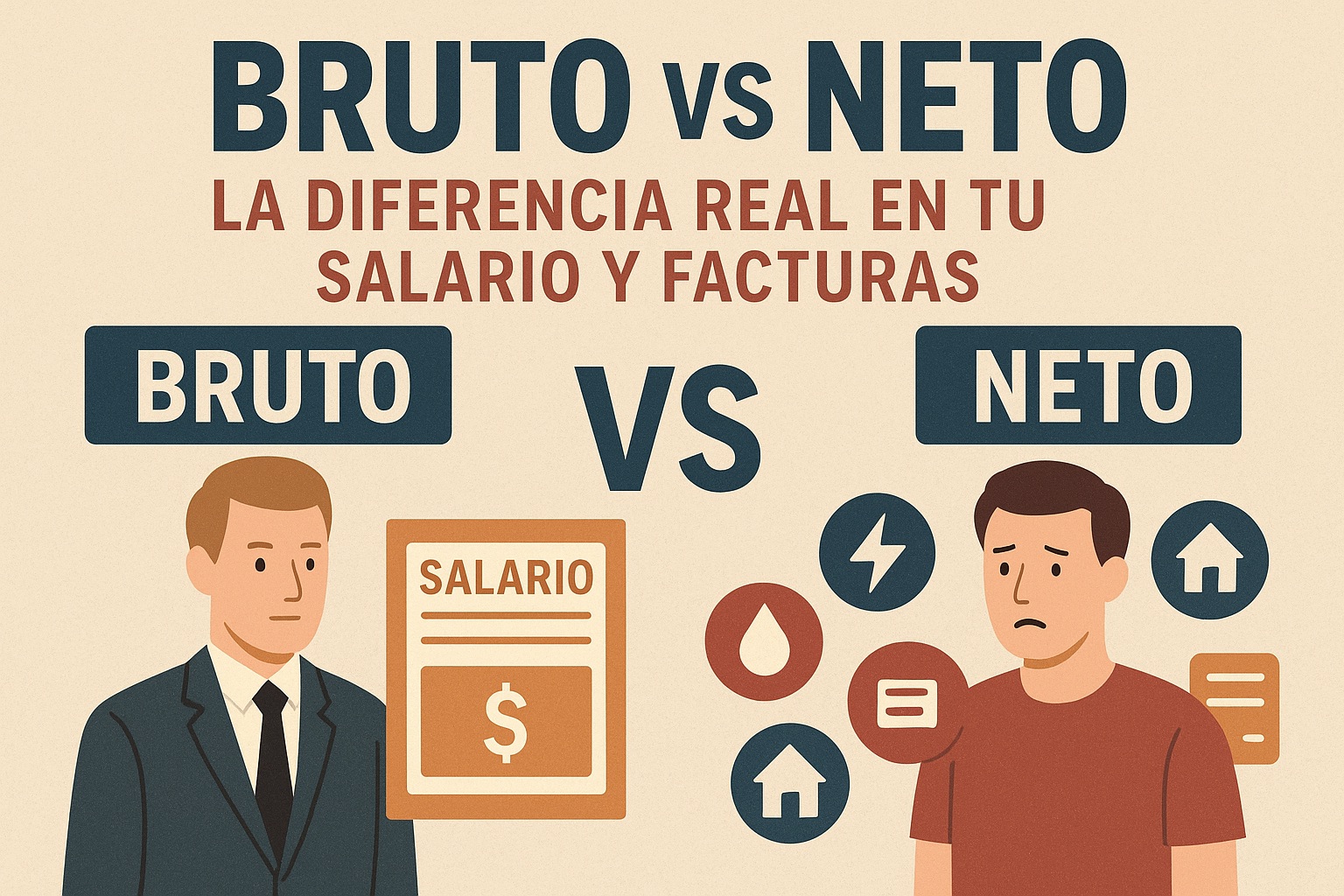
Gross salary is the raw total your employer agrees to pay you for the year. Net monthly salary is what’s left after the state, your region and Social Security have taken their cut. Everything in between is where the math gets interesting — and where the surprises live.
What gross and net actually mean, without the fluff
Gross is the complete amount before anyone touches it. Net is the final amount after every mandatory deduction has been applied. It’s that simple, and it applies to salaries, invoices, weights and business profits alike.
The words come from the Latin brutus (rough, coarse) for gross and the Italian netto (clean) for net. That’s literally the logic: you take the rough pile of money, clean it up with taxes and contributions, and what remains is what you can spend.
Where people mess up is assuming the cleaning is minor. On a €30,000 gross annual salary in Spain, your real net monthly salary tends to land somewhere between €1,850 and €1,950 depending on your personal situation. That’s roughly a fifth of your money gone before you see it. If you’re budgeting based on gross, you’re budgeting on fiction.
How net salary is calculated from gross (the two big bites)
Turning gross into net isn’t magic, it’s two blocks of deductions applied in order.
The first block is Social Security contributions. A slice comes out of your gross, and your employer pays another slice on top. This covers common contingencies, unemployment, professional training and the wage guarantee fund. It’s not a tax you can dodge — it’s the price of access to retirement, sick leave and unemployment benefits later on.
The second block, and usually the heavier one, is the IRPF withholding (personal income tax). This is not a final tax. It’s an advance payment you make to the tax authority throughout the year, and it gets settled when you file your annual return. The percentage depends on your salary, your family situation, disability status and the region where you live. Two colleagues on identical gross can easily pay different IRPF percentages.
The formula is blunt: Net = Gross − (Social Security + IRPF withholding). Online simulators from major banks give you a rough figure, but they rarely nail it because they don’t know your personal circumstances.
The Navarra twist nobody warns you about
Here’s where the gross vs net conversation gets genuinely spiky. Navarra and the Basque Country run their own tax regimes under the Convenio Económico, protected by the Spanish Constitution. That means personal income tax in Navarra is managed by the Foral Administration, not by the state AEAT.
Practical consequence: withholding tables, tax brackets and regional deductions are set independently by the Government of Navarra every year. Someone earning €35,000 gross in Pamplona can take home a slightly different net monthly salary than someone on the same gross in Madrid. Not a huge difference, but enough to matter when you’re comparing two job offers.
If you’re weighing a contract in Navarra, ignore generic national calculators and check the official foral withholding tables directly. It’s the only way to know what you’ll actually be paid.
Gross weight vs net weight: the supermarket version
Same logic, different arena. Gross weight is the total weight of a shipment including packaging, pallets, containers and wrapping. Net weight is the product alone. The difference between the two is called tare.
When you buy a 500g bag of pasta, that 500g is the net weight. The plastic and cardboard around it are the tare. Weigh the whole thing on a scale and you get the gross weight. Consumer protection law requires labels to state net content clearly precisely so you know what you’re paying for.
In logistics and freight, this distinction decides shipping costs. You pay for gross weight, you sell on net weight. Confusing the two is how margins disappear.
Invoices: net base, gross total
On any invoice, the net amount is the taxable base — the pure value of the goods or services sold. The gross amount is that base plus VAT and any other applicable taxes.
A €100 service with 21% VAT becomes a €121 gross invoice total. That €121 is what the client pays. The €100 is what the business actually earned before tax.
This matters enormously for freelancers and companies because VAT charged and VAT paid get declared and offset periodically with the tax agency. An invoice that doesn’t clearly show the taxable base, the VAT rate and the grand total is a badly drafted invoice, full stop.
Gross margin vs net margin: the business reality check
For anyone running a business, the gross vs net distinction decides whether you’re actually profitable. Gross profit is revenue minus the direct cost of producing what you sell — materials, direct labour, manufacturing. It tells you if your product makes sense at all.
Net profit is what’s left after you also subtract operating expenses, salaries, rent, taxes, interest and depreciation. A company can have a healthy gross margin and still bleed money at the net level. That’s the trap: celebrating gross margin while net margin quietly turns negative.
Investors look at net margin because it’s the honest number. Gross margin flatters; net margin judges.
Why this matters more than people admit
The gross vs net distinction isn’t academic trivia. It’s the difference between a realistic budget and a fantasy one.
- Job negotiations: always ask for a net simulation, not just the gross figure. Push for it in writing.
- Freelance pricing: quote your net base and add VAT separately, or you’ll absorb the tax yourself.
- Business analysis: track net margin monthly, not just gross. Gross margin hides problems.
- Regional moves: if Navarra or the Basque Country are on the table, run the numbers with local rules, not national ones.
The rule of thumb: if a number sounds too good, it’s probably gross. The net is where reality lives, and it’s always the smaller, more honest figure.