Post actualizado el día octubre 26, 2026 by DeiviSanzPlay
Horses sleep less than you think. A horse can nod off standing up, lock its legs and stay upright for hours. That sounds impossible, but it happens thanks to the stay apparatus, a set of tendons, ligaments and a locking mechanism in the stifle and hock that lets a horse rest without falling over. This is horse anatomy at its most practical.
How a Horse Sleeps: Standing, Lying and Everything Between
If you want to know how horses sleep, forget the human model of eight straight hours. Horses are polyphasic sleepers. They take short naps across the day and night. Deep sleep, the kind where the brain actually shuts down for REM, only happens when the horse lies flat on its side. That position is risky in the wild, so horses do it in bursts, often just 20 to 30 minutes at a time.
Most of their rest is slow-wave sleep while standing. They can do this because the stay apparatus locks the joints without muscle effort. So a horse sleep cycle looks like this: many standing dozes, a few short flat-out sessions, and total sleep adding up to roughly 3 to 5 hours per day. Foals sleep much more, sometimes flat out for hours, because they are growing and their legs are still learning to lock properly.
One more detail that surprises people: horses need at least one companion to feel safe enough for REM sleep. A lone horse often refuses to lie down. That is not stubbornness, it is survival instinct. In a herd, one horse stands guard while others lie flat. Remove the herd and you remove the deep sleep.
Horse Anatomy: Built for Speed and Grass
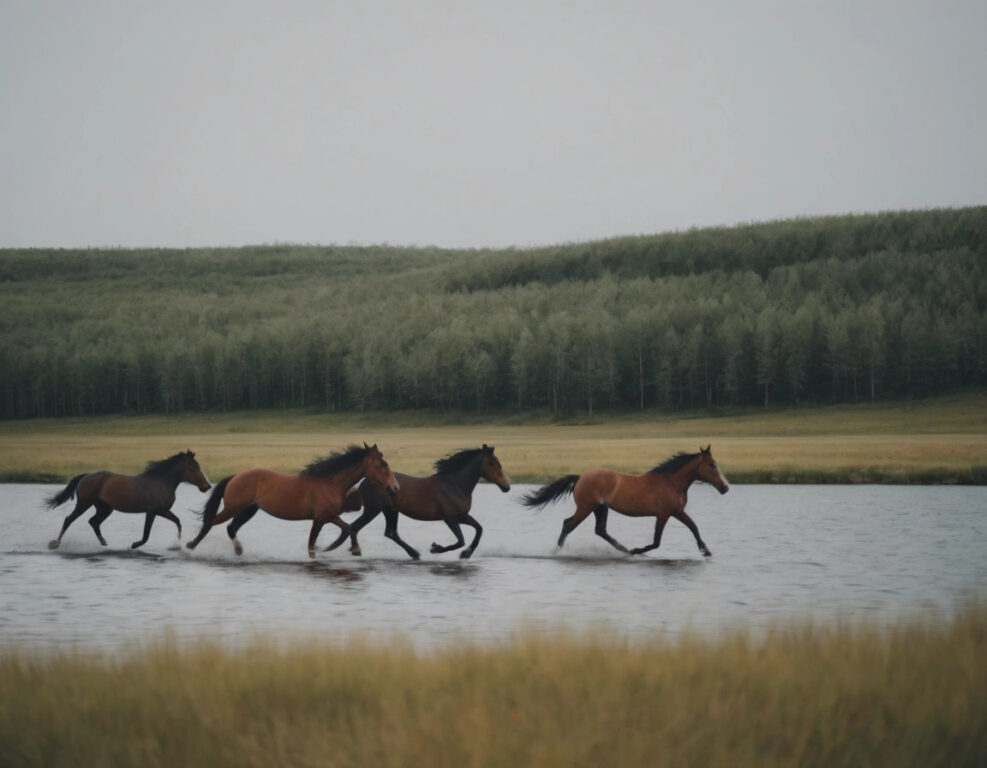
Horse anatomy is a masterclass in compromise. The legs are long and light, with a single weight-bearing toe per limb. The spine is stiff and strong, not flexible like a cat’s. That stiffness gives them top speed, but it also means a horse cannot twist or bend sharply without risk. A horse running at full gallop is basically a launched projectile with a brain.
Then there is the digestive system. Horses are hindgut fermenters. They have a small stomach, a huge cecum and a long colon where microbes break down fiber. This design works only if food keeps moving. A horse that goes too long without eating can colic, and colic kills. That is why hay should be available almost around the clock.
The mouth matches the diet. Horse teeth have high crowns with ridges that grind grass like a millstone. They also keep erupting throughout life. A 20-year-old horse has worn teeth that may need floating, which is the filing of sharp points. If you skip dental care, the horse cannot chew properly and drops weight fast.
Horse anatomy did not evolve for stables. It evolved for near-constant movement and near-constant grazing. Every management mistake comes from forgetting that.
What Do Horses Eat? Real Feeding Rules
What do horses eat? Grass, hay and fiber, mostly. A horse’s diet in the wild is 16 to 18 hours of grazing per day. In a stable, we compress that into two or three meals and then wonder why the horse is anxious or ulcer-prone. The fix is simple: more forage, less grain, and slow feeders if needed.
Hay quality matters more than any supplement. Good grass hay, tested for sugar and starch, keeps the hindgut stable. Alfalfa is higher in protein and calcium, useful for some horses but too rich for others. Carrots and apples are fine as treats, but they are sugar bombs. A horse does not need them daily.
Water is the forgotten nutrient. A 500 kg horse drinks 20 to 50 liters per day depending on weather and workload. If you see a horse eating less, check the water first. Also, salt. Horses do not lick salt blocks reliably. Add loose salt to the feed or provide it free-choice.
Common Horse Sleep and Feeding Mistakes
- Forcing a horse to sleep alone. No herd, no deep sleep, no recovery.
- Feeding large grain meals. Small stomach, big risk of ulcers and colic.
- Ignoring teeth. A horse with sharp points loses condition no matter how much you feed.
- Assuming standing rest is enough. Horses still need flat-out REM sleep to function.
- Overusing stalls. Movement keeps the gut and joints healthy.
The Social Horse: Why Behavior Explains Health
Horses are prey animals with a strong social brain. They read body language, remember faces and form bonds. A horse that feels isolated shows it through stall vices, weaving, cribbing or aggression. Those are not bad habits, they are symptoms of a management failure.
Their crepuscular rhythm matters too. Horses are most active at dawn and dusk, which is when wild herds move between grazing and water. In a stable, that rhythm often collides with human schedules. If your horse is restless at 6 a.m. or 8 p.m., it is not misbehaving. It is following millions of years of instinct.
Practical Care for 2026: What Actually Works
Forget the romantic idea of the horse as a machine. Treat it like an athlete with a fragile gut and a social mind. That means turnout, forage, water, dental checks, regular deworming based on fecal tests, and a farrier schedule every 4 to 6 weeks. Add a herd mate or at least visual contact with other horses.
If you want one rule to remember from all this, take this: a horse that sleeps well, eats fiber all day and lives with other horses will outlast any horse managed with shortcuts. Anatomy, sleep and diet are not separate topics. They are the same survival system, and the horse has been running it successfully for millions of years before we showed up.