

Post actualizado el día octubre 25, 2026 by DeiviSanzPlay
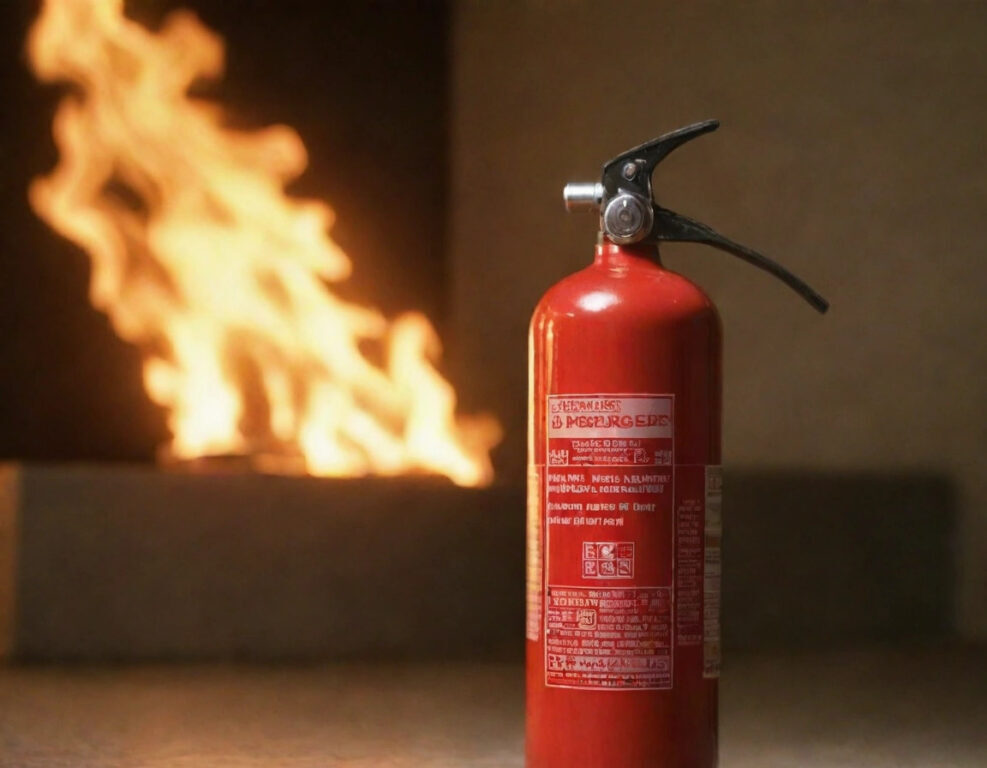
A fire extinguisher is not an ornament hanging on the wall to satisfy regulations. It is the only tool you have at hand when a small fire can turn into a tragedy in less than two minutes. And most people have no idea how it works, which one to buy, or when it expires. Let’s sort this out without beating around the bush.
What exactly is a fire extinguisher and what fires can it put out
A fire extinguisher is a pressurized container that releases an extinguishing agent to smother a small or incipient fire. Period. It is not designed for full-blown fires where there are already two-meter flames. If the fire has been burning for more than a minute or there is dense smoke, your job is not to put it out: it is to evacuate and call 112.
That said, in that initial 30-to-60-second window, a well-chosen and well-maintained extinguisher is literally the difference between a scare and losing your home. That is how it is, and anyone who says otherwise has never seen a kitchen burn.
Fires are classified into classes according to the material that burns. This is not an academic whim: it determines which extinguisher you need. The types of extinguishers and their fire classes are:
- Class A: solid materials such as wood, paper, fabric or plastics. They are put out with water or ABC powder extinguishers.
- Class B: flammable liquids such as gasoline, alcohol, solvents or paints. Here water is suicide: it fuels the flames.
- Class C: flammable gases such as butane, propane or natural gas.
- Class D: combustible metals such as magnesium, sodium or titanium. Very industrial cases.
- Class F (or K in other countries): cooking oils and fats. The typical deep fryer fire. Here water causes a brutal steam explosion.
And watch out for the electrical class: CO2 and powder extinguishers are the only valid ones if there is live current. Water, not a chance.
How a fire extinguisher works inside: the real mechanism
Inside the cylinder there is an extinguishing agent and a propellant gas, usually nitrogen or CO2 under pressure. When you operate the valve, that gas pushes the agent through the hose and it shoots out of the nozzle. That simple in concept, but with important nuances.
There are two systems: stored-pressure (the gas is mixed with the agent from the factory) and cartridge-operated (they carry a gas cartridge that is punctured when you press the lever). The former are more common in homes and offices; the latter, in industrial environments because they withstand the passage of time better.
The agent puts out the fire through one of these three mechanisms, or a combination:
- Cooling: water and some aqueous solutions absorb heat and lower the temperature below the ignition point.
- Smothering: CO2 and powder displace the oxygen from the combustion zone. Without oxygen, there is no fire.
- Chemical inhibition: dry chemical powder interrupts the chain reaction of free radicals. It is the most effective for liquid fires.
The key components of any extinguisher are the storage cylinder, the valve with the operating lever, the discharge hose or nozzle and, in cartridge-operated models, the gas cartridge. In addition, all of them have a pressure gauge that indicates whether the internal pressure is in the green range. If the needle is in the red, that extinguisher is useless.
Why having a fire extinguisher is not optional
In Spain, the Technical Building Code and the Fire Protection Installations Regulation establish which premises and homes need extinguishers. But beyond the law, there is the evidence: a well-located fire extinguisher drastically reduces the probability of a small blaze turning into a total loss.
In homes, the regulations are more lax, but common sense is not. If you have a gas kitchen, a fireplace, a barbecue or a garage with a vehicle, having at least one 6-kilo ABC powder extinguisher is the sensible minimum. And if you have a deep fryer or cook with plenty of oil, add a specific class F one.
How to choose the right extinguisher according to the risk
Don’t buy by price or by size. Buy by real risk. This is the criterion I defend and with which you can’t go wrong:
- General home: 6 kg ABC chemical powder. It covers solids, liquids and gases. It is the all-rounder.
- Kitchen with deep fryer: 6-liter class F extinguisher (potassium acetate). ABC powder does not put out a high-temperature oil fire well.
- Electrical panels, servers, electronics: 5 kg CO2. It leaves no residue and does not damage equipment.
- Vehicle: 1 or 2 kg ABC powder. Mandatory in many countries and advisable in all.
A detail that almost nobody considers: the weight. A loaded 9-kilo extinguisher actually weighs about 14 kilos. If you can’t handle it with one hand while dodging smoke, it is no use to you. Better two 6 kg ones distributed around the house than one 12 kg one you won’t be able to lift.
Extinguisher maintenance: what almost everyone ignores
A fire extinguisher expires. Yes, it expires. The extinguishing agent compacts over the years and the propellant gas slowly leaks. That is why the regulations require:
- Quarterly visual inspection: check the pressure gauge, the tamper seal, the hose and the exterior condition.
- Annual maintenance: carried out by an authorized company. It checks weight, pressure and internal condition.
- Recharge or retesting every 5 years in most powder and water models. CO2 ones every 10 years with a hydrostatic test.
And there is a killer detail: after using an extinguisher, even for just a second, it must be recharged. Even if it looks full. The pressure is no longer the same and it will not work properly again.
How to use an extinguisher without losing your head
The technique is simple but requires order. First, remove the safety pin. Second, aim at the base of the flames, not at the smoke or the upper part. Third, press the lever and sweep from side to side. Fourth, keep a distance of 1 to 2 meters.
And something they don’t tell you: if the fire is not out in 10 seconds, get out. Don’t insist. A 6 kg extinguisher discharges in 15 or 20 seconds at most. When it’s done, it’s done. There is no second chance without recharging.
The most common mistake is not the technique: it is people who have never taken an extinguisher off the wall and discover in the middle of an emergency that they don’t know how to release the pin or that the hose is stiff.
Extinguishers in business: training and location
In any business, the regulations require portable extinguishers every 15 meters of travel at most, visible and signposted. But the law doesn’t save lives: training does. An employee who has practiced once with a real extinguisher in a drill reacts ten times better than one who has only seen the device hanging on the wall.
If you have a business and you don’t do annual drills with real controlled fire, you are applying a legal patch to a real risk. And that, sooner or later, comes at a cost.
Fire extinguishers are not a formality. They are a domestic and professional survival tool. Understanding how they work, choosing the right one and keeping it in good condition is more useful than any theoretical prevention course. Because when fire appears, there are only two options: having the right extinguisher and knowing how to use it, or regretting not having done so.
