Post actualizado el día octubre 25, 2026 by DeiviSanzPlay
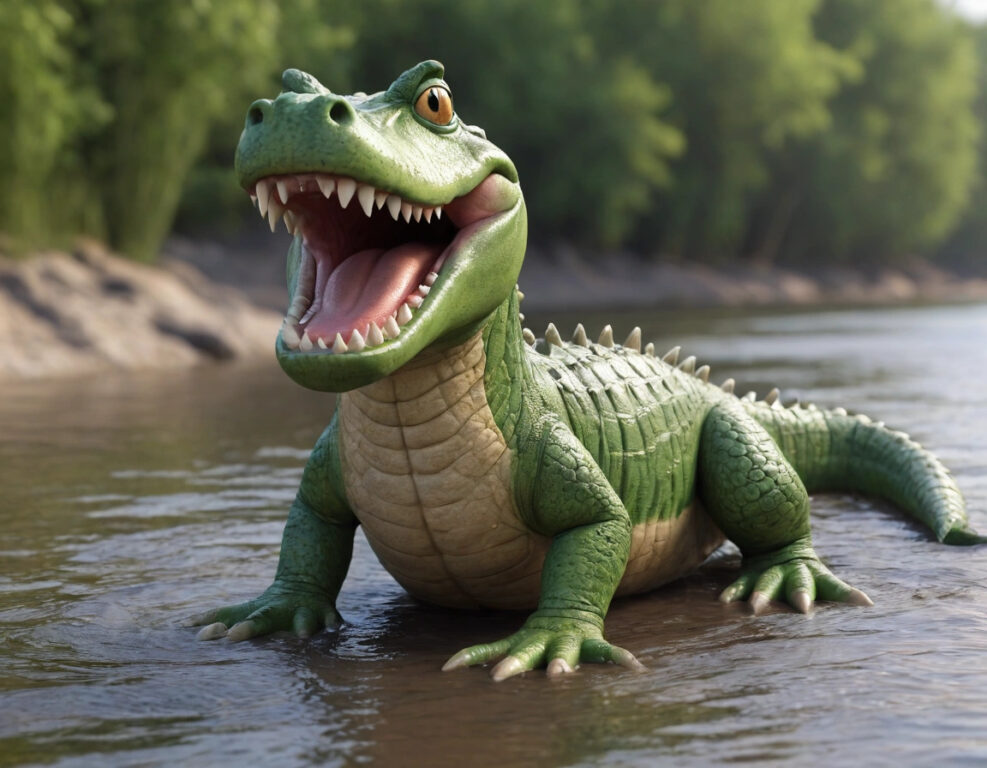
The crocodile is not an animal that moves in just one way. In the water it is a silent bullet; on land it can look like a clumsy log or, in a matter of seconds, a speedster that leaves you with your mouth open. And no, I’m not exaggerating. I’ve seen videos of crocodiles galloping and I assure you it’s not an urban legend.
This is how the crocodile moves in the water: the tail is in charge
When it submerges, the crocodile moves with brutal efficiency. Its legs stay tucked against its body and are barely useful for anything. The tail takes all the starring role, moving from side to side like a whip. That powerful lateral movement generates a thrust that propels it forward at a speed you don’t expect.
The key lies in its morphology: an elongated body, beastly dorsal musculature and a laterally flattened tail that works like a natural oar. In addition, its hard scales and almost impermeable skin reduce friction with the water. The result is a stealthy swim, ideal for hunting without being detected.
There is a detail that many people ignore: the crocodile can swim at high speed over short distances, but it is also capable of covering kilometers without tiring. Its metabolism is slow and that allows it to manage energy strategically. In other words, it’s not a 100-meter sprinter, it’s a marathoner of the water.
An adult crocodile can reach peak speeds in the water of up to 30 km/h, although only for a few seconds. Enough to catch an unsuspecting prey.
On dry land: two completely different gears
When it comes out of the water, the crocodile moves in two radically opposite ways. The first is the slow walk, the one we’ve all seen in documentaries: legs splayed out to the sides, belly almost grazing the ground and a leisurely pace that seems sluggish. In that gait, the animal saves energy and regulates its body temperature.
But when it needs to accelerate, things change. The crocodile moves with a gait called «galloping» or «running» that breaks all the rules. Its hind legs push with force, the body lifts slightly off the ground and the front legs move quickly to keep its balance. It’s a movement that recalls that of a large dog, distances aside.
Not all species gallop. Crocodiles of the genus Crocodylus, such as the Nile crocodile or the saltwater crocodile, are the ones that master this technique best. Caimans and alligators can also do it, but their gallop is less frequent and clumsier. In any case, if you see a crocodile running toward you, don’t stand there staring: those beasts can reach 17 km/h over short distances.
Why can they move like that? The biomechanics of a living fossil
The answer lies in their skeleton and their muscles. Contrary to what was believed decades ago, crocodiles are not slow, primitive reptiles. They have a more sophisticated locomotor system than it seems. Their legs, although short, are anchored to a pelvic and scapular girdle that allows a wide stride when they gallop.
In addition, their spine is flexible in the lumbar region, which facilitates that swaying movement. And their lungs, connected to the liver and intestines by a special diaphragm, act like a bellows that helps them pump air while they run. It is an adaptation they share with birds, their closest evolutionary relatives.
When the crocodile moves in the water, the biomechanics are different: the tail generates thrust waves and the body stays straight to minimize resistance. On land, by contrast, the body arches and the legs work in coordination to avoid tipping over. Two worlds, two different engines.
Differences between species: not all of them move the same way
The Nile crocodile (Crocodylus niloticus) is probably the best galloper. It is followed by the saltwater crocodile (Crocodylus porosus), the largest of all, which can also surprise with short runs. American alligators, on the other hand, rarely gallop; they prefer the slow walk or stealthy swimming.
Caimans, for their part, have a more robust body and shorter legs, which reduces their speed on land. But don’t get complacent: an angry caiman can cover several meters in an instant if it feels threatened. The unwritten rule is never to get closer than 10 meters to a crocodile on land.
There is even a species, the Australian freshwater crocodile, that has been filmed galloping at surprising speeds. Researchers believe this behavior could be more common than we think, but it goes unnoticed because crocodiles usually move slowly to avoid spending energy.
What nobody tells you: the crocodile also «trots»
In addition to the slow walk and the gallop, there is an intermediate gait called the «trot.» In it, the crocodile lifts its body off the ground and moves its legs alternately, like a medium-sized dog. It is not as fast as the gallop, but it allows it to move with a certain agility without tiring.
This trot has been observed mainly in young crocodiles and in females protecting nests. Adult males, being heavier, tend to skip this gait and go directly to the gallop if they need speed. It is a matter of body mass and energy efficiency.
The next time you see a crocodile in a zoo or in a documentary, pay attention to how it moves. If it is still, it looks like a log. If it walks, it looks like a dinosaur in slow motion. But if it runs, you’ll realize you are looking at one of the most versatile predators on the planet. An animal that swims like a missile and gallops like a horse when the situation requires it.