

Post actualizado el día octubre 17, 2026 by DeiviSanzPlay
When the first railways started moving in the early 1800s, they weren’t just a new way to travel. They were a full-on industrial reboot. The first railways took the idea of a cart on a wooden or iron track and paired it with a steam engine that could pull loads no horse ever dreamed of. That combo changed everything: trade, cities, war, and daily life.
What Made the First Railways Tick
A railway is a transport system where trains move people and goods along a fixed track. Sounds simple, but the early versions were anything but. The main function was long-distance transport that was efficient and reliable, and that meant moving not just passengers but also coal, minerals, agricultural products, and later manufactured goods and containers.
The first railways used iron or steel rails. Building them required meticulous planning to find efficient routes and overcome geography with bridges, tunnels, and viaducts. Get the gradient wrong and your locomotive stalls or your brakes fail. That’s why early railway engineers were borderline obsessive about surveying.
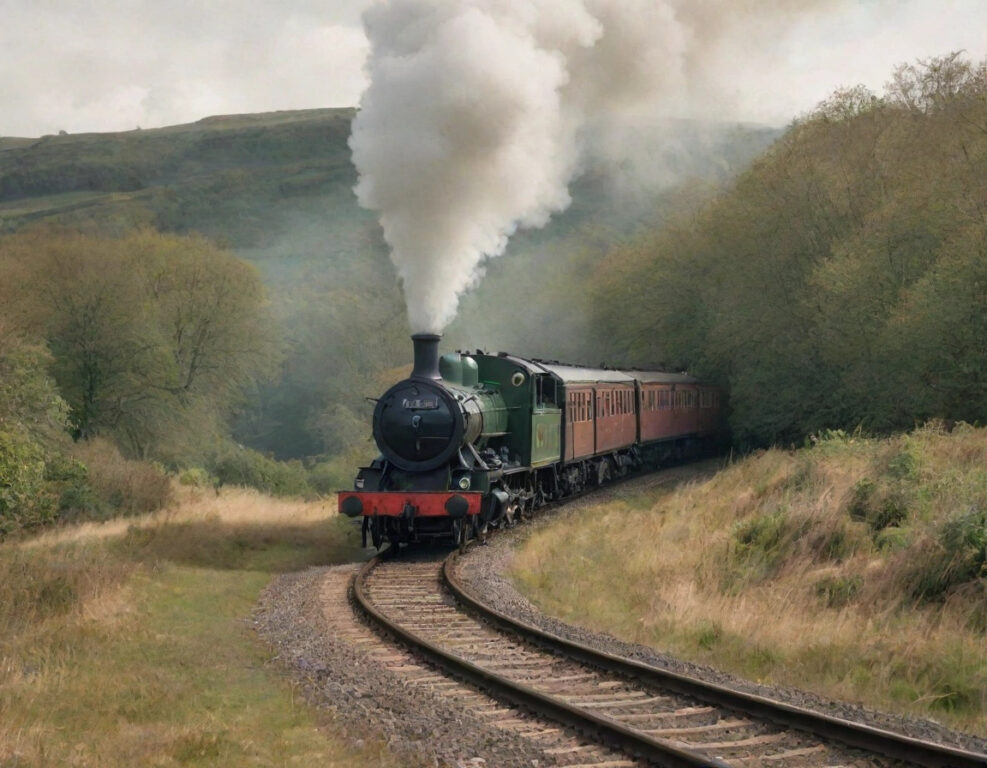
Operation began with steam locomotives. They burned coal to heat water in a boiler, creating steam that moved pistons, which drove the wheels. Managing steam and pressure was a full-time job for trained, attentive crews. If you’ve ever seen a steam engine up close, you know it’s basically a controlled explosion on wheels.
How Steam Locomotives Actually Worked
The first railways weren’t electric or diesel. They were steam-powered, and the physics is straightforward but brutal. Coal fire heats a boiler full of water. Steam builds up pressure. That pressure pushes a piston back and forth. The piston connects to a rod that turns the wheels. Repeat thousands of times per minute.
The catch: you needed a constant supply of coal and water, and you needed someone who could read pressure gauges and adjust valves without blowing the thing up. Early locomotives had no fancy sensors, just a fireman shoveling coal and an engineer watching the steam gauge like a hawk.
Rails were equally critical. Early iron rails cracked under heavy loads, so steel rails became the standard by the mid-1800s. Steel could handle the weight and the wear. Without that material upgrade, the first railways would have stayed short-haul curiosities.
Signaling, Safety, and the Chaos of Early Rail
Forget computer-based train control. Early railways ran on timetables, hand signals, and hope. If two trains ended up on the same track going opposite directions, you got a collision. And that happened a lot.
So they invented signaling systems: semaphore arms, colored lights, and eventually block signaling that kept trains spaced apart. Communication advanced too, from telegraph lines along the track to radio and then digital systems. These weren’t luxuries. They were the difference between a functioning railway and a weekly disaster.
Modern systems like automatic signaling and computer-based train control have slashed accident risks and boosted frequency and punctuality. But the core problem is the same as it was in 1830: keep trains from hitting each other while moving as many as possible.
The Shift From Steam to Diesel to Electric
The evolution of the first railways into what we have now followed a clear path. Steam gave way to diesel, which gave way to electric. Each jump improved efficiency, speed, and capacity.
Diesel locomotives were cleaner and didn’t need constant water stops. Electric trains were even better: quieter, faster, and able to use regenerative braking to feed power back into the grid. High-speed rail, which started in Japan in 1964 and spread across Europe and China, is only possible with electric traction and modern signaling.
If you look at a modern freight train hauling containers, you’re seeing the direct descendant of those coal-fired monsters from the 1800s. The principle is identical: steel wheels on steel rails, low friction, massive loads. The technology around it has just gotten smarter.
Social and Economic Shockwaves
The first railways didn’t just move stuff. They restructured society. By making rapid, economical movement of goods and people possible, they became engines of economic growth, fostering trade and industry in ways nobody predicted.
Cities exploded along rail lines. Tourism became a mass phenomenon because suddenly you could go to the coast for a weekend. Urbanization accelerated because workers could live farther from factories. Remote places got pulled into national markets.
There were downsides too. Small towns that got bypassed withered. Local industries that couldn’t compete with cheap rail-delivered goods collapsed. The railway giveth and the railway taketh away. That pattern repeats every time a new transport technology shows up.
What the First Railways Got Right (and Wrong)
They got the core idea right: steel wheels on steel rails are incredibly efficient. That’s why railways still exist and still move the heaviest loads on land. They got safety wrong at first, but they learned. They got labor wrong too, with brutal working conditions that eventually forced regulation.
Today’s rail systems, from high-speed passenger lines to automated freight corridors, are built on the same foundation. The first railways were crude, dangerous, and transformative. Everything since has been refinement, not reinvention.
So next time you see a train, remember: you’re looking at a 200-year-old idea that still beats almost everything else for moving bulk cargo over land. That’s not nostalgia. That’s engineering that refuses to die.

