Post actualizado el día octubre 25, 2026 by DeiviSanzPlay
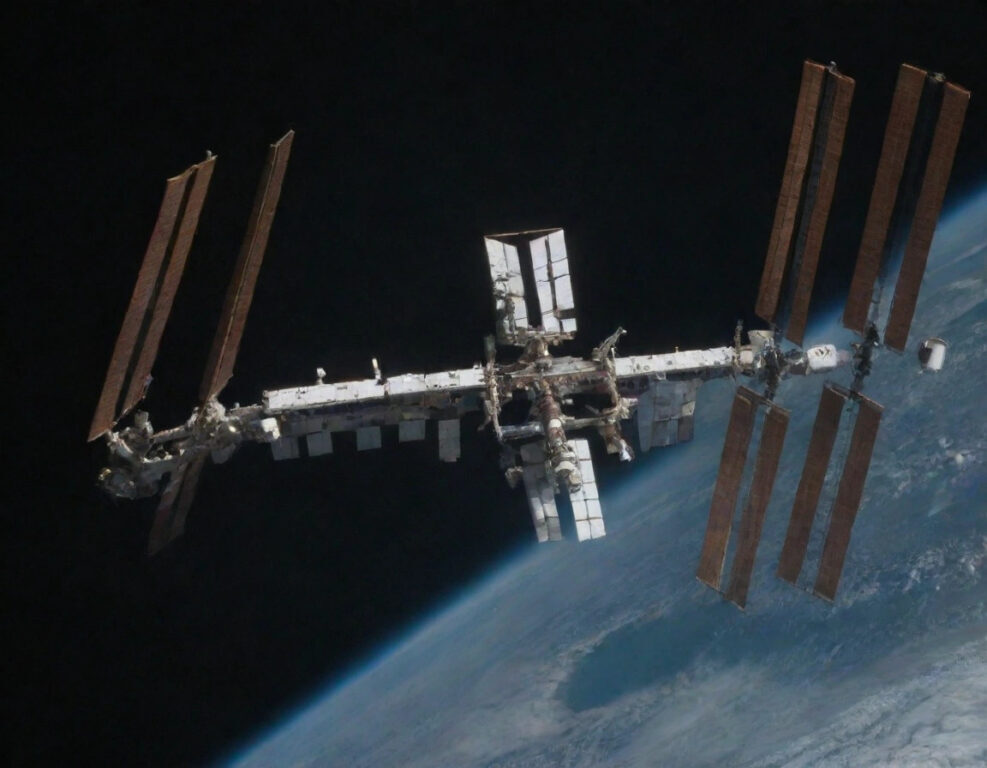
The International Space Station (ISS) wasn’t built overnight. It is the result of more than 40 assembly missions, 15 countries involved, and a good dose of controlled improvisation. If you’ve ever wondered how the ISS was built, here’s the no-frills version: the one that talks about modules that arrived late, spacewalks that ran longer than planned, and a robotic arm that became the silent hero.
The first module, Zarya, lifted off on November 20, 1998, from the Baikonur Cosmodrome. It weighed 19 tons and its function was basically to maintain orientation and propulsion while the others arrived. Two weeks later, the space shuttle Endeavour docked the Unity module. That’s where it all began. The construction of the International Space Station stretched until 2011, with a total of 37 assembly flights between shuttles, Soyuz, and Proton.
The orbital puzzle: how the modules were joined together
No welding in space. The assembly of the ISS was done through automatic docking and spacewalks. Each module carried a latching system called the Common Berthing Mechanism (CBM), designed so that parts manufactured in Russia, the United States, Japan, or Europe would fit together seamlessly. Think of it as a giant Lego set, but with millimeter tolerances and no room for error.
The modules didn’t all arrive at once. First the main module was launched, then they waited for another vehicle to catch up with it in orbit. The launch window had to be perfect: a margin of error of seconds could leave the module in the wrong orbit. That’s why the construction of the ISS depended on ballistic calculations that were reviewed over and over again.
Once the module was docked, the astronauts went outside to connect cables, pipes, and cooling systems. Those spacewalks, called EVAs, add up to more than 1,300 accumulated hours. During them, solar panels, radiators, and the famous Canadarm2 robotic arm were installed.
Canadarm2: the arm that moved tons in microgravity
If there is one tool that made the assembly of the ISS possible, it’s Canadarm2. This 17-meter robotic arm can move loads of up to 116,000 kilos in orbit. Without it, modules like the Destiny laboratory or the Columbus module could not have been put in place. Canadarm2 was installed in 2001 and since then has been key to maintenance and the capture of cargo ships like SpaceX’s Dragon.
The arm didn’t just move modules: it also captured vehicles that arrived without docking automatically. Astronauts operated it from inside the station, using cameras and joysticks. A miscalculation could send one module crashing into another, so every movement was rehearsed beforehand in simulators in Houston and Moscow.
The construction of the International Space Station would not have been possible without this piece of Canadian technology. In fact, Canadarm2 is still working today, and it is expected to remain operational until the station’s retirement in 2030.
The key modules: Zarya, Unity, Zvezda, and the rest
The Zarya module was the first, but not the most important for life on board. That role was shared among Unity (the connecting node), Zvezda (the Russian service module), and Destiny (the American laboratory). Zvezda, launched in July 2000, brought the life support systems: water recycling, oxygen generation, and sleeping space. Without it, the station could not have housed a permanent crew.
Then came the European Columbus laboratory (2008), the Japanese Kibo module (2008), and the Russian Poisk module (2009). Each one added scientific capabilities and habitable space. The construction of the ISS was an incremental process: it was never intended to be finished all at once, but rather expanded according to needs and budgets.
The solar panels, for example, were installed in several phases. The first ones arrived in 2000, but it wasn’t until 2009 that the main power system was completed. Today the station has eight pairs of panels that generate up to 120 kilowatts.
International collaboration: the political miracle behind the ISS
The ISS is the most international engineering project in history. The United States (NASA), Russia (Roscosmos), Europe (ESA), Japan (JAXA), and Canada (CSA) participate. In total, 15 countries signed the original agreement in 1998. Each one contributed modules, technology, or money. Russia provided the Zarya and Zvezda modules; Europe, Columbus; Japan, Kibo; Canada, Canadarm2.
Coordination was not simple. Communication protocols, electrical standards, and even languages (English and Russian) had to be unified. The construction of the International Space Station required engineers from different agencies to work side by side for years. And although there were political tensions, the project moved forward.
Today, the station remains a symbol of cooperation. Although Russia has announced that it will withdraw after 2028, the ISS will operate until 2030. After that, it will be deorbited and will fall into the Pacific.
Daily maintenance: life on board is no walk in the park
Once built, the ISS has to be maintained. Every day, astronauts devote at least two and a half hours to physical exercise to prevent muscle and bone loss. The rest of the time is divided between scientific experiments, repairs, and cleaning tasks. There are no free weekends: the station operates 24/7.
Preventive maintenance is sacred. Air filters, water pumps, and cooling systems have scheduled inspections. Any failure is detected from the ground thanks to the thousands of sensors that send data in real time. If something breaks, the astronauts receive step-by-step instructions from the control center.
Emergencies are also trained for. There are protocols for fires, depressurization, and ammonia leaks. Astronauts carry out periodic drills so they don’t lose the habit. The construction of the ISS included redundant safety systems from the start, but experience has shown that human preparation is just as important.
What nobody tells you: mistakes, delays, and cost overruns
The history of the ISS is not just a success story. There were years of delays, cost overruns of billions, and modules that were canceled. The initial estimated budget was 8 billion dollars; in the end, the total cost exceeded 150 billion. The United States alone has spent more than 100 billion.
There were technical failures too. In 2007, a Russian computer broke down and left the station without attitude control for a few hours. In 2018, an air leak in the Soyuz MS-09 forced an emergency repair. The construction of the International Space Station was a constant learning process, with mistakes that were corrected along the way.
Even so, the result is there for all to see: a 420-ton orbital laboratory, the size of a football field, which has been inhabited for more than 20 years. No other human endeavor has required so much cooperation and precision. And that, even if it sounds like a cliché, is hard to beat.