Post actualizado el día octubre 26, 2026 by DeiviSanzPlay
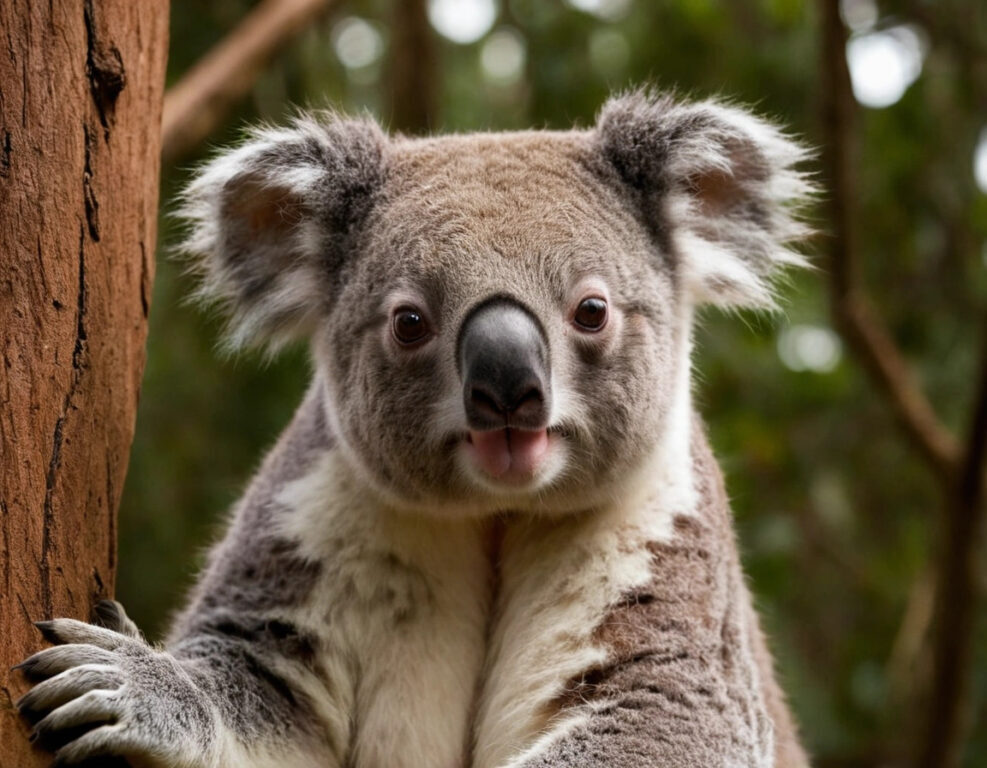
Koalas aren’t bears, they’re not lazy by choice, and they don’t just munch any old eucalyptus leaf. If you’ve ever asked yourself how koalas reproduce or what they actually eat, the short answer is: they do it on a razor-thin energy budget, and their survival depends on a handful of tree species most people can’t even name.
Koala Reproduction: A Brutally Short Window
Koala reproduction doesn’t happen year-round. Females come into estrus between roughly September and February, when Australia warms up. During that window, they emit low, guttural bellows — sounds that carry through the forest and tell nearby males it’s time to move.
Males answer with their own bellows, and fights break out. A dominant male will chase off rivals, but he doesn’t stay to raise anything. Koala reproduction is a solo job for the female once mating ends.
Here’s the part that trips people up: gestation lasts only about 35 days. The joey is born the size of a jellybean — around 2 centimeters, blind, hairless, with no ears. It climbs unaided from the birth canal to the pouch, guided by smell and instinct. If it falls, it dies. No safety net.
The Pouch Phase: Six Months Inside, Six More on the Back
Once inside the pouch, the joey latches onto a teat and stays there for roughly six months. It feeds on maternal milk that changes composition over time — the early milk is watery, later it gets fattier to support rapid growth.
Around the six-month mark, the joey starts poking its head out. Then something genuinely weird happens: the mother produces a substance called pap, a soft fecal paste. The joey eats it. This isn’t a mistake — pap transfers gut bacteria the joey needs to digest eucalyptus later. Without it, the switch to leaves would likely kill it.
After pap comes the back-riding phase. The joey clings to the mother’s back for another six months, learning which trees to pick and which leaves to avoid. Koala reproduction isn’t just about birth — it’s about passing down dietary knowledge that takes a year to transfer.
What Do Koalas Eat? Almost Nothing Else
Koala feeding is one of the most specialized diets in the mammal world. They eat eucalyptus leaves — and that’s basically it. Not all eucalyptus, either. Out of over 700 species, koalas regularly feed on maybe 20 to 30, and in any given region they’ll favor just a few.
That pickiness is survival, not snobbery. Eucalyptus leaves are loaded with toxic compounds — phenolics, terpenes, and cyanogenic glycosides — plus they’re low in protein and calories. Koalas choose leaves with lower toxin levels, often younger tips, and they sniff each leaf before eating it.
An adult koala eats between 500 grams and 1 kilogram of eucalyptus leaves per day. That’s a lot of leaf for an animal that sleeps up to 18 hours.
Why 18 Hours of Sleep Is Not Laziness
The koala feeding process explains the sleeping. Eucalyptus is fibrous and toxic, so digestion is slow and energy-expensive. Koalas have a low metabolic rate — roughly half that of a similarly sized mammal — and they conserve every bit of energy by staying still.
Their digestive system is built for it: an enlarged cecum and a long gut let them ferment the leaf fiber and detoxify compounds that would poison most animals. Even so, they can’t afford to run around. Moving costs calories they don’t have to spare.
This is also why koalas rarely drink water. The word «koala» is often said to mean «no drink» in some Aboriginal languages, and while the etymology is debated, the behavior fits: they get most of their moisture from leaves. During heatwaves or droughts, though, they do come down for water — a sign something is wrong with their habitat.
Habitat Loss Is Breaking the Koala Feeding Cycle
Koalas live in the eucalyptus forests of eastern and southeastern Australia. Their whole life — reproduction, feeding, shelter — is tied to those trees. Clear land, and you don’t just remove food; you remove the nursery, the mating ground, and the safety from predators.
Deforestation, land clearing for agriculture, and increasingly severe bushfires have pushed koala populations down sharply. The 2019–2020 Black Summer fires alone killed or displaced thousands. In 2022, koalas were listed as endangered in New South Wales, Queensland, and the ACT.
There’s a knock-on effect for koala reproduction too. Stressed females under nutritional pressure often skip breeding seasons entirely. Fewer joeys, slower recovery, and a shrinking gene pool — that’s the loop they’re stuck in.
What Happens If the Eucalyptus Goes?
Koalas can’t just switch to another tree. Their gut bacteria are tuned to eucalyptus, their teeth are shaped for it, and their behavior is locked into it. A koala dropped into a forest without its preferred species will starve even with a full canopy overhead.
That’s the real takeaway from koala feeding and reproduction: this animal isn’t fragile because it’s weak. It’s fragile because it’s specialized. Millions of years of evolution made it perfect for one niche, and humans are dismantling that niche faster than it can adapt.
- Gestation: about 35 days
- Pouch life: roughly 6 months
- Back-riding: another 6 months
- Daily leaf intake: 500 g to 1 kg
- Sleep: up to 18 hours a day
- Preferred eucalyptus species: around 20–30 out of 700+
If you ever spot a koala awake and moving during the day, pay attention — it usually means it’s stressed, sick, or its trees are gone. That’s the clearest signal this species gives us, and we’d be stupid to ignore it.