Post actualizado el día octubre 26, 2026 by DeiviSanzPlay
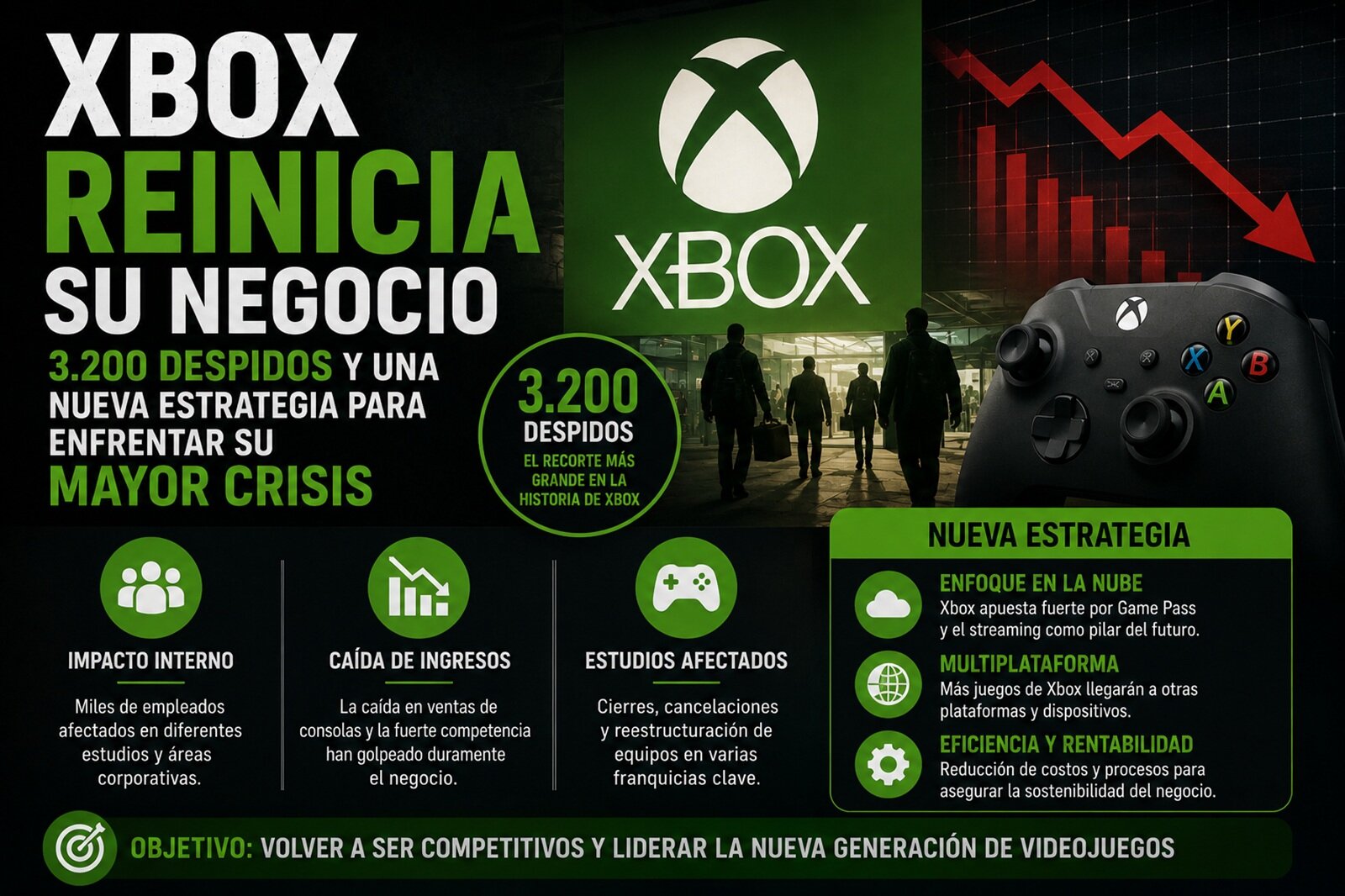
Xbox has just done what no one expected: cut 3,200 jobs and completely rebuild its business. The news isn’t just another round of layoffs. It’s the company admitting, for the first time in public, that its model stopped working.
The person who had to deliver the message is Asha Sharma, Xbox’s new CEO. She didn’t sugarcoat it. The install base is lower than Sony’s and Nintendo’s, Game Pass hasn’t delivered the return the company bet on, and the hardware side is stuck in a rut. That’s the real picture behind the Xbox layoffs of 2026.
Why Xbox Is Losing Money on Every Dollar It Invests
Here’s the number that should worry anyone who follows the industry: in a typical year, Xbox lost 64 cents for every dollar invested in its studios. That’s not a bad quarter. That’s a structural problem.
The Game Pass bet was the big play. Get subscribers, lock them into a recurring payment, and the math eventually works. Except it didn’t. Game Pass hasn’t reached the subscriber volume needed to justify the money poured into day-one releases and first-party development.
My read on this: Game Pass isn’t dead, but the idea of giving away every major release on day one at no extra cost is. That model only works when you have an enormous subscriber base. Xbox doesn’t have one, and Sony’s and Nintendo’s numbers prove it.
The Xbox Hardware Crisis Nobody Wants to Talk About
Console sales have been the weak spot for years. The Series X and Series S haven’t matched the competition, and the pipeline of exclusive titles hasn’t been strong enough to move units.
Games like Senua’s Saga and State of Decay 3 have been pushed, delayed, or left floating in uncertainty. That’s dangerous when your rivals keep shipping heavy hitters.
And the hardware crisis isn’t just about boxes on shelves. It’s about the perception that Xbox is no longer the place where you have to be if you love video games. That perception is what the Xbox restructuring is trying to fix.
The French studio Arkane Lyon, working on Marvel’s Blade, is reportedly in talks to explore strategic options. That’s corporate speak for «we don’t know what happens next.» If you’re a fan of that project, you should be nervous.
The Good News: No First-Party Game Gets Cancelled
Despite the chaos, Xbox has confirmed that none of its already-announced first-party games will be cancelled. That’s the one line in the whole statement that actually matters for players.
Internally, the plan is to simplify the hierarchy. Management levels drop from as many as 14 down to a maximum of 5. Supplier spending gets cut in half. This isn’t cosmetic. A 14-layer structure means decisions take months. Five layers means weeks.
If you’ve ever wondered why Xbox announcements feel slow and reactive compared to PlayStation’s, that organizational bloat is a big part of the answer.
Xbox’s New Competition Isn’t Sony or Nintendo
This is the part that deserves more attention. Asha Sharma said Xbox’s competition is no longer just Sony or Nintendo. It’s the «attention» of users.
She’s right, and it’s a brutal reality. You’re not just competing with the PS5 or the Switch 2. You’re competing with Netflix, with YouTube, with TikTok, with a creator streaming on Twitch at 2 a.m. Getting someone to sit down for a 40-hour RPG is harder than ever.
That reframing matters because it changes what Xbox should build. If attention is the scarce resource, then short, high-impact, subscription-friendly experiences make more sense than 100-hour epics that most players never finish.
The Xbox of 2026 doesn’t want to win the console war. It wants to win the fight for your time.
Bethesda Refocuses on Its Biggest Franchises
Bethesda will concentrate its efforts on The Elder Scrolls, Fallout, Doom, Quake, and Wolfenstein. Other, less profitable projects get set aside.
That’s a clean strategic move, and honestly, it’s the right one. Bethesda has spent years spreading itself thin across experiments that didn’t move the needle. Doubling down on the franchises people actually buy is basic business sense.
It also means we should expect The Elder Scrolls 6 to get more resources and more urgency. If Xbox wants a growth story by 2027, that game is the centerpiece.
The 2027 Promise: Growth, Focus, Discipline
Xbox says it wants to return to growth starting in 2027, with the same level of investment but with «greater focus, discipline, and clarity.» That’s the pitch. Whether it holds up depends on execution.
My take: the 3,200 layoffs aren’t the end of the story. They’re the cost of a strategy that bet too hard on subscriptions and too little on exclusive system-sellers. Xbox isn’t dying. But it is shrinking into something different, and the people paying the price are the ones who lost their jobs, not the executives who made the call.
If you play on Xbox, 2026 is going to feel quiet. The real test comes in 2027, when we find out if this reset actually worked or if it was just another round of rearranging deck chairs.