Post actualizado el día octubre 26, 2026 by DeiviSanzPlay
Scandinavian style isn’t just a trend that comes and goes. It’s a way of understanding the home that has been working for decades, and in 2026 it’s still the most searched decoration style on Google. If you’ve ever wondered why Nordic living rooms look so good in photos and so welcoming in real life, the answer isn’t magic: it’s light, wood and common sense.
I’m going to tell you what really matters when you decorate a living room in Scandinavian style, without smoke sellers or impossible budgets. Because yes, you can have a Nordic living room without spending a fortune or living in a design magazine.
What makes a Nordic living room different from any other
The first thing you need to understand is that Scandinavian style isn’t about filling the room with white and IKEA furniture. That’s a caricature. The real Nordic living room works on three pillars: natural light, honest materials and functionality above decoration.
In Scandinavia it’s dark for months. That’s why they’ve learned to squeeze every ray of sun that comes through the window. Hence the light walls, the light wood floors, the curtains that let light pass through instead of blocking it. It’s not an aesthetic whim: it’s pure survival converted into style.
The palette revolves around whites, greys, soft beiges and muted earth tones. But that doesn’t mean boring. The trick is in textures: wool, linen, bouclé, raw wood. When you don’t have color, you need texture, and that’s where the warmth of the Scandinavian living room comes from.
Hygge isn’t a decoration trick, it’s a philosophy that shows
The Danish concept of hygge gets thrown around a lot, but few people apply it well. Hygge isn’t putting candles everywhere. It’s designing so that your body feels like staying. That means a sofa you can sink into, a blanket within reach, warm light at eye level and not just from the ceiling.
In a cozy Scandinavian living room, lighting is layered: a general light, a floor lamp for reading and one or two small lamps that create pools of warm light. Cold ceiling light kills any hygge attempt instantly. Swap bulbs to 2700K and you’ll notice the difference the same night.
Nordic design doesn’t seek to impress your guests. It seeks for you to not want to leave the couch. That’s the real goal.
Light wood: the star material (and how to use it without overdoing it)
Oak, ash, pine, birch. Light woods are the backbone of Nordic style furniture. They bring warmth without darkening, and they combine with absolutely everything. But there’s a limit: if you fill the room with wood, you end up in a sauna, not a living room.
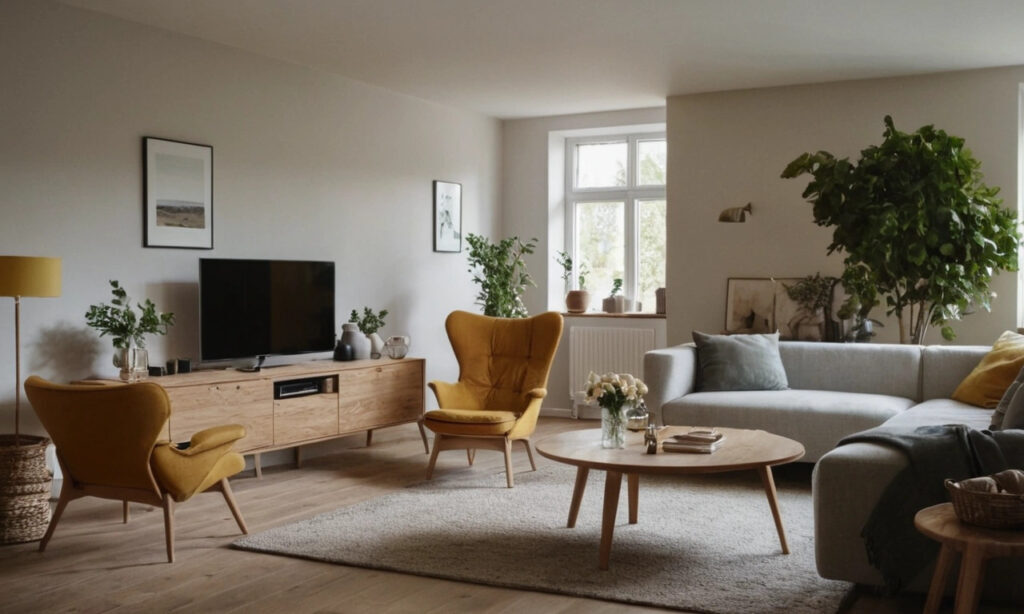
My rule: one or two large wooden pieces (coffee table and TV stand, or floor and shelf) and the rest in neutral fabrics or painted finishes. Wooden legs on the sofa or armchair are enough to connect the whole set. You don’t need everything to be wood to communicate Nordic style.
A detail many people ignore: the finish. Matte or oiled wood looks much more Nordic than glossy varnish. The latter screams 90s furniture. If you’re going to buy, look for natural finishes.
Neutral colors that don’t become depressing
The big fear with neutral living room decoration is that it turns into a hospital corridor. It happens when you use the same tone everywhere and no contrast. The solution is simple: three shades maximum, but with clearly differentiated values.
For example: off-white walls, a light grey sofa and a beige rug. Add black in small doses (lamp legs, picture frames, handles) and you get that crisp Nordic look. Black is the secret ingredient nobody mentions but everyone uses.
If you want to add color, do it with textiles: cushions, a throw, a rug with a subtle pattern. And change them with the season. That way you keep the base and update the mood without repainting.
How to make a small living room look bigger with Nordic style
This is where Scandinavian design destroys other styles. A small Nordic living room can look twice its size if you respect three rules: furniture with visible legs (so light passes underneath), light colors on walls and floor, and no heavy curtains.
Forget giant sofas that eat the room. A two-seater sofa with slim arms and a couple of light armchairs work better. And avoid closed storage at eye level: open shelves or low modules keep the visual line clean.
Mirrors help, yes, but not the huge one on the wall. A strategically placed vertical mirror next to the window multiplies light without looking like a gym.
Plants: the natural touch that isn’t optional
In a Scandinavian style living room, plants aren’t decoration, they’re structure. They bring the green that the palette lacks and soften the straight lines of the furniture. But not just any plant: leafy, sculptural, easy to care for.
Monstera, fiddle leaf fig, rubber plant, olive tree in a clay pot. One large one beats five small ones. And if you don’t have a green thumb, dried branches in a tall vase work just as well and require zero maintenance.
Functional furniture: the part everyone forgets
Nordic design was born from a practical need: small homes, long winters, limited budgets. That’s why Scandinavian furniture for living rooms is usually modular, stackable and dual-purpose. A coffee table with storage, an armchair that converts into a bed, a bench that serves as a shelf.
Before buying anything, ask yourself: do I need this or do I just like it? If it doesn’t serve a function, it’s clutter. And clutter is the number one enemy of Nordic style.
Lighting: the mistake almost everyone makes
If I could change one thing in most living rooms, it would be the lighting. A single ceiling light in the center kills the bright Nordic living room. You need at least three light sources at different heights and intensities.
Paper or linen lampshades, matte finishes, warm bulbs. And if you can dim them, even better. In winter, being able to lower the intensity at night is the difference between a cold room and a place you want to live in.
Minimalism without coldness: balance is possible
Many people confuse minimalist Nordic living room with empty room. Wrong. Minimalism isn’t having nothing, it’s having only what’s necessary and making sure each piece is good.
A comfortable armchair, a well-proportioned side table, a rug that defines the space, a couple of cushions and a blanket. That’s it. The mistake is adding just one more thing «because it looks empty.» That’s how you ruin the style.
Negative space is part of the design. Walls need to breathe, floors need to be seen. If you’re doubting whether to add something, don’t add it.
Real budget: what you should spend and what you shouldn’t
You don’t need to spend a lot to have a Nordic living room. But you do need to spend in the right places. Priority: sofa (comfort is non-negotiable), rug (defines and warms) and lighting (creates the atmosphere).
Where you can save: side tables, shelves, decorative objects. Flea markets and second-hand stores are full of light wood pieces that fit this style perfectly. In fact, the Nordic look improves with worn furniture. It’s not about everything being new.
The most common mistake is buying a cheap sofa to save money and then spending double on cushions to hide it. Bad start. Better one good sofa and cheap cushions.
Final detail: the Nordic lifestyle is noticed in the small things
What really makes a living room with Nordic decoration work isn’t the furniture catalog. It’s how you live in it. A book left open, a wool blanket on the armrest, a mug on the coffee table. That’s hygge. That’s Scandinavian style in real life.
Don’t obsess over everything looking like a magazine. Obsess over the room inviting you to sit down. If you achieve that, you’ve nailed it. And no, you don’t need to be Scandinavian to pull it off.