

Post actualizado el día octubre 17, 2026 by DeiviSanzPlay
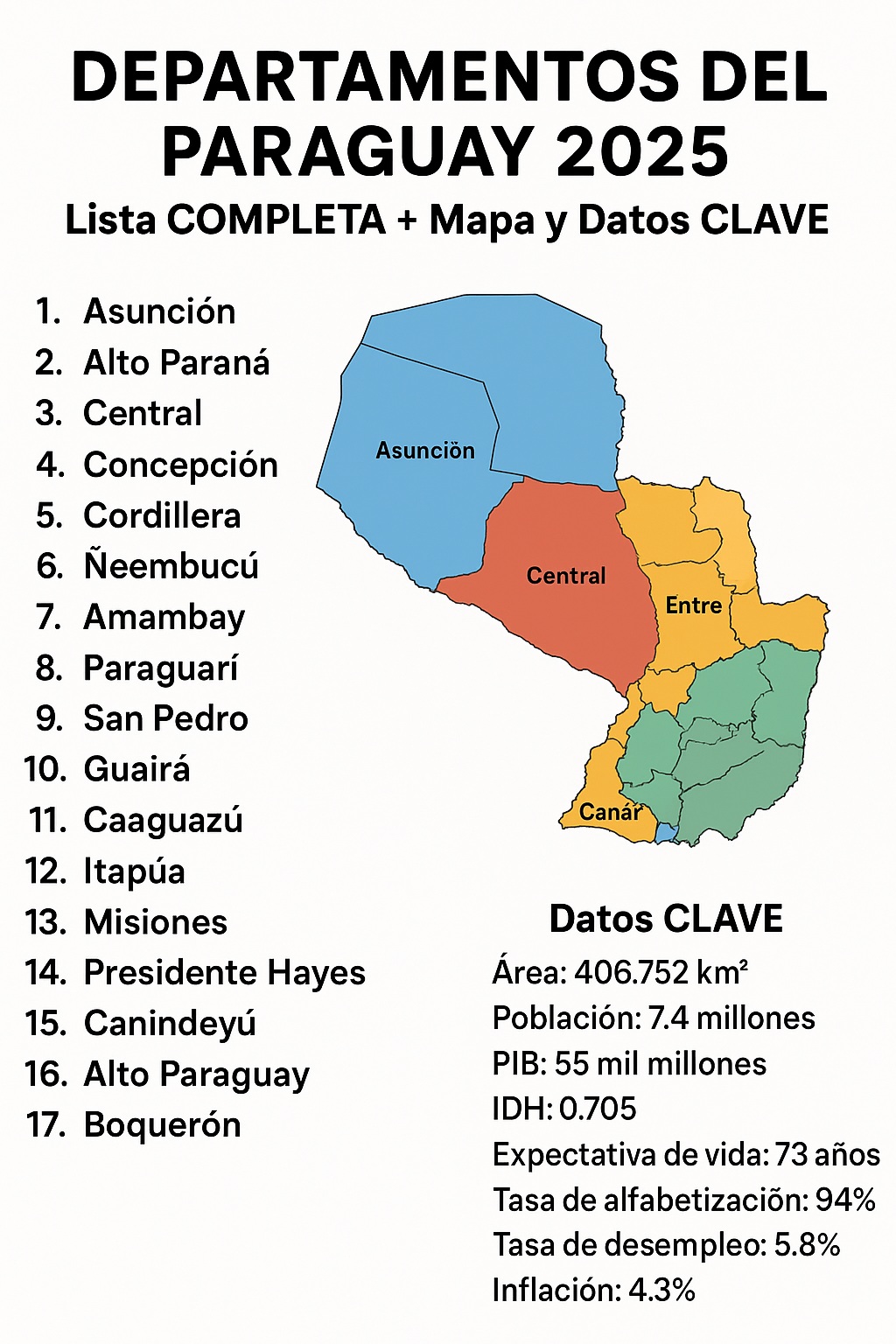
Paraguay isn’t just Asunción and a bunch of soy fields. The country is sliced into 17 departments plus the Capital District, and each one has its own personality, economy and headaches. If you’re planning a move, a road trip, or just want to win an argument about Paraguayan geography, this breakdown of the departments of Paraguay is what you actually need.
I’ve cross-checked the official division used by the Dirección General de Estadística, Encuestas y Censos (DGEEC) and the Secretaría Técnica de Planificación. No fluff, no copy-paste from Wikipedia in Spanish translated badly. Just the real map, the real capitals, and the data that matters in 2026.
How Many Departments Does Paraguay Have in 2026?
Exactly 17 departments, plus Asunción as an autonomous capital district. That’s it. No new departments have been created since the 1992 Constitution reorganized the territory, and nobody is seriously pushing for a new one right now, despite some noise from the Chaco about autonomy.
The departments of Paraguay are grouped into two big macro-regions: the Eastern Region (Región Oriental) with 13 departments, and the Western Region or Chaco with 3. Yes, three, not four — I’ll explain the confusion in a second, because half the internet still repeats a wrong list.
The 13 Departments of the Eastern Region (Región Oriental)
This is where 97% of Paraguayans live and where the money is made. The Eastern Region concentrates industry, agriculture, the biggest cities, and all the paved highways that actually connect to something.
- Concepción – Capital: Concepción. Borders Brazil along the Apa River. Cattle, yerba mate and river ports.
- San Pedro – Capital: San Pedro de Ycuamandiyú. One of the poorest but most agricultural departments, huge livestock and soy expansion.
- Cordillera – Capital: Caacupé. The religious heart of the country thanks to the Virgin of Caacupé pilgrimage every December 8.
- Guairá – Capital: Villarrica. Land of poets and musicians, also solid sugarcane and wine production.
- Caaguazú – Capital: Coronel Oviedo. Soy and timber powerhouse, one of the fastest-growing economies.
- Caazapá – Capital: Caazapá. Forest wealth, but also one of the highest deforestation rates in the region.
- Itapúa – Capital: Encarnación. Tourism, beaches on the Paraná River, and the Jesuit Missions of Trinidad and Jesús (UNESCO World Heritage).
- Misiones – Capital: San Juan Bautista. Jesuit history, rice fields and a strong cooperative culture.
- Paraguarí – Capital: Paraguarí. Historic train, rolling hills, and easy weekend escapes from Asunción.
- Alto Paraná – Capital: Ciudad del Este. Commerce, the Triple Border, and the Itaipú Dam nearby. Chaotic but economically vital.
- Central – Capital: Areguá. The metropolitan sprawl around Asunción: Luque, San Lorenzo, Capiatá, Lambaré. Most populated department by far.
- Ñeembucú – Capital: Pilar. Wetlands, fishing, and a slow pace of life along the Paraguay River.
- Amambay – Capital: Pedro Juan Caballero. Border with Brazil, known for cattle and unfortunately also for contraband.
The 3 Departments of the Western Region (Chaco)
Here’s where most lists get it wrong. The Paraguayan Chaco has three departments, not four. Ñeembucú is in the Eastern Region — it has wetlands, yes, but it sits east of the Paraguay River. Anyone telling you otherwise is copying a lazy blog.
- Boquerón – Capital: Filadelfia. Largest department in the country, Mennonite colonies, dry forest and the entry to the central Chaco.
- Alto Paraguay – Capital: Fuerte Olimpo. Least populated department, Pantanal influence, virgin nature and almost no infrastructure.
- Presidente Hayes – Capital: Villa Hayes. The Transchaco Route cuts right through it; also home to some of the driest land in Paraguay.
Which Department Is the Largest and Which the Most Populated?
Boquerón is the largest department by area, covering roughly 91,000 km² — bigger than Portugal. But it’s mostly empty. The most populated department is Central, with over 2.5 million people including the Asunción metropolitan area.
The least inhabited department is Alto Paraguay, with fewer than 20,000 people spread across a territory the size of Austria. If you want solitude, that’s your spot. If you want a hospital within 100 km, forget it.
Fun fact: Boquerón alone is larger than the entire Eastern Region combined in terms of land, but it holds less than 3% of the national population.
Key Data and Curiosities About the Departments of Paraguay
Some details that rarely make it into generic lists but matter if you’re doing business or traveling:
- Itapúa has the best river beaches in the country, especially around Encarnación and the Costanera. Summer there is packed.
- Alto Paraná generates a huge chunk of Paraguay’s GDP thanks to Ciudad del Este’s commercial zone and Itaipú royalties.
- Central is where almost every foreigner ends up living, whether they like it or not. It’s where the jobs, schools and hospitals are.
- Concepción and Amambay share long, porous borders with Brazil — great for trade, complicated for security.
- Ñeembucú is technically in the Eastern Region but feels like the Chaco: wetlands, cattle, and terrible roads after rain.
Practical Tips If You’re Visiting the Chaco Departments
The Chaco is not a casual weekend trip unless you know what you’re doing. Fuel stations are sparse — sometimes 200 km apart. Carry water, a spare tire, and offline maps. Phone signal disappears for hours.
Best time to visit the Chaco departments is May to September, when the rain is lighter and the heat is survivable. The Eastern Region is more forgiving: April to October avoids the worst of the summer humidity, though Encarnación in January is a beach party worth sweating for.
FAQ: Departments of Paraguay Answered Straight
How many departments does Paraguay have? 17 departments plus Asunción as Capital District. No more, no less.
Is Ñeembucú in the Chaco? No. It’s in the Eastern Region, despite its wetlands and rural vibe. Anyone saying otherwise is wrong.
What’s the capital of Paraguay? Asunción, which is not part of any department — it’s its own autonomous district.
Which department should I live in as a foreigner? Central, unless you have a specific reason to be elsewhere. It’s where the infrastructure and expat services are.
Which department has the best beaches? Itapúa, along the Paraná River. Encarnación’s Costanera is the go-to spot.
Why the Departments of Paraguay Matter More Than You Think
Understanding the departments of Paraguay isn’t just trivia. It tells you where the economy runs, where the roads end, and where the state is basically absent. The Eastern Region is connected, productive and crowded. The Chaco is vast, strategic and forgotten.
If you’re moving, investing, or just traveling with eyes open, use this map as your reality check. Paraguay is small on paper but wildly unequal inside its own borders — and the department lines explain exactly why.
