Post actualizado el día octubre 25, 2026 by DeiviSanzPlay
The white tiger is not a separate species, nor an albino, nor a whim of nature. It is a Bengal tiger with a recessive mutation that shuts down the production of pheomelanin and eumelanin. Translated: its coat comes out creamy white and the stripes are still there, black as night. That said, don’t buy the story that they are «purer.» They are more fragile, and I’ll explain it to you without sugarcoating.
Most of the ones you see in circuses or zoos come from a single bloodline. And that, my friend, is a first-rate genetic problem. There’s no romanticism here: there’s inbreeding, there are health problems, and there’s a business built around an animal that barely exists in the wild.
What is the white tiger, really? The mutation that changes everything
The white tiger is a variant of the Bengal tiger (Panthera tigris tigris) caused by a mutation in the SLC45A2 gene. That gene regulates pigment transport in melanocytes. When it fails, the orange fur turns white and the stripes remain dark because eumelanin is still produced in the follicles that give color to the stripes.
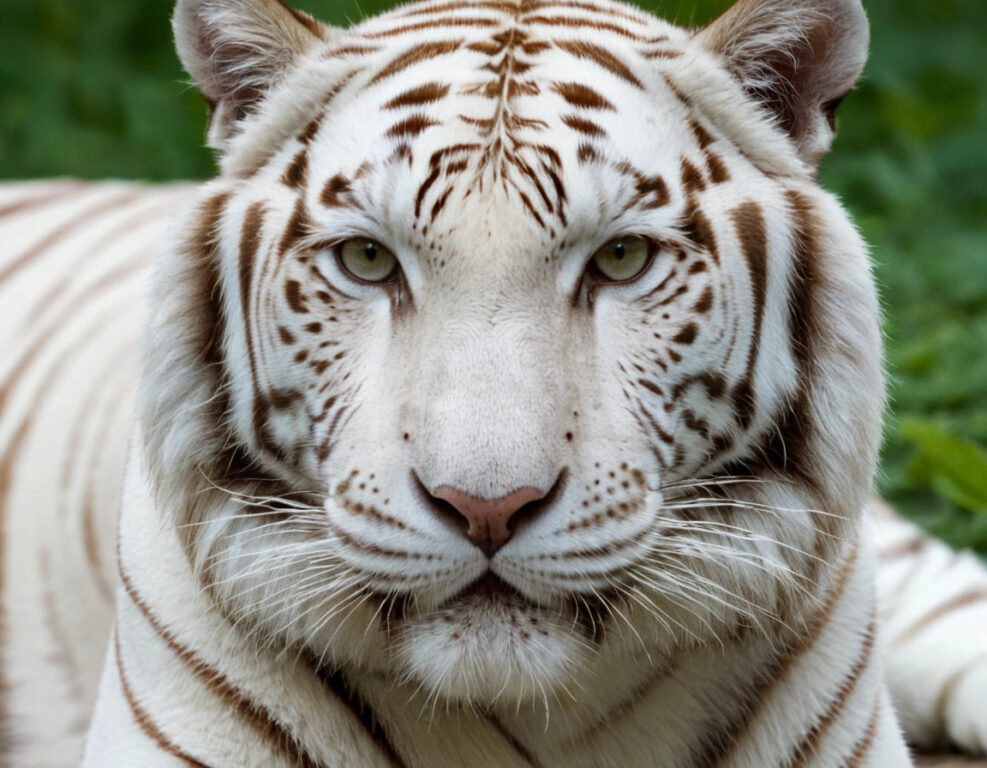
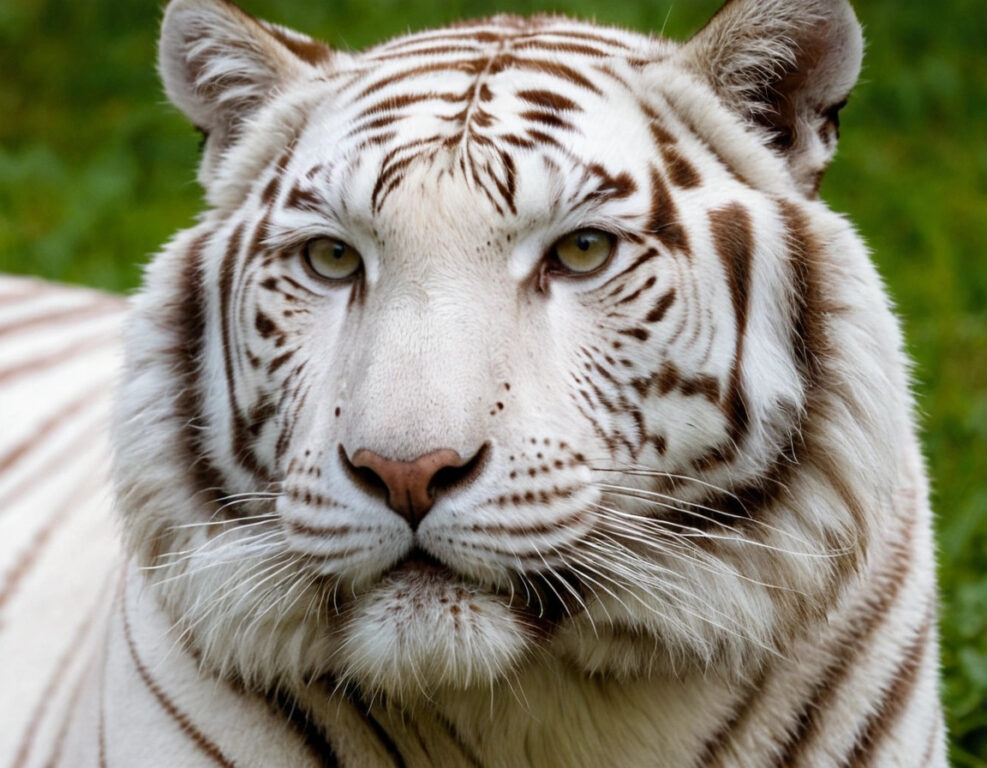
Watch out for the typical confusion: an albino tiger has no stripes and usually has red or pink eyes. The white tiger has blue eyes, black stripes, and a pink nose. These are different things. And the white tiger is not a subspecies: it is a Bengal tiger with a genetic switch turned off.
The mutation is recessive, so for a white tiger to be born, both parents must carry the gene. In the wild, that happens once every 10,000 births, according to historical records from India. That’s why it’s so rare.
White tiger characteristics: size, weight, and those hypnotizing eyes
Let’s talk numbers. An adult male white tiger can measure between 2.7 and 3.1 meters from head to tail and weigh between 220 and 300 kilos. Females are smaller, around 2.4 meters and 140-180 kilos. They are not the largest felines on the planet—that spot belongs to the Siberian tiger—but they are in the top 3 without question.
Their creamy white coat is shorter and denser than it looks. The stripes don’t follow a fixed pattern: every white tiger has a unique design, like a fingerprint. And yes, that is used in sanctuaries to identify them individually.
The blue eyes are another distinctive trait. It’s not just any blue: it’s an ice blue that contrasts with the pink nose and the inside of the ears, also pink. That combination is what has turned the white tiger into a visual icon, for better and for worse.
White tiger behavior: solitary, patient, and lethal
The white tiger shares the Bengal tiger’s instruction manual: it is solitary, territorial, and nocturnal. It marks its territory with urine and scratches on trees. A male can control between 60 and 100 km², depending on prey density.
To hunt, it uses a technique that requires the patience of a watchmaker: it stealthily approaches the prey, sometimes for hours, and when it is less than 20 meters away, it launches into a short sprint that can reach 60 km/h. If it fails, it doesn’t insist. White tigers are not long-distance runners.
Its diet is based on deer, wild boar, antelope, and buffalo. An adult tiger needs between 5 and 7 kilos of meat a day. In captivity, where they don’t hunt, they are fed meat supplemented with vitamins and calcium to prevent bone problems.
White tiger habitat: dense jungles and an uncertain future
In the wild, the white tiger would inhabit the same tropical forests and mangroves as the Bengal tiger: India, Nepal, Bhutan, and Bangladesh. It prefers areas with dense vegetation, near rivers or lagoons, because it needs water to drink and to cool off.
But here comes the reality check: there are no stable wild populations of white tigers. The last confirmed sightings in the wild date back to the mid-20th century. Today, all living white tigers descend from a handful of specimens captured in India in the 1950s, mainly from a male named Mohan.
That means the white tiger in nature is, for all practical purposes, nonexistent. What you see in documentaries or zoos is an animal bred in captivity, with a very reduced gene pool.
The dark side: inbreeding, health, and the white tiger business
I’m not going to mince words here. The captive breeding of white tigers has been criticized for decades by associations such as the AZA (Association of Zoos and Aquariums). The reason: to guarantee that they come out white, close relatives are crossed. Father with daughter, brother with sister. That causes strabismus, scoliosis, kidney problems, heart defects, and a shorter life expectancy.
Many of these tigers don’t reach 15 years, when a normal Bengal tiger can live 20 in captivity. And no, it’s not just «a little inbreeding.» It’s a serious problem that many zoos and pseudo-sanctuaries hide because the white tiger sells tickets.
The stance of serious conservationists is clear: the white tiger contributes nothing to Bengal tiger conservation. It is a distraction. Money and effort should go toward protecting the habitat and wild populations, not toward perpetuating a mutation that in the wild would be eliminated by natural selection.
White tiger facts you may not have known
- The first recorded white tiger was captured in 1951 in Rewa, India, by the maharaja Martand Singh. They named him Mohan, and he became the founder of almost all white tigers alive today.
- They are not albinos. The difference is in the eyes: blue in the white tiger, red or pink in the albino.
- Their life expectancy in captivity is around 15-20 years, but genetic problems reduce that figure in many cases.
- They can be dangerous to humans, but not because they are white, but because they are tigers. A white tiger bred in captivity can attack if it feels cornered.
- The white color doesn’t help them hunt in the jungle. On the contrary, it makes them more visible to prey. Another reason why they wouldn’t survive in the wild.
Differences from the Bengal tiger and the Siberian tiger
The white tiger is a variant of the Bengal tiger, not the Siberian. Although some breeders have crossed white Bengal tigers with Siberians to obtain larger specimens, that is an aberration from a genetic standpoint. The Siberian tiger is more corpulent, with a lighter coat adapted to the cold, but it does not have the white mutation.
The wild Bengal tiger has an intense orange coat with black stripes. It is the most numerous subspecies, with about 3,000 specimens in the wild according to the latest 2023 census. The white tiger, on the other hand, exists only in captivity, with an estimated population of about 200 specimens worldwide.
Should the white tiger continue to exist in captivity?
My opinion, and that of many biologists, is no—not as an attraction. Keeping white tigers solely for their color is a form of genetic mistreatment. That said, if they have already been born and cannot survive in the wild, the least we can do is give them a dignified life, with space, shade, water, and an adequate diet. That doesn’t change the fact that selective breeding of them should be prohibited.
Some sanctuaries in the United States and Europe have stopped breeding white tigers and focus on sterilizing them and offering them palliative care. That should be the norm, not the exception.
If you come across a zoo that advertises «white tiger breeding» as a draw, be suspicious. There’s a business there, not conservation.