

Post actualizado el día octubre 26, 2026 by DeiviSanzPlay
The polar bear isn’t just a cute face on a climate poster. It’s a 600-kilo apex predator that has turned the most hostile place on Earth into its personal supermarket. And in 2026, its world is literally melting under its paws.
Let’s cut the fluff and get into what the polar bear habitat really looks like, how it survives where nothing else can, and why its future is hanging by a thread of sea ice.
Where Does the Polar Bear Actually Live?
Forget the zoo image. The polar bear habitat stretches across the Arctic Circle: northern Canada, Alaska, Greenland, the Svalbard archipelago in Norway, and the Russian Arctic. We’re talking about a range covering roughly 19 subpopulations scattered across the circumpolar North.
But here’s the thing most people get wrong: polar bears don’t live on land. They live on sea ice. That frozen platform floating over the Arctic Ocean is their hunting ground, their highway, and their home. Without it, they’re just big white bears stuck on shore, starving.
They hang around coastal areas where the ice meets open water because that’s where seals pop up to breathe. No ice, no seals. No seals, no bear. Simple as that.
The Physical Traits That Make This Animal a Cold-Proof Machine
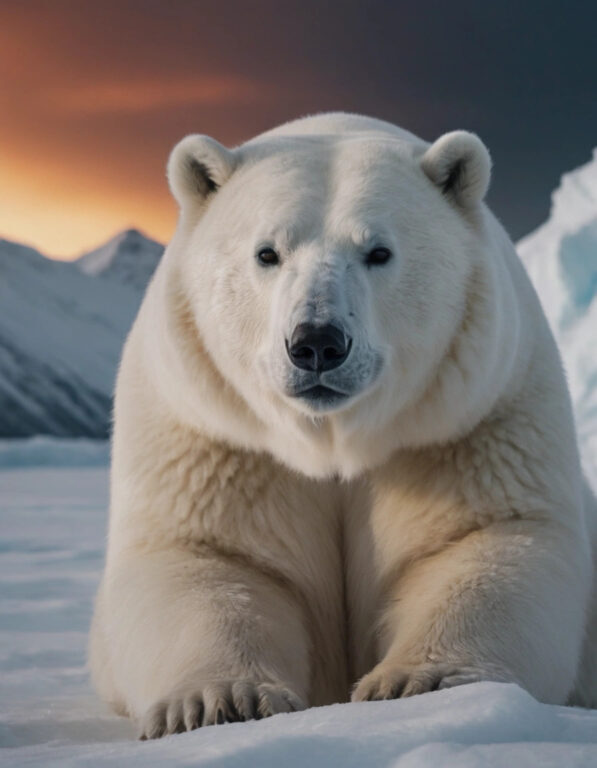
The polar bear adaptations are genuinely wild when you break them down. First, that fur isn’t actually white — it’s transparent and hollow, and it only looks white because of light reflection. Underneath, the skin is jet black, which absorbs UV radiation and keeps the animal warm.
Then there’s the fat. A polar bear can carry up to 11 centimeters of blubber under the skin. That’s not just insulation — it’s an energy reserve for weeks when hunting is bad.
Add small ears, a compact tail, and massive paws that work like snowshoes and paddles at the same time. This isn’t coincidence; it’s millions of years of evolution pointing in one direction: survive the Arctic or die trying.
An adult male can weigh up to 700 kg and stand over 3 meters tall on its hind legs. That’s the largest land carnivore on the planet.
What Does a Polar Bear Eat (And How Does It Catch It)?
The polar bear diet is almost entirely ringed and bearded seals. Nothing else comes close in importance. An adult bear needs to eat roughly one seal every 5 to 10 days to stay healthy — that’s about 2 kg of fat per day just to function.
How does it catch them? Not by chasing. Polar bears use a technique called still hunting: they park themselves next to a seal breathing hole and wait. Sometimes for hours. Sometimes for days.
Their sense of smell is absurd — they can detect a seal under a meter of snow from nearly a kilometer away. When the seal surfaces, it’s over in seconds. No drama, no chase scene.
In summer, when the ice retreats, some bears switch to bird eggs, berries, or scavenged carcasses. But let’s be honest: none of that replaces the calorie bomb of a fat seal. It’s a snack, not a meal.
Behavior: Solitary, Nomadic, and Surprisingly Good in Water
Polar bears don’t do packs. They’re solitary animals that come together only to mate or when food concentrates in one spot. That independence is key to surviving in a place where resources are scattered across thousands of kilometers.
What surprises people is how well they swim. A polar bear can paddle for days straight, covering over 100 kilometers without rest. One bear was recorded swimming continuously for nine days across the Beaufort Sea. That’s not a typo.
They’re most active between late autumn and early spring, when seal pups are born and the ice is at its thickest. In summer, many bears enter a state similar to hibernation called walking hibernation — they slow their metabolism and lose up to 1 kg of body weight per day.
Climate Change and the Polar Bear: The Real Numbers for 2026
Here’s where I stop being diplomatic. The polar bear and climate change relationship isn’t a debate anymore. Arctic sea ice has been shrinking by roughly 13% per decade since 1979, according to NASA satellite data. September minimum ice coverage — the crucial summer low — has dropped by more than 40% compared to the 1980s.
Fewer ice means shorter hunting seasons. In Hudson Bay, the ice-free period has extended by nearly a month since the 1980s. That’s a month of fasting for bears that depend on seal fat.
The consequences are measurable: lower body weight, fewer cubs surviving, and more bears wandering into human settlements looking for food. The IUCN lists the polar bear as Vulnerable, with some subpopulations already in decline.
What’s Actually Being Done (And What Isn’t)
Conservation efforts exist, but let’s not pretend they’re winning. The 1973 Agreement on the Conservation of Polar Bears banned unregulated hunting and helped some populations recover. Today, hunting is strictly regulated in Canada, Greenland, Norway, and Russia.
But regulation doesn’t fix melting ice. No treaty stops a warming atmosphere. The only real fix is cutting greenhouse gas emissions, and that’s a global problem that no single protected area can solve.
Some researchers are pushing for polar bear conservation to focus on managing human-bear conflicts, protecting denning areas, and reducing industrial activity in the Arctic. Useful, yes. Sufficient, no.
Why This Animal Matters Beyond Being Iconic
The polar bear is an apex predator. It sits at the top of the Arctic food chain, which means its health is a direct indicator of the entire ecosystem’s health. When polar bears struggle, everything below them on the food web is already in trouble.
That’s why the polar bear habitat isn’t just a nice-to-have conservation topic. It’s a climate barometer. Watching these animals is watching what’s coming for the rest of the planet, just faster and more brutal.
So no, this isn’t about saving a pretty animal for a photo op. It’s about whether we’re willing to keep the Arctic as we know it — or let it become an open-water grave for the most adapted predator the cold has ever produced.

