Post actualizado el día octubre 25, 2026 by DeiviSanzPlay
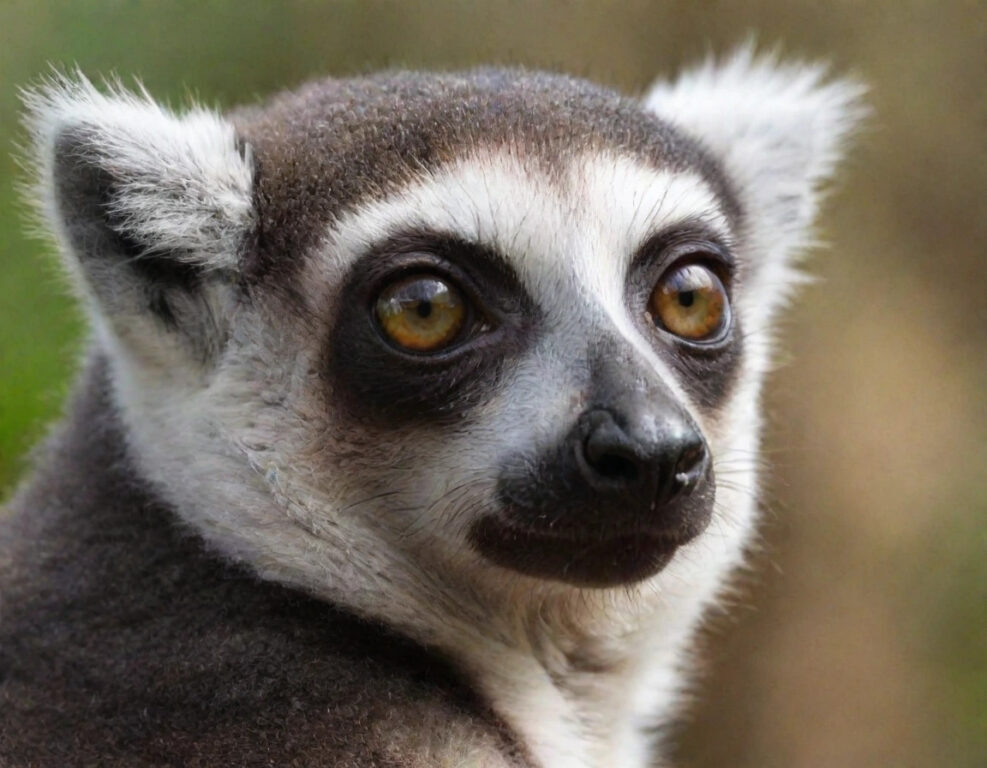
The ring-tailed lemur is one of those animals that, once you see it, you never forget. It’s not just because of its black-and-white striped tail, which looks like a living barcode. It’s because of how it moves, how it looks at you, and how it organizes its life in a group. If you’ve made it this far looking for real information about the ring-tailed lemur, forget the documentary clichés: let’s get to what really matters.
What exactly the ring-tailed lemur is
Its scientific name is Lemur catta and it is the only member of the genus Lemur. It is not a monkey, even though it is called a primate. It is a lemur, a group that exists naturally only in Madagascar. The ring-tailed lemur’s tail can measure up to 60 centimeters, longer than its own body, and it uses it to balance when jumping between trees and to communicate with the others.
Watch out for a detail that almost no one mentions: the tail is not prehensile. It cannot hang from it like a spider monkey. It holds it up like a flag when walking on the ground, and that is key to keeping the troop from scattering.
Where the ring-tailed lemur lives and why it is endangered
The ring-tailed lemur’s habitat is limited to southern and southwestern Madagascar, in dry forests, spiny scrublands, and rocky areas. It does not live in humid tropical rainforests, as many people believe. It needs trees such as tamarind and sisal to feed on and take refuge in.
Deforestation in Madagascar is the number one enemy. It is estimated that the island has lost more than 40% of its forest cover since the 1950s. Add to that fires set to create pasture and illegal logging of precious wood. The result: less than 10% of its original habitat remains standing.
The International Union for Conservation of Nature (IUCN) has classified it as an endangered species since 2018. This is not alarmism: it is an official fact.
Social life: the females are in charge here
Ring-tailed lemurs live in groups called troops, which can have between 6 and 30 individuals. And here comes the interesting part: the females dominate. This is not a rare exception; it is the norm. The females choose where to eat, when to move, and with whom to mate. The males compete for space, but the females have the final say.
That social structure is no whim. In such a harsh environment, with droughts and food scarcity, having females in charge guarantees that the young get priority access to resources. It is pure survival.
They also use their tail for more than communication: in the famous «stink fights,» males impregnate their tails with pheromones and wave them in front of other males. A kind of chemical arm-wrestling match that decides who gets close to the females.
What the ring-tailed lemur eats
Its diet is mainly frugivorous: tamarind fruits, figs, carob pods, and berries. But it does not turn its nose up at flowers, leaves, bark, and, occasionally, insects and small vertebrates. It is an opportunist, and that helps it survive when one type of food is scarce.
A surprising fact: in the dry season, when there is almost no fruit, the ring-tailed lemur can spend weeks eating only leaves and bark. Its digestive system adapts, but it loses weight. It is not an animal that can afford the luxury of being picky.
And yes, they share food. It is not a gesture of human generosity: it is a strategy to maintain group cohesion. The one who does not share ends up alone. And alone, in Madagascar, you die.
The ecological role that almost no one values
The ring-tailed lemur is a first-rate seed disperser. It eats the fruit, travels for kilometers, and defecates the seeds in areas where that plant did not exist before. Without them, many plant species in Madagascar could not regenerate.
This is not a hypothesis: it has been proven that forests with lemurs have greater plant diversity than those without them. If they disappear, it is not just a pretty primate that goes extinct. A link that sustains the entire ecosystem collapses.
Conservation: what is really being done
There are more than 30 protected areas in Madagascar that harbor ring-tailed lemur populations. The Berenty Private Reserve and Isalo National Park are two of the places where they can best be observed.
Captive breeding programs work, but they are not the solution. A lemur born in a zoo is rarely successfully reintroduced into the wild. The real priority is protecting the habitat and curbing deforestation. That means supporting local communities so they do not depend on cutting down the forest to survive.
If you visit Madagascar or a zoo with lemurs, do not treat them like pets. They are not domestic animals. They are a vulnerable species that needs distance, respect, and, above all, for their home to keep existing.
What no one tells you about their behavior
Ring-tailed lemurs are very vocal. They have a repertoire of calls that includes grunts, meows, and an alarm sound that sounds like a sneeze. That «sneeze» warns of aerial predators, such as the Madagascar hawk.
They also sunbathe. They sit with their legs spread and their bellies exposed to warm up in the morning. It is not laziness: it is thermoregulation. In a climate where nights can drop below 10 degrees, taking advantage of the sun is a matter of energy efficiency.
And something that breaks the mold: males migrate between troops. Females stay where they are born. That means genetic exchange depends on males daring to cross hostile territories. If the habitat becomes fragmented, that migration is cut off and inbreeding appears.
Why it should matter to you
The ring-tailed lemur is not just a curious animal to see in a documentary. It is a thermometer of Madagascar’s health. If they disappear, the forest degrades, the soil erodes, and local communities lose resources.
You don’t need to be a biologist to understand it. You just have to look at a photo of its striped tail and ask yourself how much longer we will be able to see it in the wild. The answer depends on decisions made far from the island, but also on what each of us chooses to support.