Post actualizado el día octubre 25, 2026 by DeiviSanzPlay
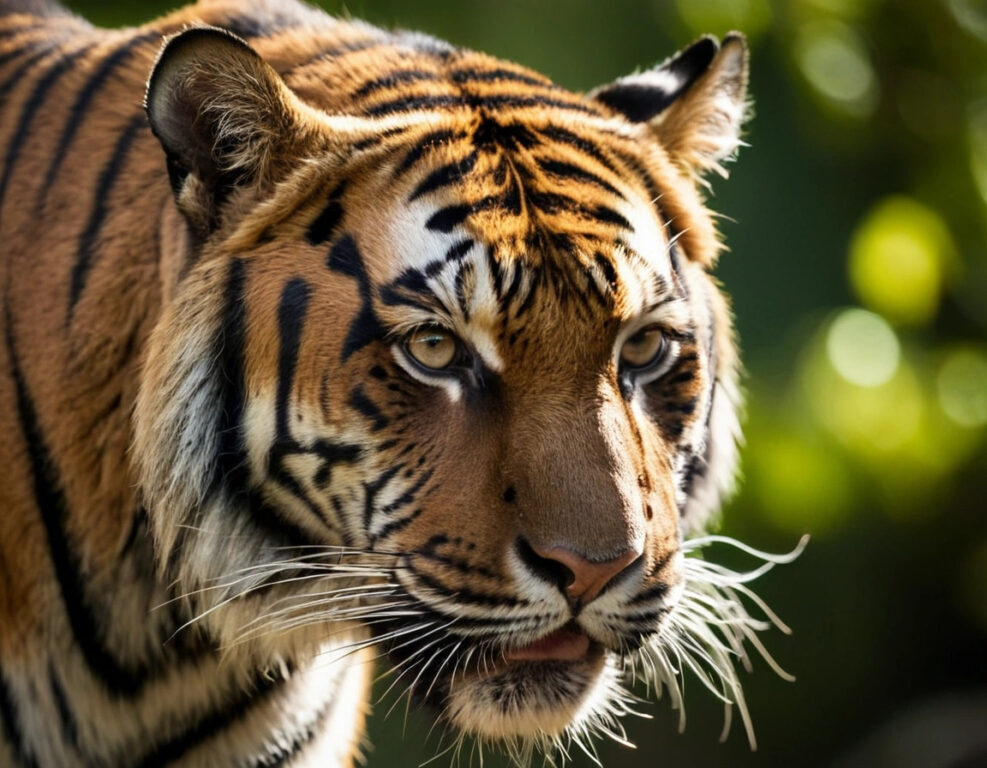
The Sumatran Tiger is not just a pretty feline. It is the only tiger subspecies that survives in Indonesia and, according to the latest censuses, fewer than 400 individuals remain in the wild. I’m talking about a figure that makes your head spin: fewer than the inhabitants of a small village. And the worst part is that the curve isn’t flattening, it keeps falling.
I have read reports from the World Wide Fund for Nature (WWF) and the United Nations Environment Programme (UNEP) and they all agree on the same thing: if drastic measures are not taken before 2030, the Sumatran tiger will enter a spiral of functional extinction. That is, even if a few remain, they will no longer be able to reproduce normally.
Why is the Sumatran tiger endangered?
The main reason is not climate change, as many people think. Climate change does aggravate the situation, yes, but the real blow comes from deforestation to plant oil palms. Sumatra has lost more than 50% of its primary forest in the last 30 years. What was once closed jungle is today roads, plantations and villages.
The Sumatran tiger needs enormous territories: an adult male can roam over more than 100 km². When that space is fragmented into patches of forest surrounded by crops, the animal finds neither prey nor a mate. And that’s where the problem begins.
Poaching is the second blow. A tiger fang sells on the black market for more than 1,500 euros. A complete skin can exceed 10,000. With figures like that, it’s no wonder hunters risk prison. Indonesian laws punish poaching with up to 10 years in prison, but corruption and a lack of resources mean many go unpunished.
«We’re not talking about saving a pretty animal. We’re talking about saving an entire ecosystem. The tiger is the piece that maintains the balance.» — A forest ranger from Riau province, in a 2024 interview.
The role of the Sumatran tiger in the ecosystem
As a large predator, the Sumatran tiger controls populations of deer, wild boar and monkeys. If it disappears, those herbivores multiply unchecked, devastate the vegetation and leave dozens of smaller species without food. It is a domino effect that is already being seen in some areas of Aceh and Jambi.
Furthermore, the tiger is an umbrella species: by protecting its habitat, you automatically protect hundreds of plants and animals that live in the same jungle. That is why conservationists insist that investing in tigers is investing in biodiversity.
Real projects to save the Sumatran tiger
It’s not all pessimism. There are initiatives that are working, albeit on a small scale. For example, the Indonesian government’s Sumatran Tiger Conservation Program, with WWF support, has managed to breed more than 60 individuals in captivity in recent years. The problem is that reintroducing them into the wild is extremely expensive and complicated: you need intact forest, enough prey and 24/7 surveillance.
Another route is the restoration of biological corridors. Strips of jungle are being replanted to connect isolated patches. In Riau province, for example, 2,000 hectares of degraded forest have been recovered since 2020. It sounds like little, but for a tiger that needs to move, every kilometer counts.
There is also international pressure. The European Union has threatened to ban palm oil from plantations linked to deforestation. That measure, if truly applied, could change things. But agricultural lobbies are slowing it down as much as they can.
The behavior of the Sumatran tiger: more solitary and more vulnerable
This tiger is smaller than its Bengal or Siberian cousins. An adult male rarely exceeds 140 kilos. It lives alone, marks its territory with urine and scratches, and only joins females during mating season. That solitude makes it very sensitive to fragmentation: if its territory is cut off, it cannot look for a mate elsewhere.
Furthermore, as its habitat shrinks, tigers come closer to villages. And that’s where conflicts begin: they kill livestock, sometimes attack people. Farmers, rightly so, see them as a threat. More than 50 fatal attacks have been documented in the last decade. The solution is not to kill the tiger, but to compensate livestock owners and improve surveillance.
What can we do to protect the Sumatran tiger?
Much more than it seems. The first thing is not to buy products containing uncertified palm oil. Look for the RSPO seal (Roundtable on Sustainable Palm Oil). It’s not perfect, but it is a filter.
The second is to support organizations working on the ground. WWF, Traffic or the Leuser Foundation are some of them. With 5 euros a month, a local forest ranger’s salary is paid for a day.
And the third, perhaps the most important, is to talk about it. The Sumatran tiger doesn’t make the news because it isn’t a polar bear. But its situation is just as critical. Sharing accurate information helps social pressure reach politicians.
The future of the Sumatran tiger is not written. It depends on decisions being made now, in 2026. If we carry on as we have so far, in 2035 only a photo in a book will remain. If we make a move, perhaps our children will be able to see it in the wild. It is not a utopia, it is a choice.