

Post actualizado el día octubre 26, 2026 by DeiviSanzPlay
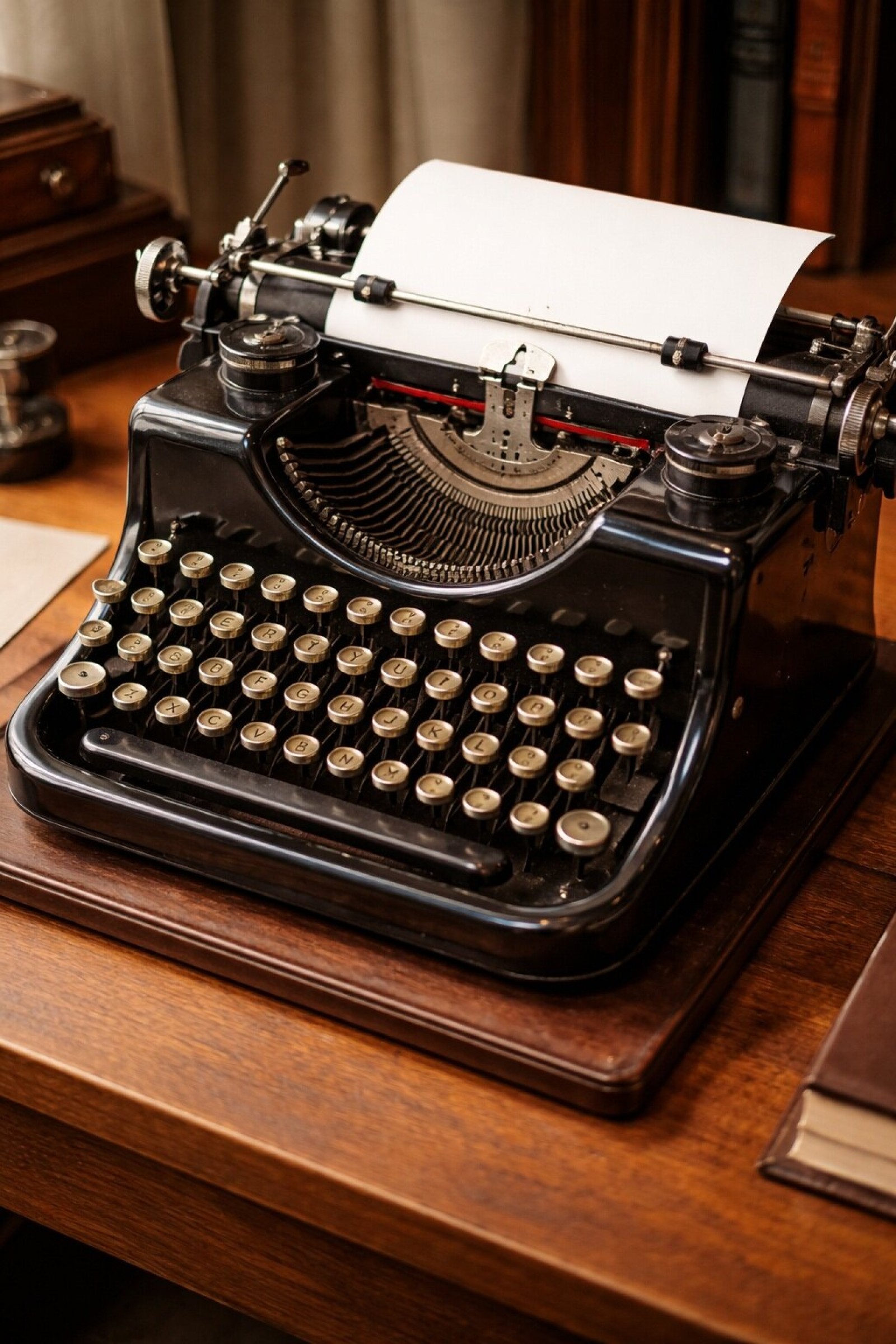
There is a sound that no digital keyboard has ever replicated. The sharp clack of a typewriter key hitting paper, the metallic ping of the carriage return, the small bell warning you that you are running out of line. If you grew up with a laptop, you have probably never felt that rhythm. And that is exactly the point: typewriters were not just machines for writing. They were machines for thinking.
The typewriter of the past forced you to commit. Every keystroke was permanent. There was no backspace, no undo, no «select all and delete». If you wanted to fix something, you had to roll the paper back, grab a correction patch, and cover the mistake on the reverse side of the page. The final document carried the topography of what you had said and what you had erased.
Why the Typewriter Sound Still Haunts Us in 2026
Search interest in «typewriter sound» and «mechanical keyboard click» has not stopped growing. Apps like Typewriter or Sound of Typing exist for a reason: people miss the percussion of their own thoughts. The typewriter sound is not nostalgia for the sake of nostalgia. It is the memory of a physical act that digital tools have flattened into silence.
When you type on a mechanical typewriter, you hear the effort. You feel the resistance. The machine does not pretend the work is effortless. That tactile feedback is exactly what modern productivity culture has tried to eliminate, and maybe that is why so many writers, from novelists to screenwriters, keep a vintage machine on their desk.
The Physicality of a Letter Written on a Typewriter
A letter typed on a vintage typewriter was an object, not a message. It had weight. It smelled of ink and metallic oil. You could run your fingers over the indentations the keys left on the paper and feel where the writer pressed harder. That is a level of intimacy no email attachment can reproduce.
People collect typewriters today for that reason. Not because they are faster or more efficient, but because they are honest. A typed page shows the mistakes, the corrections, the hesitation. It is a document with scars.
The typewriter was not a tool for writing. It was a tool for having thought before writing.
Thinking Before Writing: The Architecture of Ideas
Here is the real difference, and it is abysmal. On a typewriter, thinking was writing. The machine only materialized what you had already built inside your head. You could not «fix it later». You had to have the blueprint clear before laying the first stone.
Today we build as we go, brick by brick, with the constant possibility of tearing down and starting over. That is not necessarily worse. It is a different world. One prioritizes final perfection through a rigorous plan. The other prioritizes exploration and continuous refinement.
But let’s be honest: the second method has a cost. When everything is editable, nothing feels final. When nothing feels final, nothing feels important. The typewriter mindset was brutal, but it produced a kind of clarity that infinite drafts rarely achieve.
Manual Typewriters vs. Digital Writing Tools: A Fair Comparison
I am not going to tell you that a typewriter is better than a laptop. That would be a lie. Try writing a 5,000-word report on a manual typewriter and tell me how your wrists feel. The manual typewriter is slow, loud, and unforgiving. For certain tasks, it is objectively terrible.
But for the first draft of anything that matters, the constraint is the feature, not the bug. Here is what actually changes when you sit in front of a typewriter:
- You stop editing while writing. The two acts separate, and both improve.
- You plan more. Every sentence costs physical effort, so you waste fewer of them.
- You finish more. There is no browser tab waiting to distract you.
- You accept imperfection. The page will never be clean, and that is fine.
Are Typewriters Making a Comeback in 2026?
Yes, but not in the way you might think. Sales of new manual typewriters are almost nonexistent, but the second-hand market is alive and well. Platforms like eBay, Etsy and specialized forums keep moving refurbished Olympia, Smith-Corona and Olivetti models to buyers who are not collectors but users.
There is also a growing niche of modern typewriters designed for writers: machines like the Freewrite or the Astrohaus lineup that mimic the typewriter experience with an e-ink screen and no internet connection. They are not typewriters in the strict sense, but they inherit the philosophy: one task, no escape, commit to the page.
The Sound, the Smell, the Weight: Why Objects Matter
We have spent two decades digitizing everything and calling it progress. And in many ways, it is. But we have also lost something that no cloud backup can restore: the tangible experience of the typewriter. The paper feeding in. The ribbon wearing out. The bell that tells you to stop and start again.
A typed letter was not just communication. It was evidence. Evidence that someone sat down, loaded a sheet, and spent real time thinking about you. You cannot fake that with a templated email.
That is why the typewriter is a treasure we never should have retired. Not because it was efficient. Because it was human. Because it slowed us down enough to hear ourselves think. And in 2026, with notifications firing every eleven seconds, that might be the most valuable thing a machine can do.
