Post actualizado el día octubre 24, 2026 by DeiviSanzPlay
When you look at the sky on a clear night, those twinkling lights are nothing more than enormous balls of incandescent gas. But what exactly are stars made of? The short answer: hydrogen and helium, above all. But things get complicated when you learn that inside them, all the elements that make up your body and the planet you live on are cooked up. Yes, the calcium in your bones and the iron in your blood were forged in the core of a star that died before the Sun existed.
The cosmic recipe: hydrogen, helium, and a little bit of everything
A typical star, like our Sun, is composed of approximately 73% hydrogen, 25% helium, and barely 2% heavier elements (which astronomers call «metals,» even though they include gases like oxygen or nitrogen). That proportion is no accident: it is inherited from the Big Bang, which only produced hydrogen, helium, and traces of lithium. Everything else has been manufactured inside stars over billions of years.
The key to stars shining is nuclear fusion. In the core, the pressure and temperature are so brutal that hydrogen nuclei (protons) fuse to form helium. In that process, an enormous amount of energy is released, which counteracts gravity and keeps the star stable for millions or billions of years. Without that reaction, the star would collapse in on itself within hours.
But fusion doesn’t stop at helium. When the hydrogen in the core is exhausted, the most massive stars begin to fuse helium to produce carbon and oxygen. Then, if the mass allows, they continue with neon, silicon, and sulfur, until they reach iron. Iron is the end of the road: fusing it doesn’t release energy, it consumes it. When the core of a massive star fills with iron, the star is doomed to explode as a supernova.
That explosion is what disperses all those heavy elements through space. Without those violent deaths, rocky planets and life would not exist. So when you ask what stars are made of, you are really asking what we are made of.
The process of stellar formation: from molecular cloud to star
Stars are not born out of nothing. They form in enormous clouds of gas and dust called molecular clouds, which can be hundreds of light-years in diameter. Within them, denser regions begin to collapse under their own gravity. That collapse can be triggered by the shockwave of a nearby supernova or by collisions between clouds.
As the material falls toward the center, a protostar forms: a hot core that does not yet fuse hydrogen but shines from the gravitational energy released. Around that protostar, a disk of gas and dust forms, the protoplanetary disk, from which planets are later born. This entire process can last millions of years.
When the temperature at the center of the protostar reaches about 10 million degrees Kelvin, nuclear fusion ignites and the star enters what is called the main sequence. There it will spend most of its life, fusing hydrogen into helium. Our Sun has been in that phase for about 4.6 billion years and has another 5 billion left before it becomes a red giant.
Not all clouds collapse in the same way. The initial mass determines almost everything: if the cloud is very massive, a blue supergiant star will be born that will live fast and die young; if it is small, a red dwarf that can last trillions of years. Nature is not democratic in this.
Types of stars according to their composition and temperature
Astronomers classify stars according to their spectrum, which reflects their surface temperature and the elements that absorb light in their atmosphere. The standard classification goes from hottest to coolest: O, B, A, F, G, K, and M. Type O and B stars are blue, massive, and extremely luminous; type M stars are red dwarfs, small and cool.
Composition varies with type. Type O and B stars have cores that fuse hydrogen at a frantic rate and produce enormous quantities of heavy elements through nucleosynthesis. Red dwarfs, on the other hand, are much longer-lived and more stable; their low temperature makes fusion slow, so they can shine for trillions of years.
There is another key factor: metallicity. The oldest stars, formed shortly after the Big Bang, have very few heavy elements. Younger stars, like the Sun, have higher metallicity because they formed from material enriched by previous generations of stars. That difference affects planet formation: without metals, it is difficult for rocky worlds to form.
There are also peculiar stars, such as carbon stars (with more carbon than oxygen in their atmosphere) or type S stars, with zirconium and titanium. But those are rarities. Most of the stars you see in the sky are type G, K, or M, with compositions similar to that of the Sun.
What we still don’t know (and what we believe we know)
Although we have a fairly solid idea of stellar composition, there are details that escape us. For example, we don’t know with certainty how much dark matter there is in the universe or how it affects star formation. Nor do we fully understand the mixing processes in stellar interiors, which can bring heavy elements to the surface.
What is clear is that stars are the element factories of the universe. Every carbon atom in your body, every oxygen molecule you breathe, was forged in a star. As Carl Sagan said, we are made of star stuff. And it is not a metaphor: it is cosmic chemistry.
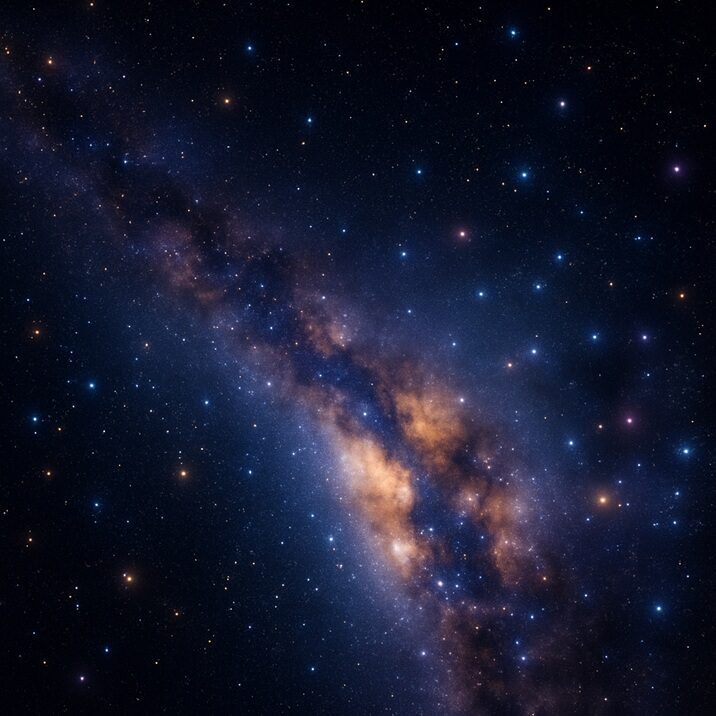
So the next time you see a shooting star or gaze at the Milky Way, remember that you are looking at the past. That light reaching you left a star that may no longer exist, but that left its mark in the form of elements that are now part of you. Stars don’t just illuminate the sky: they build us.