Post actualizado el día octubre 26, 2026 by DeiviSanzPlay
The Asiatic lion doesn’t eat like a generic big cat. If you picture it bringing down a buffalo every three days, you’re wrong. Its menu is a mix of chital deer, sambar, wild boar, and whatever the Gir landscape puts in front of it. And that’s the thing: the Asiatic lion diet is less about raw power and more about reading the terrain.
Let me be blunt: Asiatic lions are picky in a weird way. They’re not the apex killing machines documentaries sell you. They’re opportunists with a strong preference for medium-sized ungulates, and they’ll scavenge or steal a kill if it saves energy. That’s not laziness, that’s strategy.
What the Asiatic Lion Actually Hunts in Gir Forest
In Gir National Park, Gujarat, the Asiatic lion prey list is dominated by chital (spotted deer), sambar deer, nilgai (blue bull), and wild boar. Those four species make up the bulk of their diet, and any study you read from the Wildlife Institute of India points in the same direction.
Chital is the bread and butter. Easy to catch, abundant, and lean. Sambar is bigger and riskier, but lions go for it when they need more meat per hunt. Wild boar is a nasty opponent, yet lions still take them down because the payoff is huge.
Domestic livestock? Yes, and this is where I’ll take a side: it’s a real problem. Cattle, goats, and buffaloes from Maldhari settlements inside the sanctuary show up in lion scat studies. The conflict between lions and herders isn’t a side note, it’s central to how this species survives outside protected borders.
How the Asiatic Lion Hunting Strategy Works
Lions in Gir don’t run marathons. They ambush. Females do most of the killing, working in pairs or small groups, using dry grass, acacia scrub, and ravines as cover. A lion hunting strategy here is short, brutal, and efficient: stalk, close the distance, then a burst of speed of up to 80 km/h for a few dozen meters.
Males usually hang back and muscle in on the kill. It’s unglamorous but it’s how the pride structure works. Coalition males eat first, then females, then cubs. If prey is scarce, cubs starve. That’s the reality nobody puts on a poster.
Group hunting matters because Gir’s prey is fast and alert. A single lion fails more often than it succeeds. Two or three coordinating from different angles cut the escape routes. That’s why lionesses almost always hunt together — it’s not social bonding, it’s math.
Roughly 60-70% of Asiatic lion hunts end in failure. The ones that succeed feed the pride for two or three days.
Seasonal Changes: What Does the Asiatic Lion Eat in Summer vs Monsoon
Here’s where most articles get lazy. They say «lions eat deer» and move on. But the Asiatic lion food sources shift dramatically with the seasons. In the dry summer months (March to June), water sources shrink and prey concentrates around them. Lions camp near those spots and hunt with less effort.
When the monsoon hits, vegetation explodes, prey disperses, and hunting gets harder. Lions respond by broadening their range and targeting smaller or weaker animals. Livestock depredation spikes in this period because wild prey is harder to find.
Winter is the sweet spot. Cooler temperatures mean lions can hunt longer without overheating, and ungulate herds are more predictable. If you want to see lions on a kill, that’s the window.
Do Asiatic Lions Eat Anything Else? Small Prey, Carrion, and Odd Choices
Yes, and this surprises people. Asiatic lions will eat porcupines, hares, peafowl, and even reptiles when larger prey isn’t available. Porcupine quills have been found embedded in lion skulls and jaws — proof that they try, and sometimes regret it.
Carrion gets eaten too. Unlike some purist big cats, lions aren’t above scavenging a dead buffalo or a livestock carcass. In a landscape as human-dominated as Gujarat’s Saurashtra region, flexibility isn’t a bonus, it’s a requirement.
And here’s a point worth defending: the Asiatic lion’s adaptive diet is the main reason the species still exists. They lost their historic range across Persia, Arabia, and northern India. Now they’re confined to one pocket of Gujarat. That survival came from eating whatever worked, not from sticking to a rigid menu.
Asiatic Lion vs African Lion Diet: The Key Differences
African lions hunt zebra, wildebeest, and buffalo in open savanna. Asiatic lions hunt smaller, forest-adapted prey in dense scrub. No zebras in Gir. No wildebeest either. That’s why the Asiatic lion diet composition leans heavily on chital and sambar, which African lions rarely touch.
Asiatic lions also hunt alone more often than their African cousins. Open plains reward cooperation; dense forest rewards individual stalking. Same species family, totally different playbook.
And a crucial detail: Asiatic lions share their habitat with leopards, hyenas, and jackals. That competition forces them to be more aggressive about defending kills and more willing to eat fast. Every carcass is contested.
Why This Diet Matters for Conservation in 2026
The Asiatic lion population sits around 670-700 individuals, almost all in Gujarat. That’s up from roughly 20 in 1913, which is a genuine conservation win. But it also means every dietary shift, every livestock conflict, every drought hits the whole species at once.
If prey collapses, lions move into villages. If they move into villages, retaliation killings go up. If retaliation goes up, the entire recovery story unravels. The Asiatic lion feeding habits aren’t a trivia question — they’re a survival metric.
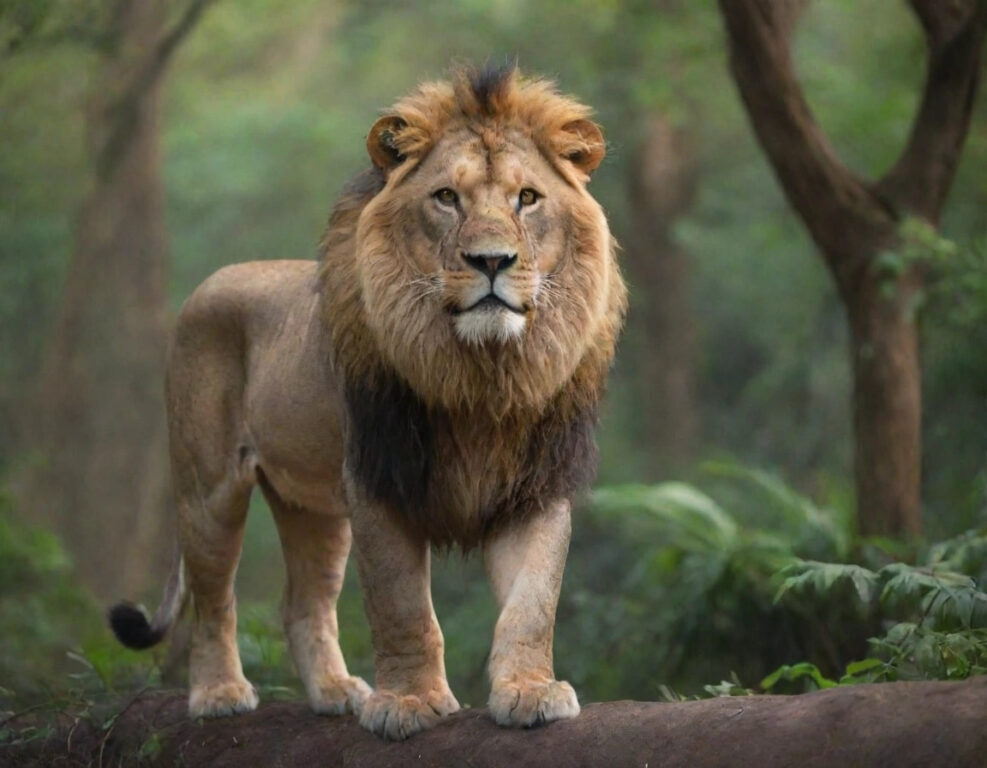
So next time you see a photo of a Gir lion, don’t just admire the mane. Think about the chital it tracked for an hour, the boar that almost gored it, and the cattle it might have stolen from a herder last Tuesday. That’s the real diet. Messy, adaptive, and the reason the species is still here.