

Post actualizado el día octubre 24, 2026 by DeiviSanzPlay
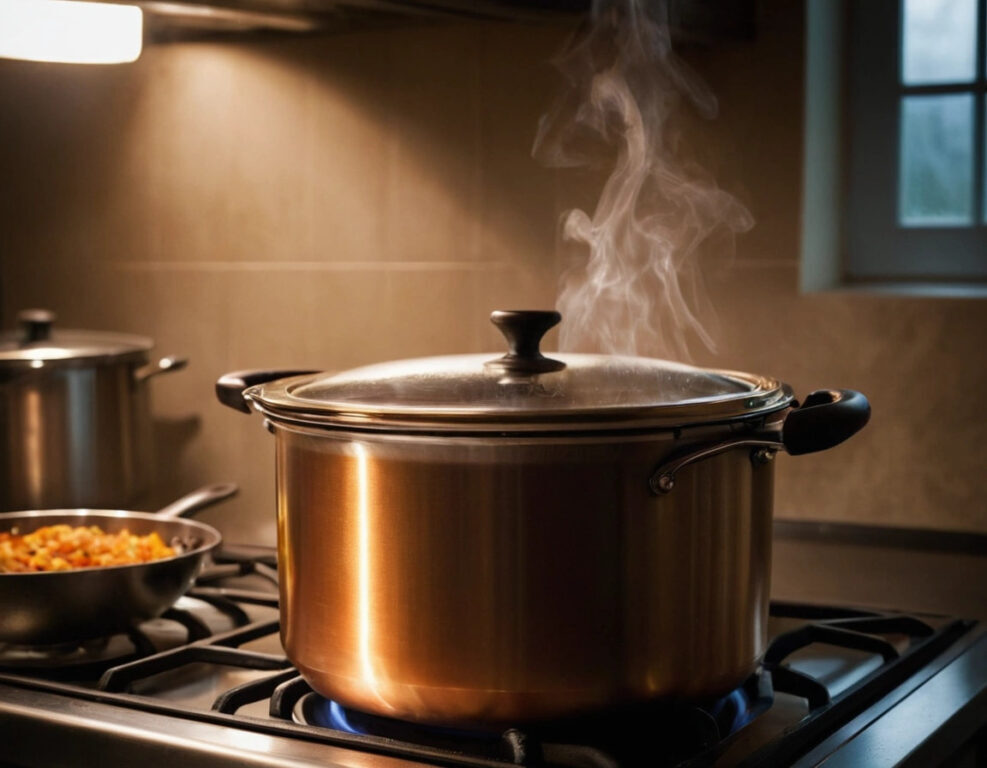
The pressure cooker is that pot that many people have in the cupboard and don’t use out of fear. And that’s a shame, because it’s the utensil that saves you the most time and energy in the kitchen. I’ll tell you straight: if you cook legumes, tough meats or stews, a well-used pressure cooker will change your life.
But before we get into the thick of it, I want to make it clear that not all pressure cookers are the same. There are the traditional ones, with a valve and weight, and there are electric ones, with menus and a screen. Each one has its audience, and choosing badly can end in frustration.
Pressure cooker: definition and how it really works
A pressure cooker is an airtight container that cooks food with steam at high pressure. When it’s sealed hermetically, the steam doesn’t escape, the internal pressure rises and the water reaches temperatures far above 100 °C. Specifically, most domestic models reach around 120 °C.
That increase in temperature is the key to everything. At 120 °C the fibers of meat break down sooner, the collagen dissolves and the chickpeas soften in no time. That’s why a pressure cooker cooks up to 70% faster than a normal saucepan.
The pressure is generated by trapping the steam. In traditional cookers, a valve lets the excess escape so it doesn’t explode. In electric ones, a sensor controls the pressure and temperature. In both cases, the result is the same: fast, flavorful cooking.
History: from Denis Papin to smart cookers
The invention isn’t new. Back in 1679, the French physicist Denis Papin presented his «digester» or «Papin’s pot.» It was an iron container with a sealed lid and a primitive safety valve. Papin was looking to extract all the substance from bones to make nutritious broths, and he certainly succeeded.
During the 18th and 19th centuries, the invention was gradually perfected. But it wasn’t until the 20th century that pressure cookers reached domestic kitchens. The fear that they would explode was real: the first models didn’t have today’s safety systems and more than one person got a scare.
The great revolution came with double safety valves and locking systems. Today it’s practically impossible for a pressure cooker to explode if it’s in good condition and used properly. Manufacturers invest millions in testing each model at extreme pressures.
And then came electric cookers, which in addition to cooking under pressure, can be used to steam, make yogurt, sauté or even cook at low temperature. They’re on another level.
What a pressure cooker is for: uses beyond legumes
Many people associate the pressure cooker with chickpeas and lentils, and stop there. Wrong. A pressure cooker is good for much more. Let me summarize the uses I give it myself:
- Legumes: chickpeas, beans, lentils. Without pre-soaking in many cases, in 30-40 minutes.
- Tough meats: beef shank, pork cheek, veal shank, ribs. They come out tender in an hour.
- Rice and grains: brown rice in 20 minutes, quinoa in 5.
- Soups and broths: bone broth in 45 minutes instead of 4 hours.
- Desserts: flans, puddings, cheesecakes. Yes, you read that right.
- Steamed vegetables: potatoes in 10 minutes, artichokes in 15.
- Vegan dishes: seitan stews, tempeh, vegetable stews.
The versatility is enormous. And you don’t need to be a chef to make the most of it. Just follow the manufacturer’s instructions and adjust the times, and you’ll have home-cooked food in record time.
Real advantages over other cooking methods
The first advantage is saving time. There’s no debate. A stew that takes 3 hours in a normal pot is ready in 45 minutes in a pressure cooker. That’s time you get back for yourself.
The second is energy savings. Less cooking time means less gas or electricity. And if we’re talking about electric cookers, consumption is even lower because they’re insulated and make better use of the heat.
The third is nutrient retention. By cooking quickly in a closed environment, water-soluble vitamins (like C and the B group) are lost less than in a long boil. Fewer minerals are also lost in the cooking water.
The fourth is flavor. Since the water doesn’t evaporate, the flavors become concentrated. A broth made in a pressure cooker tastes more intense than one made in an open pot. And the meats stay juicy inside.
Safety: myths and realities of modern pressure cookers
The fear of it exploding is the main brake for many people. And it’s a fear inherited from old cookers. Today’s pressure cookers incorporate several safety systems:
- Safety valve: releases steam if the pressure rises too much.
- Lid lock: prevents opening the cooker while there’s pressure inside.
- Pressure indicator: a rod that rises and tells you if there’s still pressure.
- Silicone gasket: seals the lid and prevents leaks.
With these systems, a pressure cooker is as safe as a normal saucepan. Of course, you have to check the gasket and valves from time to time, and not fill it more than two-thirds of its capacity.
Traditional vs. electric pressure cooker: which to choose
Here there’s debate. Traditional cookers are cheaper, take up less space and work on any stove, including gas. Electric ones are more expensive, but they offer automatic menus, a timer and keep food warm.
If you cook every day and want convenience, the electric one is your ally. If you’re the type who controls the heat by eye and doesn’t want to depend on electricity, the traditional one is unbeatable. I have both and I use the electric one for legumes and the traditional one for quick stews.
An important detail: electric cookers usually have somewhat lower pressure (about 11 psi) than first-generation traditional ones (up to 15 psi). That translates into slightly longer cooking times, but the difference is a matter of minutes.
Frequently asked questions about pressure cookers
How long do chickpeas take to cook in a pressure cooker?
Without pre-soaking, between 35 and 45 minutes from when the pressure rises. If you’ve soaked them the night before, 20-25 minutes is enough. Add a bay leaf and a piece of kombu seaweed to improve digestion.
Can you cook rice in a pressure cooker?
Yes, but carefully. White rice takes 5-7 minutes and brown rice takes 20-25. The water ratio is lower than in a normal pot: one and a half parts water to one part rice.
How do you clean a pressure cooker?
The cooker itself is washed with hot water and soap. The lid, valve and gasket require more attention: you have to take them apart and clean off food residue well. Many models have dishwasher-safe parts, but the gasket is better washed by hand so it lasts longer.
How often should the pressure cooker gasket be replaced?
It depends on use. If you use it daily, every 12-18 months. If it’s occasional, every 2-3 years. A hardened or cracked gasket doesn’t seal well and the cooker loses pressure. It’s an inexpensive part and replacing it is simple.
Are pressure cookers expensive?
There are all prices. A decent traditional cooker is around 30-60 euros. A quality electric one can cost between 80 and 200 euros. Considering the time and energy savings, it pays for itself in a few months.
Tips to get the most out of it
Don’t fill the cooker more than two-thirds. Foods that foam, like legumes, shouldn’t exceed half. Leave room for the steam.
Always use a little liquid. At minimum, a cup of water or broth. Without liquid no steam is generated and the cooker won’t work.
Lower the heat when steam starts coming out. You don’t need to keep the heat high the whole time. As soon as the valve starts whistling, lower to medium or low heat.
Let the pressure drop on its own. For meats and legumes, it’s better to wait for the pressure to release naturally. For vegetables and fish, you can speed up the process with the quick-release valve.
Adjust the times to your cooker. Each model has its particularities. The first few uses are trial and error. Note down the times that work for you and repeat them.
The most common mistake: not using it out of fear
I’ve seen many people have a pressure cooker sitting unused in the cupboard. «It’s just that it scares me,» they say. And meanwhile, they lose hours and hours of cooking. It’s a waste.
Modern pressure cookers are safe. Period. If you follow the instructions, there’s no danger. And if it makes you nervous, start with something simple: steamed potatoes or rice. You’ll see that once you get the hang of it, you won’t go back.
What’s more, the energy savings are real. In a context of sky-high electricity and gas prices, cooking in less time is a relief for your pocket. And for the planet.
So now you know: if you have a forgotten pressure cooker, take it out. If you don’t have one, think about it. It’s one of those utensils that, once you try them, you can’t understand how you lived without them.
