Post actualizado el día octubre 25, 2026 by DeiviSanzPlay
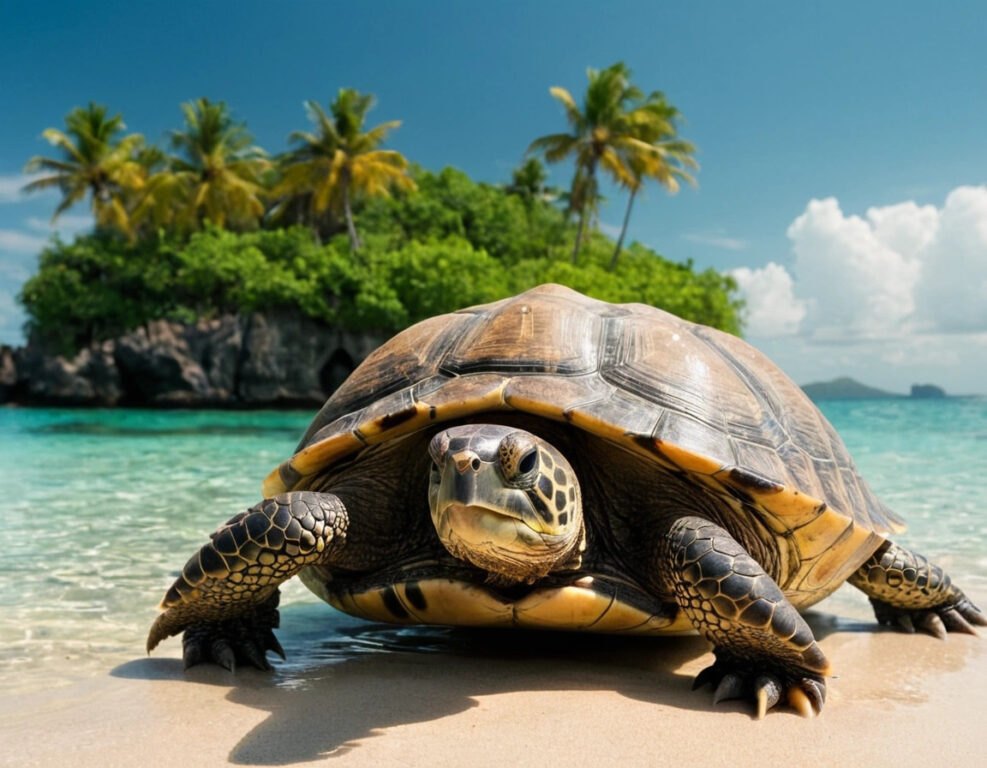
The longest-lived tortoise in the world is named Jonathan and is still alive in 2026. It is not a legend or an internet hoax: it is a real animal that lives on the island of Saint Helena, in the middle of the South Atlantic, and that was born around 1832. That means it is about 193 or 194 years old. When he was already an adult tortoise, a king still ruled in Europe, cars did not exist, and people lit their homes with candles.
Jonathan, the giant tortoise that has seen three centuries pass
Jonathan is a Seychelles giant tortoise, of the species Aldabrachelys gigantea hololissa. He arrived on Saint Helena in 1882 as a gift for the island’s British governor. At that time he was already about 50 years old, so the calculations of his age are not an invention: they are based on that documented fact and on the growth of his shell.
The longest-lived tortoise in the world does not live in a luxury zoo or a research center. He lives in the gardens of Plantation House, the official residence of the governor of Saint Helena, alongside three other giant tortoises: David, Emma, and Fred. There he grazes on grass, sunbathes, and receives visits from tourists who come exclusively to see him.
His shell is worn, with marks and areas polished by rubbing. He has cataracts in one eye and has lost his sense of smell, but the veterinarians who care for him say he still has a good appetite and moves around on his own. In 2024 he was diagnosed with an infection in his beak and was treated with antibiotics and a soft diet. He recovered.
Why do giant tortoises live so many years?
The extreme longevity of the longest-lived tortoise in the world is not an isolated case. The giant tortoises of Seychelles and Galápagos are known for easily exceeding 100 years, and some reach 150 or more. Several factors explain this.
The first is their slow metabolism. Giant tortoises have a very low metabolic rate, which reduces cellular wear and the production of free radicals. The second is their immune system, which seems to resist the passage of time better than that of mammals. And the third is that they have no natural predators when they are adults: their shell protects them from almost everything.
In addition, giant tortoises can enter a state of torpor when food or water is scarce, which allows them to survive in harsh conditions. That ability to slow their bodies down for weeks or months also contributes to their living so long. It is not magic, it is extreme biology.
Other long-lived animals that compete with Jonathan
Although Jonathan is the verified longest-lived tortoise in the world, there are other animals that come close. The Aldabra giant tortoise named Adwaita died in 2006 in a zoo in Calcutta at an estimated age of 255 years, but that figure was never confirmed with documents. Tu’i Malila, a radiated tortoise from Tonga, lived at least 188 years and died in 1965.
Among non-tortoise animals, the Greenland shark can reach 400 years, and the Iceland clam (Arctica islandica) has recorded individuals of more than 500 years. But if we are talking about terrestrial vertebrate animals, the longest-lived tortoise in the world is Jonathan, without question.
There is a detail that many people overlook: Jonathan’s age is not confirmed with a birth certificate, because in 1832 no one kept that record for a tortoise. What is documented is his arrival on Saint Helena in 1882. From that point on, scientists estimate that he was between 50 and 60 years old. That is why it is said that he was born around 1832, with a margin of error of a few years.
What Jonathan has seen while the world changed
Jonathan has lived longer than any person alive today. He was born before the telephone was invented, before penicillin was discovered, before humans set foot on the Moon. He has seen empires fall, survived two world wars, and witnessed the rise of the internet and mobile phones.
On Saint Helena, the longest-lived tortoise in the world is a local celebrity. He appears on stamps, on T-shirts, and on the island’s currency. In 2022, on the occasion of his 190th birthday, public events were organized and he was given a vegetable cake. The governor at the time described him as «a symbol of resilience and calm.»
There is something almost philosophical about his case. While humans obsess over productivity and speed, Jonathan has spent nearly two centuries doing the same thing: eating, sleeping, and walking slowly. And there he still is. He does not need to do anything special to be the longest-lived land animal on the planet.
What will happen when Jonathan dies?
No one knows when Jonathan will die, but the veterinarians who care for him say he could live a few more years. When that happens, the longest-lived tortoise in the world will become another. Currently, the next on the list is an Aldabra giant tortoise named Tommy, who lives in the Zurich Zoo and is about 120 years old. There is also Goliath, in Florida, at about 90.
What is certain is that Jonathan will not be forgotten. His story has become a viral phenomenon every time his birthday approaches. Media around the world talk about him, and on Saint Helena they are already preparing to celebrate his 194 years in 2026. If you want to see him in person, you will have to travel to one of the most remote islands on the planet. There are no direct flights from Spain or from the Americas: you get there by boat from Cape Town or on a weekly flight from Johannesburg.
So now you know which is the longest-lived tortoise in the world. It is not a myth, it is not an exaggeration: it is a real animal that is still grazing in a garden in the South Atlantic, oblivious to all the noise we humans have made around him. And if anything proves his existence, it is that longevity is not about doing more, but about doing everything more slowly.