

Post actualizado el día octubre 27, 2026 by DeiviSanzPlay
Most people hear «scientific method» and picture a guy in a lab coat scribbling formulas. Truth is, you already use it every single day without noticing. When you test a new detergent against your old one, you’re running the scientific method. When you sleep 6 hours one week and 8 the next to see which feels better, same thing.
The scientific method is just a structured way to figure out whether something is actually true or if you’re fooling yourself. That last part matters more than most explanations admit. Humans are fantastic at convincing ourselves we’re right, and the method exists precisely to stop that.
Steps of the Scientific Method Explained Simply
There’s no magic number of steps, but the classic version breaks down into six. You’ll see them in every school textbook, and they hold up fine if you apply them honestly.
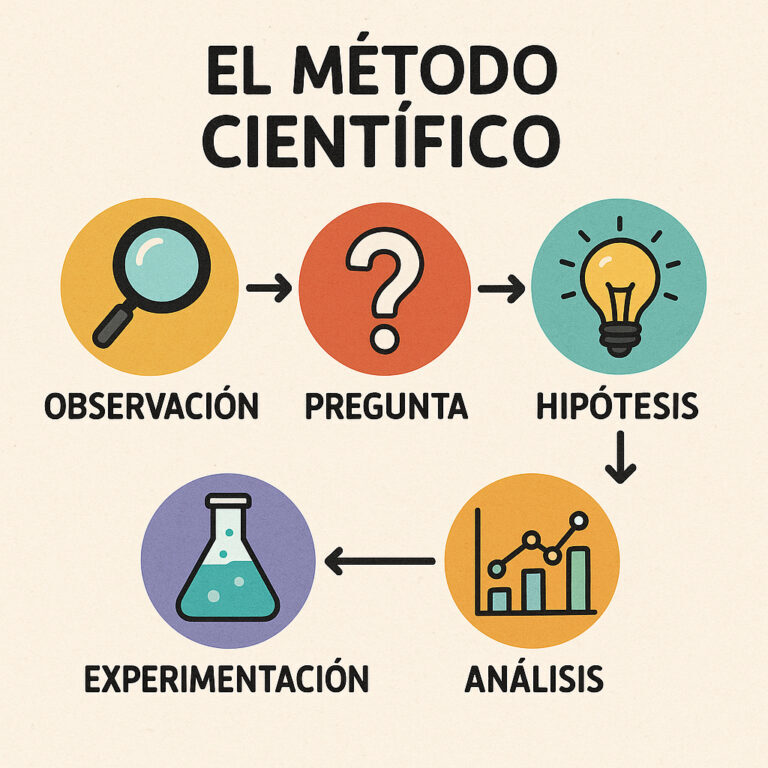
1. Observation
You notice something odd or interesting. Say your houseplant looks healthier after you start talking to it while watering. Could be nonsense. Could be real. You don’t know yet, and that’s the point.
2. Question
You turn that observation into a specific question: does talking to a plant actually affect its growth? Vague questions produce vague answers, so this step forces precision.
3. Hypothesis
You propose an explanation you can test. «I think talking to the plant makes it grow faster.» A good hypothesis is falsifiable — meaning someone could prove you wrong. If nothing could ever disprove your idea, it’s not science, it’s faith.
4. Experimentation
You take two identical plants, talk to one, ignore the other, and keep light, water and soil the same. That’s a controlled experiment. The variable you change is the one you’re testing; everything else stays locked.
5. Analysis
After three weeks, you measure. The plant you talked to is 3 cm taller. Now you compare the numbers and ask whether that difference means anything or is just noise.
6. Conclusion
You decide what the data supports. Maybe there’s a link. Maybe it was random. Either way, you report what you found, not what you hoped to find.
Why the Scientific Method Beats Guesswork
A lot of people confuse the scientific method with «doing research.» It’s not the same. Research is gathering information. The scientific method is a filter that separates real patterns from coincidences.
And here’s a detail most explanations skip: the process isn’t a straight line. You loop back constantly. A failed experiment often sends you right back to step 1 with a new observation. Real scientists spend most of their time bouncing between steps, not marching through them once.
Key Characteristics That Make It Work
- Objective: conclusions come from data, not from what you feel should be true.
- Repeatable: someone else, in another city, should get similar results following your steps.
- Logical and ordered: no jumping around, no skipping the boring parts.
- Self-correcting: when new evidence contradicts the old conclusion, the conclusion changes. Not the evidence.
That fourth point is where a lot of pseudoscience falls apart. Real science updates when facts change. Fake science digs in deeper.
The Trap: Correlation Is Not Causation
This is where most self-taught «scientists» get burned. Your plant grew more after you talked to it. Fine. But maybe it also got more sunlight that week. Or the room was warmer. Or you watered it more because you were paying attention to it.
The scientific method demands you eliminate those alternative explanations before claiming a cause. That’s why control groups exist. Without them, you’re just telling stories with numbers attached.
If your experiment can’t fail, it isn’t an experiment. It’s a performance.
You Use the Scientific Method Without Realizing It
Look at your daily life. You try two phone chargers to see which one loads faster. You test a new route to work to check if it saves time. You compare two brands of coffee and decide one gives you jitters.
All of that follows the same logic: observation, question, guess, test, compare, conclude. The only difference is that you rarely write it down. When you do write it down, you stop fooling yourself.
Even something as simple as figuring out why your phone battery drains so fast is a mini scientific investigation. You isolate variables — screen brightness, background apps, Wi-Fi — and test one at a time. That’s textbook methodology.
Common Misunderstandings Worth Killing
«The scientific method proves things.» No, it doesn’t. It supports or rejects hypotheses with varying degrees of confidence. Absolute proof belongs to math, not empirical science.
«A hypothesis is just a guess.» Not quite. A guess is casual. A hypothesis is a structured, testable prediction built on prior knowledge.
«Scientists follow the steps in order every time.» They don’t, and pretending otherwise makes science look robotic. Real research is messier, iterative, and often frustrating.
How to Apply It Tomorrow
Pick one thing in your life you’re unsure about. Something small. Does waking up earlier make you more productive? Does a certain food make you sluggish? Write down your question, state your prediction, change one variable, and track the result for a week.
That’s it. That’s the scientific method in your kitchen, your gym, or your home office. No lab coat required. The moment you stop guessing and start testing, you’re doing real science — and you’ll trust your own conclusions way more because you earned them.
