

Post actualizado el día octubre 17, 2026 by DeiviSanzPlay
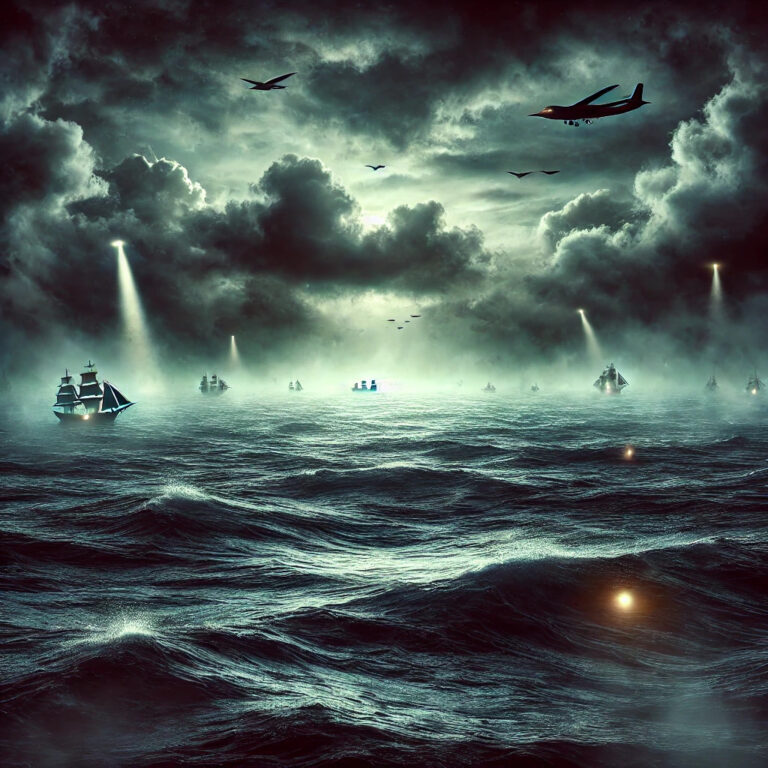
The Bermuda Triangle isn’t a dot on a map you can point to with a ruler. It’s a rough patch of the North Atlantic bounded by Miami, San Juan (Puerto Rico) and Bermuda, and it got its reputation the old-fashioned way: a handful of genuinely weird disappearances that never got a clean explanation. That’s the hook. Not aliens, not portals. The fact that the paperwork on some of these cases is still open.
I dug into this because most articles recycle the same five stories without checking dates, weather reports or Coast Guard records. When you actually read the primary sources, the Bermuda Triangle mysteries get more interesting, not less. Some cases are clearly explainable. Others are not, and the not-explainable ones are the ones worth your time.
Flight 19: The Case That Built the Legend
On December 5, 1945, five U.S. Navy TBM Avenger torpedo bombers took off from Fort Lauderdale on a routine navigation training flight. The flight leader, Lieutenant Charles Taylor, reported his compasses failing. Radio transcripts show him getting disoriented, thinking he was over the Florida Keys when he was almost certainly east of the Bahamas. The flight never returned. A Martin PBM Mariner sent to search for them also vanished with 13 crew aboard.
That single day is why the phrase «Bermuda Triangle disappearances» exists in popular culture. But here’s the part people skip: the Navy’s own investigation blamed Taylor for getting lost, then later changed the official report to say «causes or reasons unknown» because his mother complained. That bureaucratic flip-flop, not the weather, is what fed sixty years of conspiracy theories.
Could Taylor have simply been wrong about his position? Yes. Did that make five planes and 27 men vanish into thin air? No. The wreckage was never found because the Atlantic off the Bahamas is deep, currents are brutal, and 1945 search technology was primitive. Absence of evidence isn’t evidence of a portal.
The Real Geography and Why It Matters
The Bermuda Triangle covers roughly 500,000 square miles of ocean, and it sits on top of some of the busiest shipping lanes in the Western Hemisphere. That’s the boring truth nobody wants to hear: more traffic means more accidents. If you put a triangle around any heavily trafficked stretch of ocean, you’d get a similar list of incidents.
What makes this patch different is the combination of shallow shoals like the Bahamas Banks, the Gulf Stream pushing warm water north at 5 mph, and sudden tropical storms that can flip from calm to violent in under an hour. A small boat caught between the Gulf Stream and a squall line has a real problem, and that problem predates any mythology.
Lloyd’s of London, the insurance market that actually tracks ship losses, has said for decades that the Triangle isn’t statistically more dangerous than any other well-traveled ocean region. That’s not a sexy answer. It’s also the most credible one available.
Methane Hydrates: The Best Scientific Theory on the Table
If you want a genuinely plausible mechanism behind some Bermuda Triangle disappearances, look at methane hydrate deposits on the continental shelves. These are ice-like structures of methane trapped in water, and when they destabilize they can release huge bubbles of gas into the water column.
The theory, pushed by researchers including Dr. Richard McIver and later popularized by the 2003 Discovery Channel documentary, is that a ship floating over a methane blowout loses buoyancy instantly because the water beneath it is suddenly full of gas. A plane flying through a methane plume could theoretically stall or ignite. It’s speculative, but it’s testable physics rather than interdimensional portals.
A 2016 study in the journal Oceanography confirmed that methane seeps exist off the U.S. East Coast. Whether one ever brought down a ship in the Triangle specifically is unproven. Still, it’s the strongest natural explanation anyone has offered.
Why the Myth Refuses to Die
The Bermuda Triangle as a brand was invented in 1952 by a Fate magazine article, then supercharged by Charles Berlitz’s 1974 bestseller The Bermuda Triangle, which sold millions of copies by mixing real cases with invented ones. Berlitz included ships that never existed and timelines that didn’t match Coast Guard logs.
That’s the uncomfortable part. A lot of the «unsolved mysteries of the Bermuda Triangle» were solved decades ago, but the solutions don’t sell books. The Mary Celeste, for example, was found abandoned near the Azores in 1872, nowhere near the Triangle. Yet it still gets lumped in.
Social media made it worse. A single TikTok about a «mysterious portal» gets more engagement than a NOAA report explaining Gulf Stream dynamics, so the noise wins. That’s not a Bermuda Triangle problem, it’s a media literacy problem.
What Actually Remains Unexplained in 2026
Here’s my honest read after going through the records: the truly unexplained cases are fewer than five. The USS Cyclops in 1918 is the standout. A 542-foot collier with 306 crew vanished between Barbados and Baltimore with no distress call, no wreckage, and no explanation. That one still bothers me, because it was a large, modern ship in calm conditions.
Star Tiger and Star Ariel, two British South American Airways Avro Tudors that disappeared in 1948 and 1949, are also genuinely baffling. Both were in good condition, both gave routine radio reports, both vanished without a trace. Investigators at the time couldn’t explain them either.
Those three cases are the ones I’d defend as real Bermuda Triangle mysteries. Everything else, from Flight 19 to the Ellen Austin, has a plausible explanation if you’re willing to accept that the ocean kills people and doesn’t leave receipts.
The Bottom Line for Anyone Searching
If you’re here because you want confirmation that something supernatural is going on, I’m not your guy. If you want the actual state of the evidence in 2026, it’s this: the Bermuda Triangle is a real geographic area, the disappearances are real, and most of them are explainable through weather, human error and bad luck. The handful that aren’t explainable are the reason the legend survives, and they deserve better than clickbait.
What I’d tell anyone planning to sail or fly through the region: respect the Gulf Stream, check the squall forecasts, and don’t trust a compass that’s been sitting in a locker for two years. The Triangle doesn’t need magic to be dangerous.
