

Post actualizado el día octubre 26, 2026 by DeiviSanzPlay
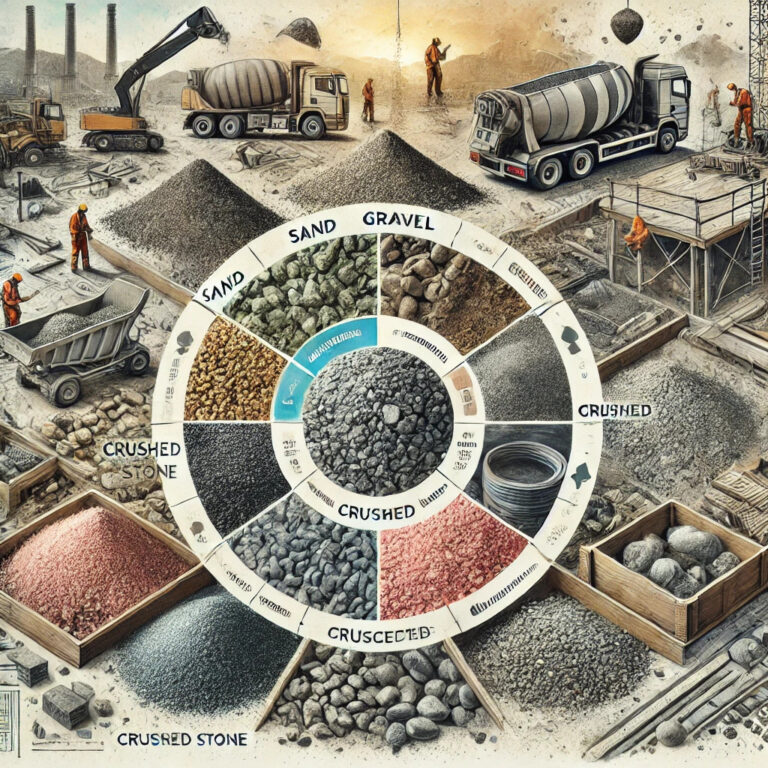
Aggregates aren’t just random rocks. They’re the skeleton of every concrete mix, asphalt road, and drainage bed you’ve ever walked on. And no, they’re not all the same. Mix up your aggregate types and you’ll get cracked foundations, weak mortar, and a bill you didn’t budget for. Let’s cut the fluff and get into what types of aggregates exist, how they differ, and which one you actually need.
What Counts as an Aggregate (and What Doesn’t)
An aggregate is any granular material — sand, gravel, crushed stone, slag, recycled concrete — used in construction. It’s not a binder. It doesn’t glue anything by itself. It sits inside the cement paste or bitumen and gives the mix its bulk, strength, and dimensional stability. That’s the whole point.
Size is the first real divider. Fine aggregates pass through a 4.75 mm sieve (No. 4 in ASTM terms). Coarse aggregates don’t. That single threshold decides whether you’re making mortar or pouring a footing.
The Main Types of Aggregates You’ll Actually Find on Site
Forget textbook lists that go on for pages. In practice, aggregates fall into three origin-based buckets, and every other classification is a subcut of these.
Natural aggregates
Sand, gravel, and crushed rock pulled straight from rivers, pits, or quarries. River aggregates get tumbled by water for years, so they come out rounded and smooth. Quarry aggregates are crushed, so they’re angular and rough. That shape difference isn’t cosmetic — it changes how the concrete behaves.
Artificial aggregates
Made in a plant. Expanded clay, expanded shale, slag, and manufactured lightweight aggregates fall here. They’re used when you need lower density, better insulation, or specific engineering properties that nature doesn’t hand you.
Recycled aggregates
Crushed concrete, brick, and asphalt from demolished buildings. In 2026 this category is growing fast — not just for green credentials, but because landfill costs and virgin material prices keep climbing. Recycled concrete aggregate (RCA) is now standard in road sub-bases and non-structural concrete.
Coarse vs Fine Aggregates: Where Each One Goes
Fine aggregates — sand, mostly — go into mortars, plaster, and the top layer of fine-finish concrete. They fill the gaps between bigger particles and make the mix workable.
Coarse aggregates — gravel, crushed stone, from 4.75 mm up to 40 mm or more — carry the load. Foundations, slabs, structural columns, road bases. If it has to bear weight, coarse aggregate is doing the heavy lifting.
The rule of thumb: the bigger the load, the coarser the aggregate. But past a point, oversized particles make the mix hard to place and increase segregation. There’s a sweet spot, and it’s project-specific.
Properties That Actually Matter When You Pick an Aggregate
Hardness, shape, gradation, water absorption, and surface texture. That’s the short list. Each one changes how the final concrete or asphalt performs.
- Hardness: affects compressive strength and wear resistance. Soft aggregates crumble under traffic loads.
- Shape: angular particles interlock and boost strength; rounded particles improve workability but reduce bond.
- Gradation: a well-graded mix (particles of many sizes) packs tighter and needs less cement paste.
- Water absorption: porous aggregates suck up mixing water, throwing off your water-cement ratio if you don’t account for it.
Ignore any of these and you’ll see it later — as shrinkage cracks, poor finish, or a mix that fails a slump test on the day of the pour.
River vs Quarry Aggregates: A Real Difference, Not Marketing
River aggregates have been smoothed by water transport. They’re rounded, cleaner, and give a smoother finish. Great for exposed concrete and decorative work.
Quarry aggregates are crushed, so they have angular faces and sharper edges. That angularity creates mechanical interlock inside the mix, which translates to higher compressive strength. For structural concrete, quarry-crushed stone usually wins.
There’s a catch: angular aggregates need more water and paste to reach the same workability. So you trade strength for pumpability. Pick based on what the job demands, not on habit.
How Aggregate Size Shapes Your Mix Design
Aggregate size drives strength, durability, and workability all at once. Fine aggregates give you a homogeneous, smooth mix. Coarse aggregates give you stability and load-bearing capacity. A balanced gradation — the right blend of both — is what separates a mix that lasts 50 years from one that spalls in five.
For pavements, you’ll typically see a 20 mm nominal maximum size. For mass concrete, you might go up to 40 mm or beyond. For thin overlays and repair mortars, you’re down at 10 mm or less. There’s no universal answer, and anyone who gives you one is guessing.
Recycled Aggregates: Worth It or Not?
Yes, for the right application. RCA works well in sub-base, backfill, and low-grade concrete. It reduces landfill waste and cuts demand for virgin quarry material. The trade-offs: higher water absorption, lower density, and more variability batch to batch. If your spec is tight, natural aggregate is still the safer bet.
But for sustainable projects, recycled aggregate is no longer a niche choice. It’s a legitimate material with its own standards (EN 12620, ASTM C33 covers some recycled uses). Specify it correctly and it performs.
Quick Answers to the Questions Everyone Asks
What are aggregates? Granular materials — sand, gravel, crushed stone, recycled concrete — used in concrete, mortar, asphalt, and drainage. They’re classified as fine or coarse by particle size, and as natural, artificial, or recycled by origin.
Which type is most common? Natural aggregates dominate globally. Sand and crushed stone are the workhorses of every construction site on the planet.
Fine vs coarse — what’s the cutoff? 4.75 mm. Below that, fine. Above that, coarse. Simple as that.
Best option: natural or artificial? Depends on the job. Natural for bulk and structural work. Artificial and recycled for specialized or sustainability-driven projects. Neither is universally better.
Next time you walk past a pile of gravel, you’ll know exactly what it is, where it came from, and what it’s about to become.
