

Post actualizado el día octubre 26, 2026 by DeiviSanzPlay
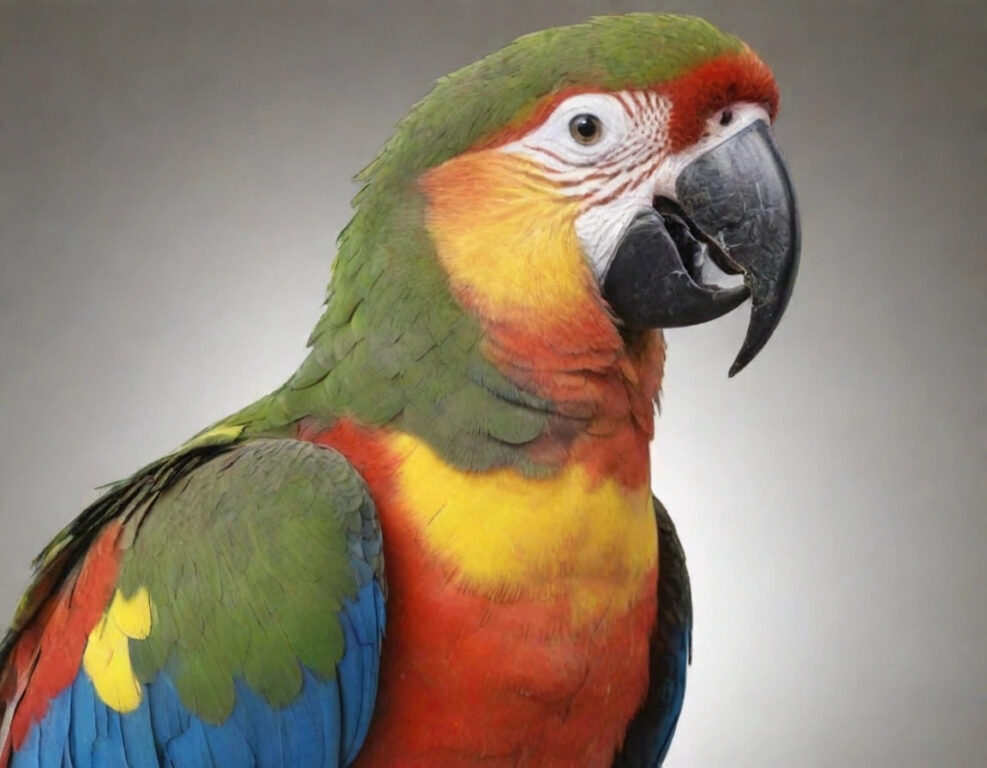
Parrots can repeat words because they have a specialized vocal organ called the syrinx and a brain wired for vocal imitation, not because they understand human language. That’s the short answer, and it’s also where most people get it wrong. If you’ve ever stood in front of an African grey and heard it nail your exact tone, you know it feels eerie. But there’s real biology behind it, not magic.
The reason a parrot can repeat words that people say comes down to three things working together: a flexible sound-producing organ, a sharp ear for detail, and a social brain that treats imitation as a way to fit in. Miss any one of those and you just have a bird that squawks.
Why parrots repeat words: the syrinx does the heavy lifting
Humans talk with a larynx. Birds talk with a syrinx, a structure sitting deep in the chest where the trachea splits into the bronchi. In parrots it’s surrounded by muscles that can tighten, loosen, and reshape the airway in fractions of a second.
That muscle control is what lets a parrot imitate human speech sounds so precisely. The syrinx can produce two separate tones at once, which is why some parrots sound like two voices overlapping when they mimic a phone ringing or a doorbell.
Compare that to most birds, which have a much simpler syrinx. A pigeon or a chicken physically cannot shape sound the way a macaw can. So when someone asks how parrots learn to talk, the honest answer starts with anatomy, not intelligence.
The brain is doing something stranger than you think
Parrots have a region often called the song system, and in species like the budgerigar and the African grey it’s unusually dense. Scientists have found that these birds have vocal-learning circuits that overlap with areas linked to movement and reward.
That overlap matters. It means when a parrot repeats a word, it’s not just echoing. It’s pairing the sound with a social payoff — attention, food, a reaction from you. That’s why a parrot that gets ignored stops talking, and one that gets a laugh never shuts up.
Recent research on parrot cognition, including work published on species like the kea and the African grey, shows they can solve multi-step puzzles and even understand concepts like «same» and «different.» So the parrot talking ability isn’t dumb mimicry — it’s mimicry backed by real problem-solving hardware.
Why some parrots talk better than others
Not every parrot will repeat words, and pretending otherwise is dishonest. Species matters a lot. African greys, Amazon parrots, and monk parakeets are the usual chatterboxes. Cockatoos and lovebirds can learn, but often with less clarity.
Age matters too. A hand-raised chick exposed to human speech early picks up sounds faster than an adult bird that spent years in an aviary. And environment decides the rest — a parrot in a quiet room learns fewer words than one living in a loud kitchen where people talk all day.
Here’s the part most articles skip: parrots mimic what gets a reaction, not what you want them to learn. Teach them «hello» and they might ignore it. Sneeze once and they’ll copy that sneeze for the next fifteen years. Beware.
Do parrots actually understand the words they repeat?
Mostly no, with a few well-documented exceptions. The famous African grey Alex, studied by Irene Pepperberg for decades, could label colors, shapes, and quantities — over 100 words used meaningfully. That’s the outlier, not the rule.
For the average pet parrot, repeating words is closer to conditioning. It associates a sound with a context: «cracker» gets said at snack time, so the bird says it at snack time. That’s not conversation. It’s pattern recognition with a very good vocal output.
So when a parrot shouts «good morning» at 6 a.m., it’s not greeting you. It’s running a script that once earned attention. Still impressive, just not philosophical.
Can any other animal do this?
Vocal imitation is rare. Beyond parrots, you mostly see it in songbirds, hummingbirds, dolphins, whales, elephants, and bats. Humans are on that short list too, which is why we find parrots so unsettling — they’re doing something we thought was ours.
But parrots push it further than almost anyone. They combine imitation with social use, which is why a talking parrot feels like a roommate instead of a recording. No other bird pulls that off at this level.
What this means if you own a parrot
If your goal is a bird that repeats words, pick the right species, start young, and give it daily interaction. Boredom kills vocal learning faster than anything else. A parrot left alone in a cage all day won’t build a vocabulary — it’ll just scream.
And accept the trade-off. The same brain that learns «I love you» will also learn your alarm, your laugh, and the exact pitch of your partner yelling your name. There’s no filter. That’s the deal with parrots.
The bottom line: parrots repeat words because they evolved a vocal organ built for precision, a brain built for imitation, and a social drive that rewards copying the sounds around them. It’s not language. It’s something weirder — and honestly more interesting.
