

Post actualizado el día octubre 25, 2026 by DeiviSanzPlay
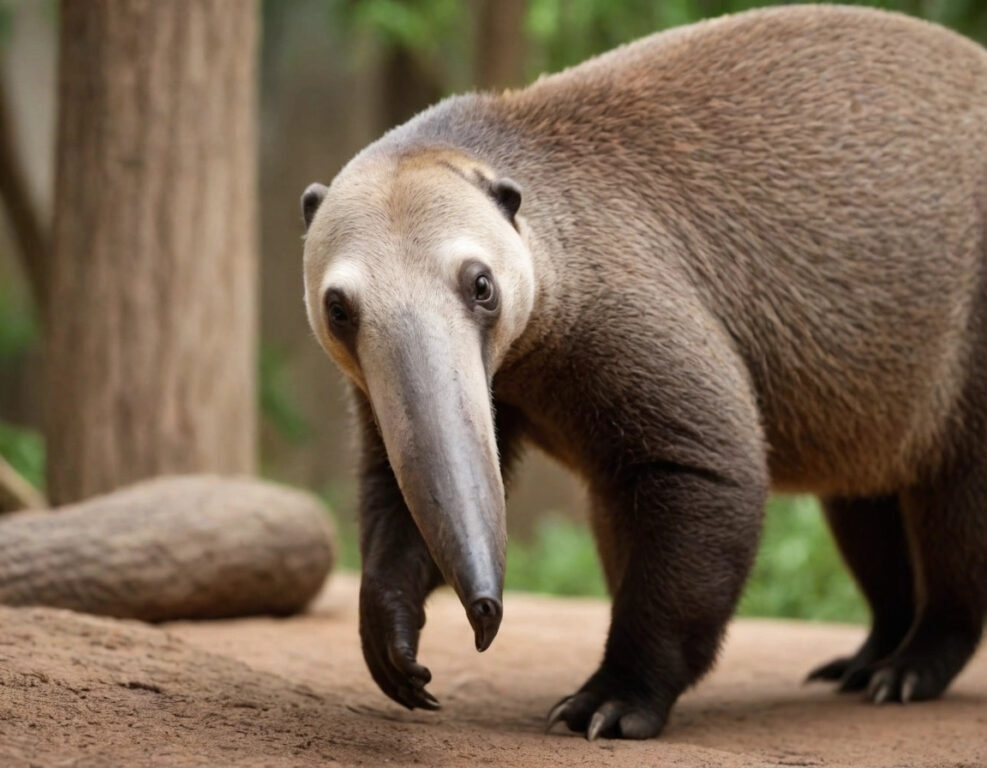
The giant anteater is fading away, and it’s not just because of logging. If you’re looking for why the giant anteater is going extinct, the quick answer is habitat loss, but the real one is messier: a cocktail of arson fires, ant poisons, roadkill on new highways, and an absurd superstition that turns it into a trophy. In 2026 the species is still listed as vulnerable by the IUCN, and in countries like Brazil, Argentina, or Paraguay there are populations that are no longer recovering.
I’ll tell you straight, no sugarcoating: this animal doesn’t die of hunger, it dies because they broke its map. Its historic territory was the Brazilian Cerrado, the Gran Chaco, and the plains of Venezuela. Today those are soybean fields, cattle pastures, and kilometers of fencing. When a forest disappears, it’s not just a tree that disappears: the ground where it feeds disappears.
The giant anteater doesn’t eat just any ant
Here’s the key that almost nobody mentions. Myrmecophaga tridactyla is an extreme specialist. It’s not an opportunistic omnivore. It needs colonies of specific ants and termites, and not just any species. A single individual can visit up to 200 nests a day, eating some 30,000 insects, but it does so without destroying the colony: it comes, eats, and leaves. That balance is fragile.
When pesticides are sprayed to protect crops or anthills are poisoned to prevent pests in pastures, the giant anteater is left without a pantry. It’s not that it can’t find food: it’s that the food it finds is contaminated. Field studies in the Cerrado show that areas with intensive agriculture have less than half the active ant colonies of a native area.
Fires, highways, and the myth of the magic fur
The fires in the Pantanal in 2020 and 2024 scorched millions of hectares. The giant anteater, with its long fur and slow gait, is a perfect victim of fire. It doesn’t run, it doesn’t climb well, it doesn’t hide. And when it survives, it finds itself in a black desert.
Highways are another silent trap. Being a large animal with nocturnal or crepuscular habits, it crosses the roads, and roadkill is a direct cause of mortality in Mato Grosso do Sul, in the Argentine Chaco, and in the Colombian plains. There aren’t enough wildlife crossings, and the ones that exist aren’t well designed for its size.
And then there’s poaching. In some rural areas the belief persists that its fur cures diseases or brings good luck. It’s pure superstition, but it kills all the same. A single hunter can wipe out an individual that takes between 13 and 15 months to raise a single offspring.
One offspring every two years: reproduction doesn’t help
The giant anteater doesn’t breed like a rabbit. The female has a single offspring per year, sometimes every two. She carries it on her back for months and weaning is slow. That means any loss of adults is a brutal blow to the population.
If you add to that the fact that the survival rate of offspring in degraded areas is low due to lack of shelter and predators like pumas or jaguars, the result is a downward curve that doesn’t straighten itself out. The extinction of the giant anteater won’t be a sudden event: it will be a silent drip.
What’s being done and why it’s not enough
There are serious projects. Brazil’s Institute for the Conservation of Wild Animals and several NGOs work on biological corridors and on rescuing orphaned offspring. There are also reintroduction plans in Argentina, such as the one in Iberá National Park, where the species returned after decades. It works, but it’s expensive and slow.
The problem is scale. A 20-kilometer corridor doesn’t save a species that needs thousands. And enforcement in remote areas is almost nonexistent. The legislation exists, but the budget to apply it doesn’t.
What you can do without being a biologist
- Don’t buy products that promote «handicrafts» or «amulets» made with anteater fur. It’s illegal trafficking.
- Support verified organizations working in the Cerrado and the Pantanal, not generic social media campaigns.
- If you travel to areas where it lives, respect the distances. A giant anteater stressed by tourists stops feeding well.
- Demand that local governments include real wildlife crossings in new highways, not just signs.
The uncomfortable truth is that the giant anteater is going through what so many others are: it’s not profitable. It doesn’t bring in money like soybeans, it doesn’t generate votes like a highway. But its disappearance leaves a gap in the ecosystem that nothing can fill. It controls populations of ants and termites that, without it, run rampant and damage crops and homes.
In 2026, the question is no longer whether it’s going extinct. It’s whether we’re going to let it finish disappearing while we look the other way.
