Post actualizado el día octubre 25, 2026 by DeiviSanzPlay
Koalas and kangaroos are not marsupials by a whim of evolution. They are the result of a masterstroke that nature rehearsed more than 100 million years ago, when mammals began to split into two great camps: those that gestate their young inside the uterus with a well-developed placenta and those that expel them almost half-formed so they can finish developing in an external pouch.
That second group is the marsupials, and in Australia they found paradise to prevail. Koalas and kangaroos are marsupials because they belong to the infraclass Marsupialia, a lineage that bet on giving birth to immature young and finishing the job outside the mother’s womb. And it paid off: today they dominate an entire continent.
What it means to be a marsupial, beyond the pouch
The trait everyone identifies is the pouch, the marsupium. But being a marsupial is much more than carrying a built-in backpack. The key lies in the moment of birth: the young leave the uterus after a very short pregnancy, sometimes barely 10 or 12 days, and they do so in an embryonic state that would be frightening.
A newborn kangaroo weighs less than a gram. It is a kind of pink worm, blind and hairless, that has to climb up its mother’s abdomen to the pouch using only its front legs. There it latches onto a teat and does not let go for months. The teat swells inside its mouth and literally keeps it anchored. Nature in its purest form.
In placental mammals, like us, the fetus develops connected to the mother through the placenta and is born when it already has functional organs. In marsupials, the placenta is rudimentary and development is completed on the outside. That is the fundamental difference between marsupials and placentals.
Koalas: the slowest and most specialized marsupial
The koala is an arboreal marsupial that takes specialization to the extreme. Its young, called a joey, is born after about 35 days of gestation and measures less than two centimeters. It climbs to the pouch on its own, where it stays for about six months. After that it comes out, but it continues riding on its mother’s back until it is almost a year old.
What is curious about the koala is that its diet, based almost exclusively on eucalyptus leaves, is toxic to almost any other animal. Koalas are marsupials that have developed a liver capable of detoxifying those compounds and a very slow metabolism to spend little energy. That is why they sleep up to 20 hours a day. They are not lazy: they are efficient.
Their status as marsupials also allows them something key: the pouch faces backward in females, an adaptation so that the young does not fill up with leaves and branches while the mother climbs. Every detail is thought out.
Kangaroos: the marsupial that redefined jumping
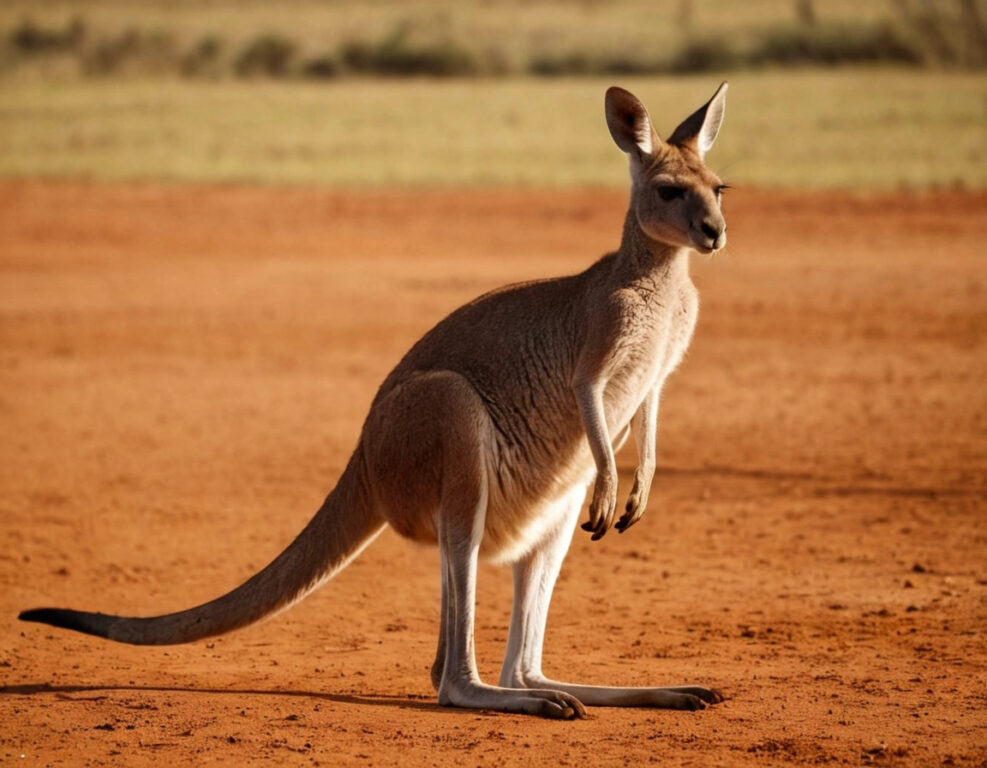
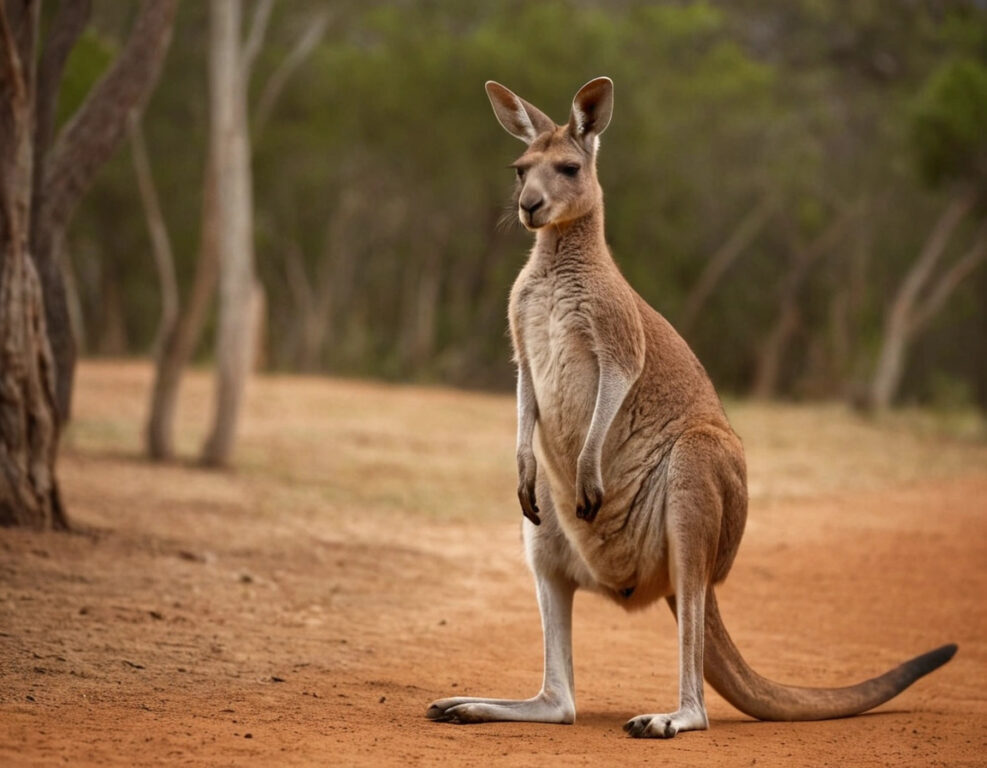
The kangaroo is the most famous marsupial and the one that best represents the evolutionary success of this group. A red kangaroo can jump more than 8 meters in length and reach 60 km/h over short distances. Its tail is not an ornament: it works as a fifth limb that gives it balance and power in every jump.
Kangaroo reproduction is a case apart. The female can have at the same time one young in the pouch and another in a state of embryonic diapause, that is, an embryo frozen in its development that activates when the first young leaves the pouch. It is a brutal strategy for not losing time if environmental conditions are bad.
Kangaroos are marsupials that have turned drought into an advantage. Their reproductive system allows them to produce young only when there is enough food. That, on a continent where rain is a lottery, is pure gold.
Why in Australia and not somewhere else
The story of why koalas and kangaroos are marsupials has a lot to do with geography. Australia separated from Gondwana about 80 million years ago and became isolated. In that isolation, marsupials did not have to compete with placental mammals, which displaced them on other continents.
In South America there are also marsupials, such as the opossum, but there the competition with placentals was fierce. In Australia, by contrast, marsupials occupied all ecological niches: herbivores, carnivores, climbers, burrowers. Koalas and kangaroos are marsupials because they evolved in a natural laboratory without rivals.
When humans arrived in Australia about 65,000 years ago, they already found an ecosystem dominated by marsupials. And today, despite habitat destruction, they remain the symbol of a way of life that works.
Marsupials vs. placentals: it is not better or worse, it is different
There is a very widespread misconception: that marsupials are an inferior or primitive version of mammals. False. They are an evolutionary branch as valid as ours, with more than 100 million years of success.
The proof is that koalas and kangaroos are marsupials that have survived ice ages, extreme droughts and brutal climate changes. Their strategy of giving birth to immature young and completing them in the pouch gives them a reproductive flexibility that placentals do not have.
If a kangaroo loses a young, it can have another in weeks thanks to diapause. A woman cannot. That difference is what has allowed marsupials to colonize environments where food is scarce and survival is an obstacle course.
What almost no one tells you about the pouch
The pouch is not just a refuge. It is a complete ecosystem. Inside, the young regulates its temperature, receives milk with a composition that changes according to its age and is protected from predators. Kangaroo milk, for example, varies in fat and protein depending on the joey’s stage. It is personalized nutrition.
Moreover, in many marsupial species, the mother can produce two types of milk at the same time if she has one young inside and another outside the pouch. A mechanism that scientists are still studying to understand how it is regulated.
Koalas and kangaroos are marsupials because they inherited a reproductive system that, against all odds, turned out to be an advantage in their environment. It is not magic, it is evolution. And understanding it helps us appreciate why Australia is such a strange and fascinating continent.
The next time you see a kangaroo jumping or a koala sleeping, think that you are seeing a survivor of a 100-million-year story. They are not weird creatures: they are winners.