

Post actualizado el día octubre 17, 2026 by DeiviSanzPlay
Every Ash Wednesday, while half the country nurses a Carnival hangover, thousands of people put on black veils and cry fake tears over a giant papier-mâché fish. That’s the Burial of the Sardine, and no, it’s not just a quirky excuse to keep drinking. It’s one of the most loaded rituals in Spanish popular culture, and most people who party through it have no idea what they’re actually celebrating.
The Burial of the Sardine (Entierro de la Sardina) marks the hard stop of Carnival and the start of Lent. Fire, satire, mourning costumes, and a dead fish. Sounds absurd, and it is, but that absurdity is exactly the point.
What the Burial of the Sardine actually means
Let’s cut through the folklore fog. The Burial of the Sardine is a symbolic funeral for excess. The sardine represents the end of feasting, meat, and general debauchery before the 40 days of abstinence that Lent demands. Burning or burying it is the physical way of saying: party’s over, time to behave.
There’s a theory that dates the origin to 18th-century Madrid, when a shipment of sardines arrived in terrible condition and authorities ordered them buried to stop people from eating them. Another version claims it’s a pure metaphor: the sardine as the last cheap food of the poor before fasting kicked in. Honestly, I lean toward the second one. The first sounds like a bureaucratic excuse that later got wrapped in ritual, which is basically how half of Spain’s traditions were born.
What nobody disputes is that by the 19th century this was already a full-blown popular festival, and by the 20th it had become a tourist magnet in several cities.
When and where it’s celebrated in 2026
The Burial of the Sardine is celebrated on Ash Wednesday, which in 2026 falls on February 18. That’s the day after Carnival Tuesday, the exact hinge between wild partying and religious restraint. Some towns shift the date slightly depending on local calendars, but Ash Wednesday is the anchor.
Cities where it hits hardest:
- Murcia: The biggest one by far. Declared of International Tourist Interest, it pulls hundreds of thousands of people. Giant sardine, fireworks, and a parade that shuts down the entire city.
- Madrid: The procession ends at the Casa de Campo, where the sardine goes up in flames. More satirical, more chaotic.
- Tenerife: Blends with the last gasp of the Santa Cruz Carnival, one of the biggest in the world.
- Other spots: Seville, Valladolid, and dozens of small towns each add their own twist, from burials to full-on burnings.
Murcia is the one to book if you actually want to see the Burial of the Sardine at maximum scale. The rest are worth it, but they’re local flavor, not spectacle.
The ritual: fire, fake mourning, and satire
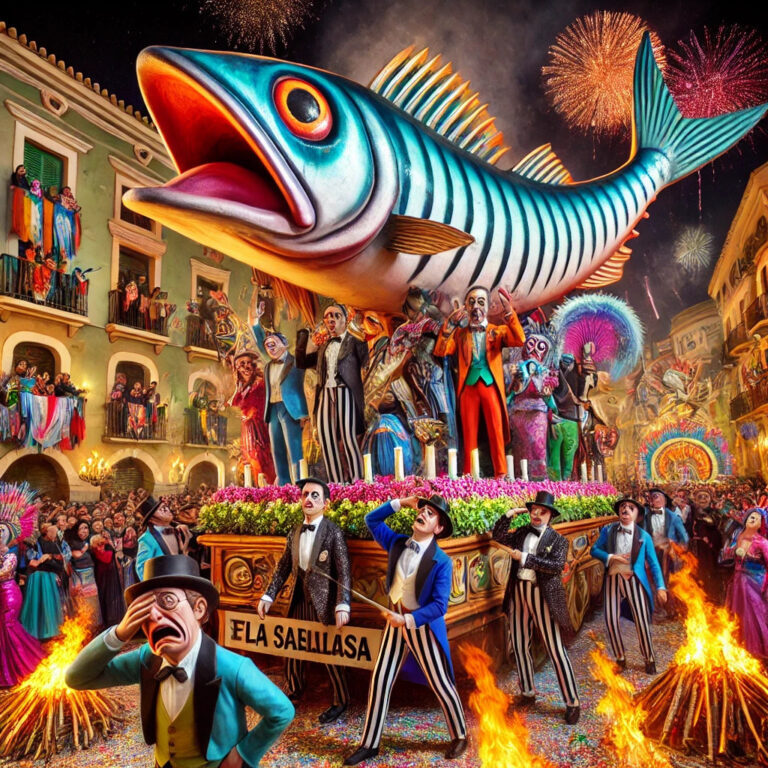
Here’s what actually happens. A procession forms. People dress in black, sometimes with veils, sometimes with absurd funeral attire. There’s a coffin, or a giant sardine figure, or both. Music plays, but it’s a funeral march played with a wink. People wail theatrically, then burst out laughing.
The climax is the burning. In Murcia and Madrid, a large sardine figure goes up in flames. That fire is the symbolic release from everything you did during Carnival. It’s not a sad moment, it’s a purge. You burn the excess, you bury the party, and you walk into Lent lighter.
The genius of the Burial of the Sardine is that it lets you mock religion, authority, and yourself all at once, and then go home without a single consequence.
Why the sardine and not another fish
The sardine was the cheapest fish in Spain for centuries. It was what poor people ate when they couldn’t afford anything else. So putting it at the center of a funeral for abundance is a brutal joke: the last thing you bury is the food of the poor, right before a period of fasting that hits the poor hardest.
That class dimension gets lost in the tourist brochures, but it’s there. The Burial of the Sardine is a plebeian ritual dressed up as a funeral. It’s satire with a fish skeleton.
Satire and social criticism: the real engine
For centuries, this festival has been used to poke fun at politicians, the church, and whatever authority was in fashion. In the 19th century, buried sardines came with satirical verses and caricatures of public figures. Today, the targets change but the mechanism is identical.
That’s why the Burial of the Sardine survives while other Carnival rituals faded. It’s not just a party, it’s a pressure valve. You laugh at power, you burn a fish, and you go back to normal life. Cheap therapy, Spanish style.
FAQ: quick answers about the Burial of the Sardine
What is the origin of the Burial of the Sardine?
It comes from old customs of closing Carnival and opening Lent. The most accepted theories point to either a real order to bury spoiled fish in 18th-century Madrid or a metaphor for the end of abundance before fasting.
When is the Burial of the Sardine celebrated in 2026?
On Ash Wednesday, February 18, 2026. Some towns adjust the date to fit their local Carnival schedule.
Where is it celebrated with the most intensity?
Murcia, Madrid, and Tenerife lead the pack. Murcia’s version is the only one declared of International Tourist Interest.
Why is the sardine burned or buried?
As a symbolic act: it marks the end of Carnival excess and the start of Lent. It also carries a heavy dose of satire and social criticism.
Do you need tickets to attend?
No. Most parades and burnings are free and open to the public. In Murcia, get there early if you want a decent spot, because the crowds are brutal.
If you’ve only ever seen the Burial of the Sardine as a weird parade with people crying over a fish, now you know what’s underneath: class resentment, religious pressure, and centuries of using humor to survive both. Next Ash Wednesday, watch the fire a little differently.


