Post actualizado el día octubre 26, 2026 by DeiviSanzPlay
The common chimpanzee isn’t just another ape swinging through the trees of Central and West Africa. It’s the animal that stares back at you and makes you uncomfortable, because something in that gaze feels uncomfortably familiar. And it should. We share roughly 98% of our DNA with them, a figure that still gets thrown around too casually in documentaries without anyone stopping to think about what it actually means.
What it means is that the characteristics of the common chimpanzee are, in many ways, a distorted mirror of our own. Not a cute one. Not a flattering one. A real one, with dominance, violence, cooperation, tool use, and politics baked in.
Physical Traits: Built for the Canopy, Not the Gym
Forget the image of a chimp as a smaller, hairier human. A male common chimpanzee weighs between 40 and 70 kilos, but its upper body strength is roughly 1.5 to 2 times that of an adult man of similar size. Their muscle fiber composition is different from ours, optimized for explosive pulling and climbing rather than endurance running.
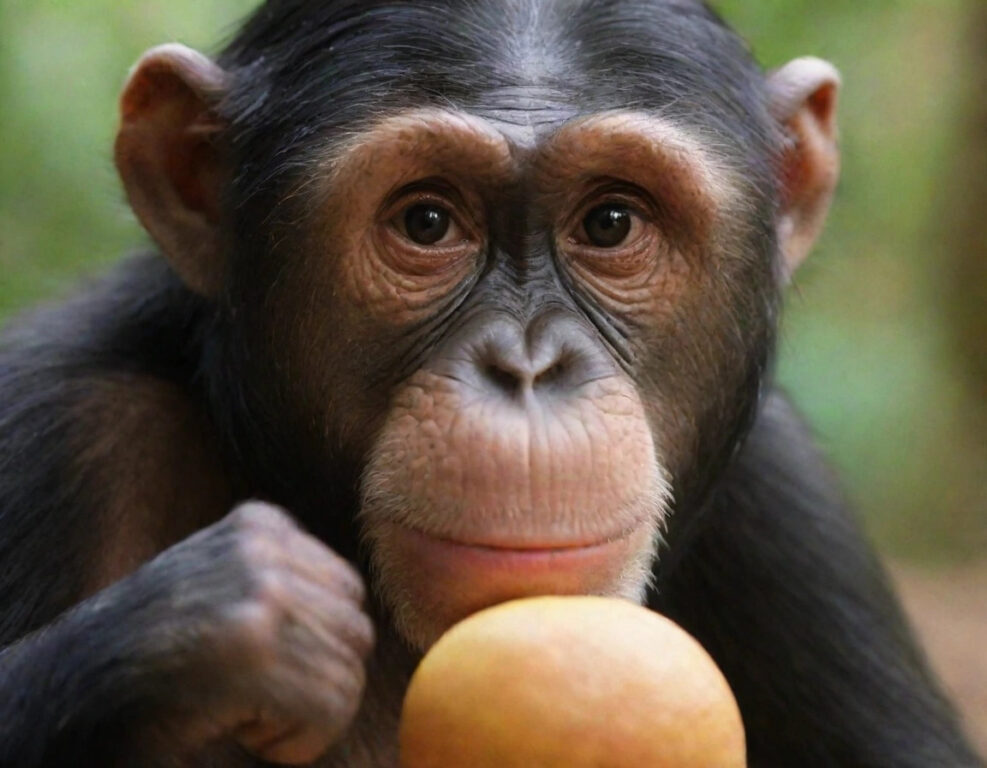
Their dark fur covers most of the body, but the face, ears, hands, and feet are bare skin. That skin darkens with age, so a young chimp has a pale pinkish face while an older adult often has a nearly black one. It’s a useful field marker for estimating age in the wild.
They have opposable thumbs and big toes, which lets them grip branches and manipulate objects with a precision that most primates can’t match. Knuckle-walking is their main way of moving on the ground, but they’re also capable of walking bipedally for short distances, especially when carrying food or tools. That bipedal posture, by the way, is one of the characteristics of the common chimpanzee that researchers watch closely because it hints at how our own ancestors might have started down the road to full upright walking.
Habitat: The African Forest Belt Is Shrinking Fast
The common chimpanzee lives across a belt of tropical rainforest and savanna-woodland mosaic that stretches from Senegal in the west to Uganda and Tanzania in the east. That range covers around 21 countries, but it’s fragmented. Chimps don’t do well in open, human-modified landscapes, and every road, plantation, and mining camp cuts another corridor.
They need trees for sleeping nests, which they build fresh almost every night. A chimp that can’t find suitable trees will simply not sleep well, and that affects everything from immune function to social behavior. Habitat loss isn’t an abstract conservation talking point here. It’s a direct physical stressor.
Social Structure: A Brutal Meritocracy With Alliances
Chimpanzee society is male-dominated, but not in the simple way people assume. Males stay in the group they’re born into, while females typically migrate to a new community at adolescence. That means males grow up surrounded by relatives and lifelong rivals, and females start over in a group of strangers.
Dominance rank among males isn’t just about size. It’s about political skill. A chimp becomes alpha by building coalitions, grooming the right allies, and knowing when to intimidate and when to back off. Researchers at Gombe and Taï National Park have documented alpha males losing rank after failing to maintain their alliances, sometimes within days.
Females have their own hierarchies, often based on age and residency. A female who has been in the community for 20 years carries more social weight than a recent immigrant, even if she’s physically smaller. This is one of the characteristics of the common chimpanzee that separates it sharply from the bonobo, where female coalitions dominate males outright.
Diet and Tool Use: Omnivores With a Tech Sector
Chimpanzees eat fruit as their main calorie source, but they’re true omnivores. Leaves, seeds, flowers, bark, honey, insects, eggs, and meat from monkeys, duikers, and birds all show up in their diet depending on season and location. Meat is a relatively small part of their intake, but it’s socially significant because it’s shared and used to reinforce alliances.
The tool use is where things get genuinely impressive. They fish for termites with trimmed grass stems, crack nuts with stone hammers and anvils, use leaf sponges to soak up water, and even fashion spears to stab bushbabies hiding in tree hollows. Different communities have different tool traditions, which means chimpanzee culture is real and transmitted socially, not genetically.
If you want a single fact that captures why the characteristics of the common chimpanzee matter to science, it’s this: they have culture. Not instinct. Culture.
Communication: Gestures, Screams, and Politics
Chimpanzees communicate through a mix of vocalizations, facial expressions, and body postures. A pant-hoot can carry over a kilometer through dense forest and tells other groups where you are. A silent bared-teeth grin signals submission. A direct stare with raised hair is a threat.
They also use gestures flexibly. The same hand movement can mean different things depending on context, which is a feature once thought to be uniquely human. That flexibility is one of the key characteristics of the common chimpanzee that supports the idea that gesture, not just sound, was the foundation of early language.
Reproduction and Lifespan: Slow, Long, and Fragile
Female chimpanzees reach sexual maturity around 13 years old and have a menstrual cycle similar to humans. Gestation lasts about 230 days. They usually give birth to one infant every five to six years, and the infant stays dependent on its mother for years, learning tool techniques, social rules, and foraging routes.
That slow reproduction is a problem. A population can’t recover quickly from poaching or disease. Wild chimpanzees live 30 to 40 years on average, sometimes over 50. In captivity, they can reach 60. But every adult female lost to the bushmeat trade or a snare is a multi-decade hole in the community’s future.
Conservation Status: Endangered, Not Just Threatened
The IUCN lists the common chimpanzee as Endangered. The main drivers are habitat destruction, poaching for bushmeat, and live trafficking for the pet and entertainment trade. Disease is a growing factor too, since chimps are susceptible to human respiratory viruses, Ebola, and anthrax.
Sanctuaries and protected areas help, but they’re a patch on a much bigger wound. The real fix is keeping forests standing and enforcing laws that already exist on paper. Anything less is just watching the decline in slow motion.
Chimpanzee vs Bonobo: The Real Split
People lump them together, but chimpanzees and bonobos diverged around 1.5 to 2 million years ago and took different social roads. Chimpanzees lean competitive, male-dominated, and territorial. Bonobos lean egalitarian, female-led, and sexually conflict-averse.
Both use tools and show high intelligence. The difference is how they handle tension. Chimps fight for rank. Bonobos diffuse tension with sex and play. Neither strategy is morally better. They’re just different evolutionary answers to the same survival question.
The common chimpanzee is the closest living relative we have, and that’s exactly why its decline should bother us more than it does. Losing them isn’t just losing a species. It’s losing the only other animal that builds political alliances, mourns its dead, and teaches its young a trade.