

Post actualizado el día September 27, 2026 by DeiviSanzPlay
I recommend you read this interesting article: What are the parts of the NAIL?.
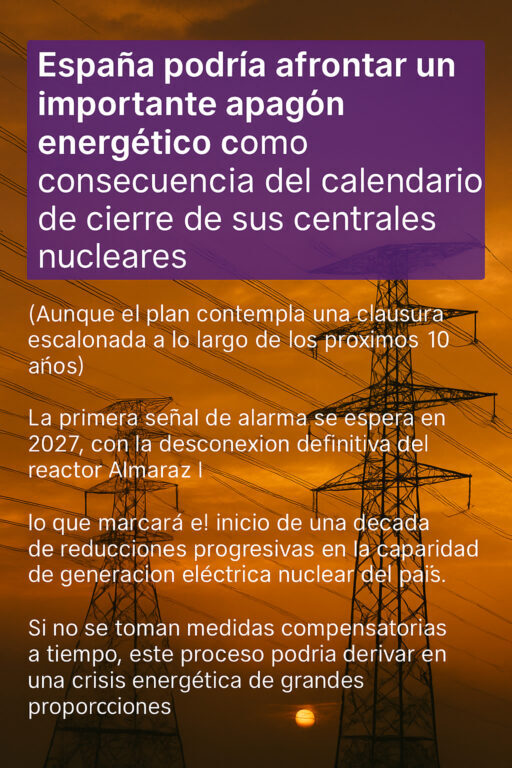
Spain’s energy planning for the coming years has raised alarms among industry experts, economists, and citizens concerned about the future of electricity supply. The schedule for the closure of nuclear plants, which contemplates the progressive shutdown of all operating reactors by 2035, could lead to an unprecedented energy blackout if effective complementary measures are not implemented in time.
Why does Spain want to close its nuclear plants?
The Spanish Government, within the framework of the National Integrated Energy and Climate Plan (PNIEC), has drawn up a roadmap to progressively reduce dependence on nuclear energy. This decision is motivated by factors such as the age of the reactors, maintenance costs, and a firm commitment to renewable energy sources such as solar, wind, and green hydrogen. The ultimate goal is a clean and sustainable energy transition.
However, this approach—although environmentally necessary—presents significant technical and logistical challenges.
The closure schedule: key dates
The staggered closure will begin in 2027 with the disconnection and permanent shutdown of the Almaraz I reactor, one of the oldest and most critical plants in the country. It will be followed in subsequent years by Almaraz II, Ascó I and II, Cofrentes, and Vandellós II. By 2035, if the current plan is maintained, Spain will cease producing nuclear energy entirely.
This represents a loss of approximately 20% of current national electricity generation, which will need to be compensated by other sources if an energy deficit is to be avoided.
Is Spain prepared to replace that capacity?
The growth of renewable energies has been significant, but still insufficient to cover the gaps that the nuclear closure will leave. According to data from the Spanish electricity system operator (Red Eléctrica), renewable energies do not always guarantee constant production, especially during demand peaks or adverse weather conditions.
This is where the risk becomes tangible: if the system is not adequately reinforced with energy storage, international interconnections, or backup technologies, Spain could suffer power outages or severe increases in the cost of electricity, affecting both industry and the end consumer.
In conclusion
Spain could face a major energy blackout as a consequence of the closure schedule for its nuclear plants. Although the plan contemplates a staggered shutdown over the next 10 years, the effects will be felt much sooner. The first warning sign is expected in 2027, with the permanent disconnection of the Almaraz I reactor, which will mark the beginning of a decade of progressive reductions in the country’s nuclear electricity generation capacity. If compensatory measures are not taken in time, this process could lead to an energy crisis of major proportions.