Post actualizado el día octubre 17, 2026 by DeiviSanzPlay
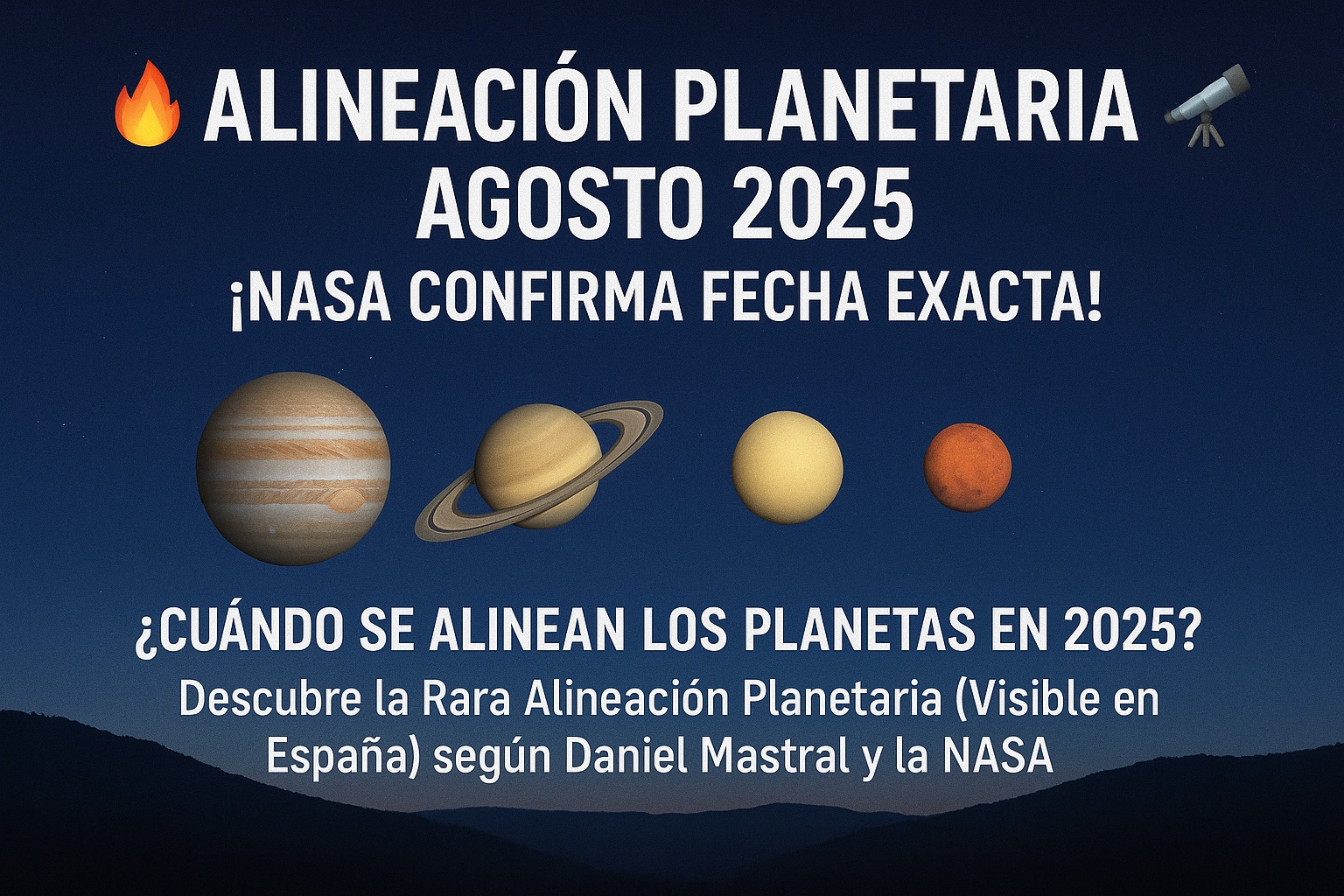
Forget what you read about August 2025. The planetary alignment that really matters is happening in 2026, and if you live in Mexico City, Chile, or Madrid, you’re in a prime spot to catch it. Four bright planets—Jupiter, Saturn, Venus, and Mars—will crowd the same patch of sky before dawn, and you don’t need a telescope to enjoy the show. Just set your alarm, step outside, and look up.
Why This Planetary Alignment 2026 Is Different
Planetary alignments aren’t rare in the cosmic sense, but a grouping this tight and this bright is. From our earthly perspective, the four planets will appear lined up like beads on a string, even though they’re millions of kilometers apart in space. That’s the trick: it’s all about orbital perspective, not actual proximity.
What makes 2026 special is the pairing of Venus and Jupiter—the two brightest planets in the night sky—coming closer together than they have in over a decade. Add Mars’s rusty glow and Saturn’s golden hue, and you get a sky scene that even city dwellers will notice.
If you miss this one, you’ll have to wait until 2036 for something comparable. That’s a full decade. So yeah, it’s worth losing a little sleep.
When and Where to See It in Mexico City, Chile, and Madrid
Timing is everything. The alignment will be visible in the pre-dawn hours, roughly between 5:30 and 6:30 AM local time, depending on your location. You’ll want to find a spot with an unobstructed view of the eastern horizon.
Mexico City: Light pollution is a challenge, but not a dealbreaker. Head to the outskirts—Parque Nacional Desierto de los Leones or the hills of Tlalpan—where the sky is darker. The planets will be low on the horizon, so a rooftop or a hill with a clear eastern view works too.
Chile: You lucky bastards. Northern Chile, especially the Atacama Desert, has some of the clearest skies on Earth. Observatories like Paranal and La Silla will likely host viewing events. Even from Santiago, a short drive to the Andes foothills will give you a spectacular view.
Madrid: The city’s light dome is brutal, but you can escape it. Head to the Sierra de Guadarrama or the plains of Extremadura if you’re willing to drive. Within Madrid, the Casa de Campo or the banks of the Manzanares River offer decent enough views if you know where to look.
How to Spot Each Planet Without Fancy Gear
Venus will be the easiest—it’s the brightest, often called the morning star. Jupiter is a close second, shining with a steady white light. Mars will show a distinct reddish tint, and Saturn will look like a golden dot. With basic binoculars, you can make out Jupiter’s four largest moons and Saturn’s rings. That alone is worth the effort.
Apps like Stellarium or SkySafari will help you pinpoint each planet in real time. Just point your phone at the sky and follow the screen. No guesswork.
NASA will stream the event live from observatories in Hawaii and Chile, so if clouds ruin your view, you can still watch online. But nothing beats seeing it with your own eyes.
The Spiritual Hype vs. Astronomical Reality
Every time planets line up, social media floods with talk of energy shifts and spiritual awakenings. Astrologer Daniel Mastral has pointed out that there’s no gravitational or magical effect—it’s just a beautiful orbital coincidence. And he’s right. The gravitational pull of these planets on Earth is negligible.
That said, there’s nothing wrong with using the event as an excuse to pause and reflect. Meditating under a sky full of planets can be a powerful emotional experience, even if it’s purely psychological. If that resonates with you, go for it. Just don’t credit your life changes to Mercury retrograde.
Science says no to planetary influence on human affairs. But the beauty of the cosmos? That’s real, and it’s free.
What If You Miss It? Plan B and Beyond
If clouds, sleep, or life get in the way, don’t panic. Planetary conjunctions happen regularly. In 2027, Venus and Saturn will have a close encounter. In 2028, Mars and Jupiter will pair up. None will be as tight as 2026, but they’re still worth watching.
Meteor showers, lunar eclipses, and solar eclipses are also on the calendar. The universe is constantly putting on a show. You just have to look up.
For the 2026 alignment, mark your calendar for the exact date—astronomers will narrow it down as we get closer. Set a reminder, charge your binoculars, and scout a dark spot ahead of time. This is one of those rare moments where the solar system puts on a show for the naked eye. Don’t waste it.
And if you do see it, take a photo. Not for Instagram—for yourself. Because in 2036, when the next big one comes around, you’ll want to remember how it felt to stand under four worlds at once.