

Post actualizado el día octubre 26, 2026 by DeiviSanzPlay
Most people picture a pharaoh as a guy with a fancy beard and a golden mask. That’s the Hollywood version. The real Egyptian pharaohs were something far stranger: a political machine wrapped in theology, a king who had to prove he was a god every single day or the whole universe would supposedly collapse. No pressure.
If you’ve ever asked yourself who the Egyptian pharaohs really were and what role they played, forget the museum audio guide. Their power wasn’t just about armies and taxes. It was about convincing millions of people that the Nile flooded, the crops grew, and the sun rose because of them. That’s the level of PR we’re talking about.
What Was an Egyptian Pharaoh, Exactly?
The word «pharaoh» originally meant «great house,» referring to the royal palace. It only became a title for the ruler himself around the 18th dynasty. By the time of Ramesses II, calling the king «pharaoh» was as normal as calling him «his majesty.»
The Egyptian pharaohs were not simply kings. They were the living Horus on earth, the son of Ra, and the bridge between the human and the divine. In practical terms, that meant the pharaoh controlled the army, the temples, the grain stores, and the law. In symbolic terms, it meant that if he failed, the cosmos itself was considered damaged.
That’s why the death of a pharaoh was treated as a cosmic crisis, not just a succession problem. The Egyptians believed that ma’at — order, truth, balance — depended on the throne being occupied by the right person. A weak pharaoh wasn’t just a bad ruler. He was a threat to reality.
Divine Kings, Human Problems
Here’s where the myth cracks. Despite being called gods, the Egyptian pharaohs got sick, lost battles, and were sometimes assassinated by their own family. Tutankhamun died around 19 years old. Ramesses III was killed in a palace conspiracy known as the Harem Conspiracy, something historians have confirmed through CT scans of his mummy.
So no, they weren’t invincible. They just had to look like they were. The role of the Egyptian pharaoh was as much about performance as it was about power. Every ritual, every temple inscription, every victory relief was a piece of propaganda designed to keep the illusion alive.
The Pharaoh as High Priest
One of the most overlooked roles of the Egyptian pharaohs was religious. They were expected to perform daily temple rituals, offering to the gods on behalf of the entire country. In theory, only the pharaoh could communicate directly with the deities.
In practice, priests did most of the work. But the pharaoh remained the symbolic intermediary. This is why temples like Karnak and Abu Simbel were covered in images of the king making offerings. It wasn’t vanity. It was theology in stone.
The Dynasties: A 3,000-Year Power Franchise
Egyptian history is usually divided into 31 dynasties, grouped into the Old Kingdom, Middle Kingdom, and New Kingdom. The Egyptian dynasties were basically family businesses that held the throne until they ran out of heirs, money, or luck.
Some of the most famous Egyptian pharaohs came from the New Kingdom, including Hatshepsut, Akhenaten, Tutankhamun, and Ramesses II. Hatshepsut is a special case: a woman who ruled as a full pharaoh, complete with the false beard and male titles. She wasn’t a regent playing nice. She was the king, and Egypt prospered under her.
- Narmer — credited with unifying Upper and Lower Egypt around 3100 BC.
- Khufu — builder of the Great Pyramid of Giza.
- Hatshepsut — female pharaoh who expanded trade to Punt.
- Akhenaten — the heretic who tried to make Aten the only god.
- Tutankhamun — famous mostly because his tomb survived intact.
- Ramesses II — the showman who signed the first known peace treaty.
- Cleopatra VII — the last pharaoh, and the smartest politician of them all.
How They Looked and What They Wore
The clothing of the Egyptian pharaohs wasn’t just fashion. It was a uniform of divine authority. Linen tunics, gold sandals, the nemes headdress, the false beard, the crook and flail — every item had a meaning.
The headdresses of the Egyptian pharaohs symbolized control over both Upper and Lower Egypt. The white crown hedjet represented the south, the red crown deshret represented the north, and the double crown pschent meant the king ruled both.
About skin color: most Egyptian pharaohs were depicted with reddish-brown or dark skin, which makes sense given Egypt sits in Africa. The attempt to whitewash them is a modern invention, not an ancient one.
Death, Mummies, and the Afterlife Obsession
The Egyptian pharaohs were obsessed with death, but not in a morbid way. They saw it as a transition. Mummification wasn’t about preserving a corpse for sentimental reasons. It was about giving the king a body he could use in the afterlife.
The embalming process was brutal and precise: remove the organs, dry the body with natron salt for 40 days, stuff it with resin-soaked linen, and wrap it in hundreds of meters of bandages. The sarcophagus of an Egyptian pharaoh was the final security box, covered in spells from the Book of the Dead.
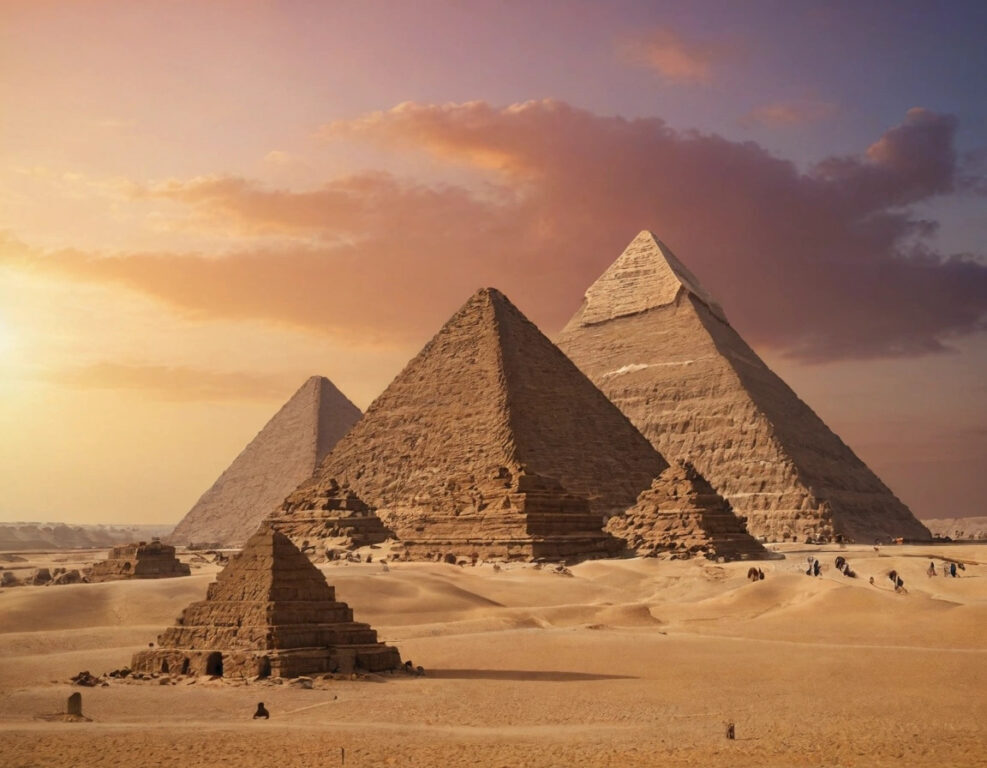
The pyramids weren’t just tombs. They were resurrection machines designed to launch the pharaoh into the stars.
That’s why Khufu built the Great Pyramid and why later kings switched to the Valley of the Kings — hidden tombs to stop robbers. It didn’t work. Almost every royal tomb was looted in antiquity except Tutankhamun’s.
Power, Politics, and Succession Chaos
The powers of the Egyptian pharaohs were theoretically absolute. They owned all the land, commanded the army, and controlled trade. But real power often sat with priests, viziers, and generals.
Succession was normally hereditary, but it was messy. Brothers fought sisters. Uncles married nieces. Sometimes a non-royal general seized the throne. The 19th and 20th dynasties are a good example: Ramesses II ruled for 66 years, and then his successors spent generations trying to hold onto what he built.
The last Egyptian pharaohs were Cleopatra VII and her brother Ptolemy XIII, who ruled until Rome swallowed Egypt in 30 BC. After that, the title disappeared, but the myth never did.
What They Ate and How They Lived
The diet of the Egyptian pharaohs was surprisingly rich. Bread, beer, roasted meat, figs, dates, honey, and wine. Banquets were political events, not just dinner parties. If you got invited, you were either important or about to be used.
Life expectancy among the Egyptian pharaohs was all over the place. Some died in their 20s from disease or murder. Others, like Ramesses II, lived into their 90s. There was no standard. Power didn’t guarantee a long life — it just guaranteed a bigger tomb.
Why the Pharaoh Still Matters in 2026
We keep coming back to the Egyptian pharaohs because they represent something we still struggle with: the fusion of politics and belief. They built a civilization that lasted 3,000 years on a single idea — that the ruler and the divine were connected.
Whether that idea was true or not didn’t matter. People believed it, and that belief built the pyramids, the temples, and an entire worldview. In 2026, we’re still digging up their secrets. And honestly, we’ve only scratched the surface.
